Nutrient Absorption: The 3 Rules Behind Every Food Pairing
Stop memorising food pairing lists. Three mechanisms explain every one of them — changing a nutrient's form, carrying it in fat, or slowing how fast you break it down.
You’ve read the lists. Spinach with lemon. Turmeric with black pepper. You nodded along. Thought that makes sense. And by dinner you’d forgotten all of it.
That isn’t a memory problem.
A list of pairs gives you nothing to hang them on. Nobody tells you why those particular pairs work — and once you know why, you stop needing the list at all.
Here’s the useful part. There are only three things food can do to other food.
Three. Once you can name them, you can look at any plate and see what’s missing, including combinations nobody has written a listicle about.
The three rules, with the numbers:
– Change the form — vitamin C turns plant iron into the version your gut can take. Absorption went from 0.8% to 7.1%
– Give it a ride — fat carries fat-soluble compounds across. Avocado raised beta-carotene absorption 15.3×
– Slow the exit — piperine slows how fast you break curcumin down (one 1998 study, never replicated)
– And the fourth thing: what gets in the way — tannins, phytates and calcium bind or compete (the calcium one is weaker than it is usually presented). 100 mg of tannin cut iron absorption by 88%
This is about how absorption works, not about diagnosing anything. If you think you’re low on something, that’s a blood test conversation with your doctor.
Why the lists never stick
Search this topic and you’ll get variations of the same article: four pairings, seven pairings, ten food combos. All of them true. Almost none of them explaining anything.
The problem with a list is that every item is a separate thing to remember. Fifteen pairings means fifteen memories, and they all fade at the same rate.
A mechanism is different. Learn that fat carries fat-soluble compounds, and you’ve simultaneously learned why olive oil belongs on your salad, why a fat-free dressing is a waste of good vegetables, and why cooked tomatoes need oil to be worth anything. One idea, many meals.
So let’s do the three.
Rule 1 — Change the form
Some nutrients turn up in a shape your gut simply can’t use. Something else on the plate has to convert them first.
The clearest case is iron from plants. It arrives mostly as ferric iron, Fe3+. Your small intestine absorbs ferrous iron, Fe2+, far more readily. Vitamin C is a reducing agent — it hands over an electron and converts one into the other.
So how much does that actually matter? Hallberg and Brune measured it across 299 subjects using radio-labelled iron. (Hallberg & Brune, 1986)
| Ascorbic acid added to the meal | Iron absorbed |
|---|---|
| Across a 25 mg to 1000 mg range | 0.8% → 7.1% |
Two details here matter more than the headline number does.
About 50 mg per main meal is enough. The relationship is log/log — each additional increment buys less than the one before. Going from nothing to 50 mg captures nearly all of it. Half a red bell pepper does that.
It has to be the same meal. The conversion happens in your stomach while the food is there. Iron at noon and fruit at four in the afternoon means you ate both nutrients and paired neither.
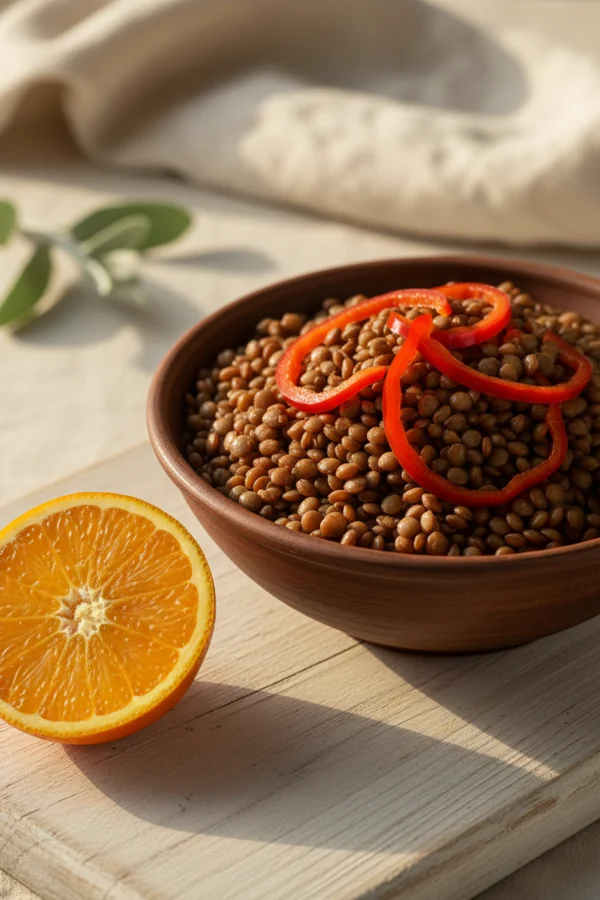
For a long time I ate lentils several times a week and never once thought about what else was on the plate with them. That was the whole game, and I was missing it.
If you want the full version, I covered vitamin C and iron in the same meal separately. The same logic applies to other iron-rich plant foods — lentils, tofu, spinach, beans.
Rule 2 — Give it a ride
Vitamins A, D, E and K don’t dissolve in water. Neither do carotenoids — the compounds that make carrots orange, tomatoes red and kale dark green.
No fat in the meal? Most of them pass straight through you.
This rule has the most dramatic numbers in the whole article, and it isn’t close. Researchers added 150 g of avocado to a salad and measured what got absorbed. (Unlu et al., 2005, Journal of Nutrition)
| Compound | Absorption vs. the fat-free salad |
|---|---|
| Beta-carotene | 15.3× |
| Alpha-carotene | 7.2× |
| Lutein | 5.1× |
Fifteen times. Not fifteen percent — fifteen times. The same salad, eaten without fat, delivered a fraction of what was on the plate.
And it scales. Earlier work by Brown and colleagues stepped dressing from fat-free to 6 g to 28 g, and absorption climbed at every step. This isn’t a threshold you tick off; more fat kept helping across the range tested.
Cooking belongs to this rule too
Heat breaks down plant cell walls and releases compounds that were locked inside. Lycopene from cooked tomato products was measured as roughly 2.5× more bioavailable than lycopene from fresh tomatoes (Gärtner et al., 1997).
But — and this is the part usually left out — that only pays off if there’s fat in the meal. Cooked tomatoes with no oil release more lycopene into a system that still can’t carry it anywhere.
I cooked tomatoes for years without oil because it felt lighter. It wasn’t lighter. It was just less.
Which is why a tomato sauce made with olive oil is not a coincidence of Italian cooking. It’s two mechanisms stacked. Heat changes more than carotenoids, though — I went through what heat takes and what it gives back separately.
This is also the reason vitamin D supplements are usually taken with a meal rather than on an empty stomach.
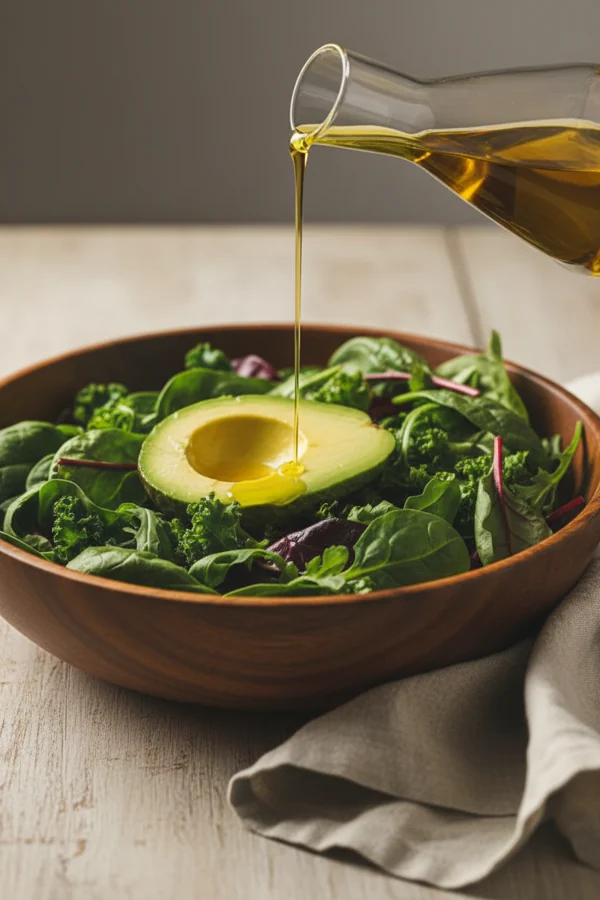
More on this: why a fat-free salad wastes them.
Rule 3 — Slow the exit
The third mechanism isn’t about getting a compound in at all. It’s about stopping it leaving so fast.
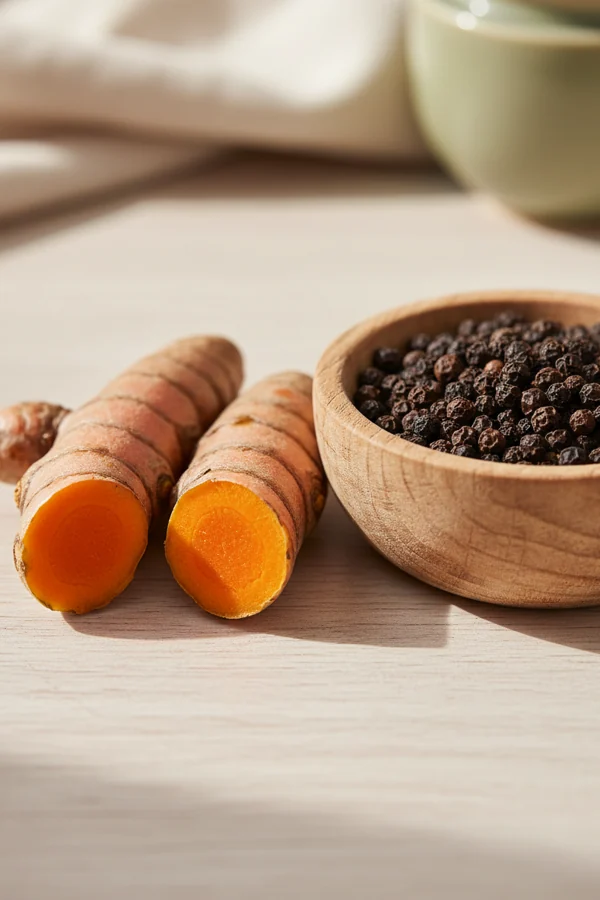
Curcumin, the active compound in turmeric, is the standard example. Your liver clears it fast — most of it is broken down and gone before it can do much of anything. Piperine, from black pepper, slows that clearance step.
The number everyone quotes comes from Shoba and colleagues in 1998: 2 g of curcumin taken with 20 mg of piperine raised curcumin bioavailability by 2000% at 45 minutes in human volunteers. (Shoba et al., 1998)
Now the part the listicles leave out
That 2000% figure comes from a single study published in 1998, and no independent research group has replicated it since.
The mechanism is well accepted — piperine does inhibit the enzymes that clear curcumin. The magnitude is a different question, and a twenty-fold increase measured once in a small group is not the same thing as an established fact.
So: turmeric with black pepper is a reasonable habit with a plausible mechanism behind it. It is not the settled miracle that the number implies.
What I noticed:
“I quoted that 2000% for years because every article I’d read quoted it. It wasn’t until I opened the 1998 paper itself that I saw how thin the base under it was. Now I read the study before I repeat the statistic — it’s slower, and it keeps changing what I write.”
More on this: what the 2,000% claim actually rests on.
The fourth thing — what gets in the way
The three rules above all add. This one subtracts — and it’s often bigger than everything you just gained.
Some compounds bind minerals before you absorb them, or compete for the same transport route.
| Inhibitor in the meal | Effect on iron absorption |
|---|---|
| Tannin, 5 mg | −20% |
| Tannin, 25 mg | −67% |
| Tannin, 100 mg | −88% |
| Phytate, 2 mg | −18% |
| Phytate, 250 mg | −82% |
| Calcium | Competes for the same transport pathway — but weaker than it is usually presented |
Look at that tannin row again. You can execute all three rules perfectly and still lose most of the iron to a cup of tea alongside the meal.
There’s an irony in the phytate row too: beans, lentils and whole grains are among the best plant iron sources, and they carry phytate in the same package. Soaking, sprouting and fermenting all bring it down — making phytate the one blocker you can actually remove, rather than one you simply route around — which is why an overnight soak on beans and whole grains is worth the forward planning.
Timing is its own variable here. Tea an hour after a meal returns absorption to baseline. Coffee an hour after does nothing useful — it has to go before the meal instead. The two drinks genuinely need opposite instructions, and I worked through the studies in tea and coffee follow opposite timing rules.
Cooking method matters here as well, in the same way cooking and cooling changes food in ways most people never consider.
Reading a plate in ten seconds
Here’s the whole framework as three questions. Ask them of your next meal and you’re done.
| What’s on the plate | Ask | The fix |
|---|---|---|
| Plant iron — beans, lentils, tofu, spinach | Is there vitamin C in this same meal? | Bell pepper, citrus, tomatoes, strawberries |
| Deep-coloured vegetables | Is there any fat here? | Olive oil, avocado, nuts, seeds |
| Tea or coffee | Where is it relative to the meal? | Tea an hour after · coffee before |
Notice what none of this asks you to do. Nothing gets eliminated. Nothing new gets bought. You’re rearranging what’s already there.
That’s usually where the gains actually are. Not in adding a superfood — in not wasting the food you already cooked. If you’re curious where your intake sits more broadly, low-level nutrient gaps are worth understanding, and it helps to know how to read a supplement label before buying anything. For a worked example, these anti-inflammatory breakfast ideas already satisfy two of the three rules.
Frequently Asked Questions
What foods should be eaten together for better absorption?
Rather than memorising pairs, apply the three rules: put vitamin C with plant iron, put fat with deeply coloured vegetables, and keep tannin-heavy drinks away from the meal. Those three cover most of what any pairing list contains.
Does cooking increase or decrease nutrient absorption?
Both, depending on the nutrient. Heat destroys some vitamin C, but it breaks down cell walls and releases carotenoids — lycopene from cooked tomato products was measured at roughly 2.5 times the bioavailability of fresh. The catch is that released carotenoids still need fat in the meal to be absorbed.
Do I really need fat to absorb vitamins?
For vitamins A, D, E and K, and for carotenoids, yes. In one controlled study, adding avocado to a salad raised beta-carotene absorption 15.3 times compared with the same salad eaten fat-free.
What blocks nutrient absorption?
Mainly tannins from tea and coffee, phytates in grains and legumes, and calcium competing with iron (though the calcium effect is weaker than usually presented). All are dose-dependent — 100 mg of tannin in a meal was measured cutting iron absorption by 88%.
Does it matter if I eat them in the same meal or just the same day?
Same meal. The vitamin C and iron reaction happens in your stomach while the food is there. Eating both nutrients on the same day in separate meals gives you no pairing effect at all.
Is turmeric useless without black pepper?
No, but pepper plausibly helps. The often-quoted 2000% figure comes from a single 1998 study that no independent group has replicated, so treat the mechanism as reasonable and the exact magnitude as unsettled.
The Bottom Line
Three rules. Change the form. Give it a ride. Slow the exit. Plus one thing to keep out of the way.
That’s the entire model, and it replaces every pairing list you’ve ever half-remembered. Vitamin C with plant iron. Fat with colour. Drinks away from the meal.
I wrote about vitamin C and iron first, then about tea and coffee timing. It took writing the third piece to notice those weren’t three separate tips — they were three faces of the same thing. That’s the only reason this article exists, and it’s why it came last instead of first.
You can read more about how I work through this on the about the author page.
References
- Hallberg L, Brune M. Effect of ascorbic acid on iron absorption from different types of meals. 1986. — https://pubmed.ncbi.nlm.nih.gov/3700141/
- Unlu NZ, Bohn T, Clinton SK, Schwartz SJ. Carotenoid absorption from salad and salsa by humans is enhanced by the addition of avocado or avocado oil. J Nutr 2005;135:431-436. — https://pubmed.ncbi.nlm.nih.gov/15735074/
- Shoba G, et al. Influence of piperine on the pharmacokinetics of curcumin in animals and human volunteers. Planta Med 1998. — https://pubmed.ncbi.nlm.nih.gov/9619120/
- Gärtner C, Stahl W, Sies H. Lycopene is more bioavailable from tomato paste than from fresh tomatoes. AJCN 1997. — https://ajcn.nutrition.org/article/S0002-9165(23)15679-6/fulltext
- Inhibition of non-haem iron absorption in man by polyphenolic-containing beverages. — https://pubmed.ncbi.nlm.nih.gov/10999016/
- A 1-h time interval between a meal containing iron and consumption of tea attenuates the inhibitory effects on iron absorption. AJCN, 2017. — https://ajcn.nutrition.org/article/S0002-9165(22)02698-3/fulltext
Everything I share here is educational and reflective, not medical advice. It should not replace diagnosis, treatment, or care from a licensed healthcare professional. See the full medical disclaimer.

About Mr. Anh
We turn solid evidence into everyday habits Americans can actually do—plain English, cups/oz, grocery-aisle swaps, and routines that fit real life. Our editorial process: Experience—we road-test tips in real schedules…