How to Read a Vitamin Label: RDA, DV, and UL Decoded (Plus 4 Red Flags)
More isn't safer. Decode RDA, DV, %DV and the hidden UL, learn the right vitamin forms and 4 label red flags — and read any supplement in 30 seconds.
- Quick decode (read this first)
- Read the label like a road sign
- Why "more" can hurt
- First skill: flip to the back
- Reading %DV without getting fooled
- The form beats the brand — "cash or a check?"
- Four red flags — what to AVOID
- The seals that actually mean something — USP, NSF
- How to read the label if you're… (your personal lens)
- Your 30-second label check
- FAQ
- Bottom line
Every morning, millions of people swallow a vitamin they picked for one reason they’d never admit out loud: the biggest number on the front of the bottle. Nobody ever taught them how to read a vitamin label — the part that actually matters, on the back.
I get it. “High Potency — 1,000% Daily Value” sounds like you’re getting your money’s worth. But here’s the part the industry would rather you skip: that giant number isn’t a sign of a better product. For several vitamins it’s a quiet warning — a dose sailing past a safety ceiling the label is legally allowed to hide from you.
And it gets worse. The cheap form of “folate” in most bottles? Roughly 40% of people can’t fully use it — so it goes straight down the drain. You could be paying for something your body throws away, or quietly taking too much of something else — and the bottle will never say a word.
The good news: all of that lives on the back of the bottle, and it’s easier to read than you’d guess. By the end of this page you’ll flip over any vitamin and read it like the pharmacist behind the counter — in about 30 seconds. No appointment, no chemistry degree. Just a skill that lives entirely in your hands.
A quick note: I trained in traditional medicine in Vietnam, but I’m not currently practicing and I’m not a clinician. I don’t sell or push any supplement brand — my goal is to hand you a skill, not a shopping list. I lean food-first: a label only matters when food alone can’t cover a real gap. If you have a medical condition, are pregnant, or take medication, run any supplement past your pharmacist or doctor first. This is education, not medical advice.
Quick decode (read this first)
⚡ The whole skill in six moves — grab a bottle and follow along:
- Flip it over. Read the Supplement Facts panel on the back, not the front.
- Scan the %DV. Some you want high (vitamin D in winter, B12); a few you do NOT want over 100% (vitamin A as retinol, iron if you’re not low).
- Beware the megadose. “1,000% DV” is a red flag, not a gold star — especially A, D, E, K and iron.
- Read the form. Favor methylfolate, methylcobalamin B12, d-alpha vitamin E, D3 over D2.
- Dodge two phrases: “proprietary blend” and “third-party tested” with no tester named.
- Look for a real seal: USP Verified or NSF Certified.
👉 Try it now: run those six checks on a bottle from your own cabinet. Most people find at least one red flag on the first try. The rest of this guide explains why each step matters.
Read the label like a road sign
Here’s the easiest way to keep those confusing acronyms straight: picture yourself driving down a road.
- RDA = the distance (and fuel) YOU actually need for your trip. It’s personal — it shifts with your age and sex.
- DV = the one big road sign posted for every driver. A single, one-size number the FDA puts on the label for everyone.
- %DV = your speedometer — how fast one serving is going relative to that sign.
- UL = the cliff at the end of the road. Go past it and you go over — and there’s no sign telling you where that cliff is, because the label doesn’t print the UL.
A capsule stamped “1,000% DV” is a car doing ten times the limit — the question isn’t “impressive?” but “how close is the edge?” (FDA; NIH ODS).
Takeaway: RDA is your need, DV is the posted sign, UL is the cliff the label won’t warn you about.
Why “more” can hurt
The most expensive myth in the vitamin aisle is that a bigger number means a better product. Two kinds of vitamins, two ways of pouring water:
- Water-soluble vitamins (the B’s and C) are like pouring into a glass with no bottom — once it’s full, the extra spills out (your body flushes it). A too-high dose is mostly wasted money.
- Fat-soluble vitamins (A, D, E, K) and minerals like iron are like a bathtub with the plug in — the extra stays, rises, and can overflow to a level that does harm. Too much vitamin A (retinol) stresses the liver and is a known risk in pregnancy; too much iron is genuinely dangerous, especially for kids (NIH ODS).
Takeaway: for fat-soluble vitamins and iron, the tub has a plug — “1,000% DV” is the water rising, not a gift.
First skill: flip to the back
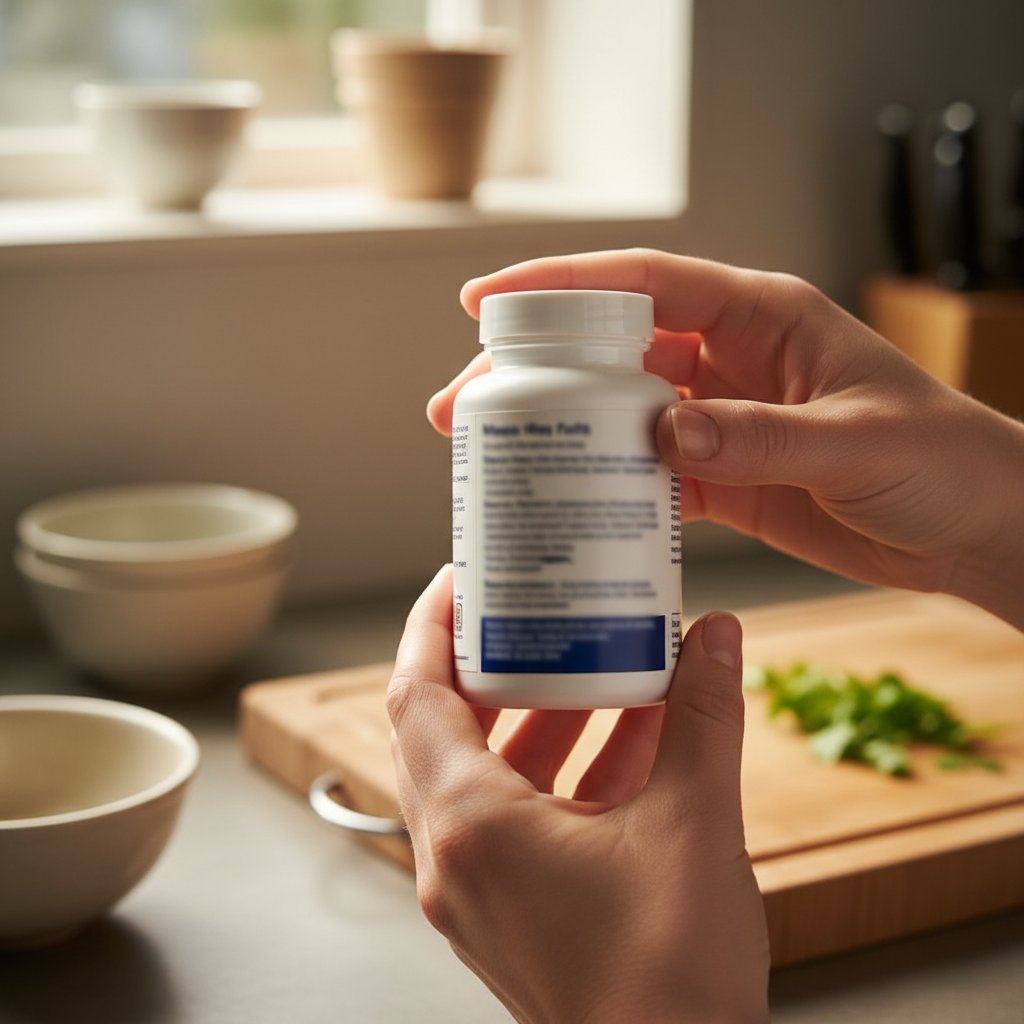
The front of the bottle is advertising — “high potency,” “pharmaceutical grade,” “whole-food derived” are loosely regulated marketing words. The back is where the regulated truth lives, in the Supplement Facts panel (FDA). Always read three things: the serving size (is “1,000% DV” one capsule or four?), the nutrient list with amounts, %DV and form, and the “Other ingredients” line.
Takeaway: the front is there to sell you; the back is there to inform you.
Reading %DV without getting fooled
People treat “100% DV” as the perfect dose. It isn’t — it’s just a benchmark (5% or less is low, 20% or more is high, per the FDA). Sometimes you genuinely want to go above it (vitamin D through a dark winter; B12 if you’re older or plant-based). Sometimes you want to stay well below it (vitamin A as retinol, iron if you’re not low). A row of “300%… 500%… 1,000%” isn’t a premium product — it’s a prompt to ask, “do I actually need this much, and how close is the cliff?”
Takeaway: %DV tells you fast-or-slow, not whether it’s right for you.
The form beats the brand — “cash or a check?”
This matters more than the brand name or the price. Picture the same nutrient handed to you two ways: as cash (spend it now) or as a check (you’ve got to take it to the bank first). For a few nutrients, the label tells you which you’re holding — if you know the words.
Folate — folic acid (a check) vs methylfolate (cash)
Folic acid has to be “cashed” by an enzyme before your body can use it. About 40% of people carry a gene variant (MTHFR) that makes that bank run slow, so the check never fully clears (NIH ODS, Folate). Methylfolate (5-MTHF) is cash — usable right away. Matters most for anyone who could become pregnant (see our pregnancy nutrition guide).
B12 — cyanocobalamin vs methylcobalamin
Cheap bottles use cyanocobalamin (stable, inexpensive). The active, ready-to-use form is methylcobalamin (NIH ODS, B12). Most do fine on either, but the methyl- form is the gentler pick — more in our B12 guide.
Vitamin E — d-alpha vs dl-alpha (“the right key, or a ring of 8?”)
Synthetic dl-alpha is like a ring of eight keys where only one opens the lock; natural d-alpha is that one key. So d-alpha is about twice as available to your body at the same IU (NIH ODS, Vitamin E). The tiny “dl” is the tell. (For vitamin D, D3 is generally stronger than D2 — see our vitamin D guide.)
What I noticed: A friend was paying about $60 a month for a glossy multivitamin with a gold “premium” front and a long list of impressive botanicals. We flipped it over one evening. Almost everything he was proud of sat inside a single “proprietary blend” — no individual doses — and the folate was plain folic acid, the form he happened to convert poorly. He wasn’t buying a better vitamin; he was buying better packaging. He switched to a simple, USP-verified bottle with named doses and methylfolate, for a fraction of the price. One person’s story, not a recommendation — but it’s exactly what this 30-second skill is for.
Takeaway: reading one word on the ingredient line beats the brand on the front every single time.
Four red flags — what to AVOID
- “Proprietary blend” / “complex” / “matrix” — groups ingredients under one total weight while hiding the amount of each. No dose, no way to judge it.
- “Third-party tested” with no name — the phrase has no legal definition; anyone can print it. If they don’t name who tested it, treat it as marketing.
- Megadoses near or over the UL — “1,000% DV” of a fat-soluble vitamin or iron.
- Marketing-grade words — “pharmaceutical grade,” “whole-food derived,” “boosts immunity”: none are regulated quality terms.
(Sources: ConsumerLab, GoodRx, FDA.)
Takeaway: these four phrases mean put the bottle down.
The seals that actually mean something — USP, NSF
- USP Verified = the right ingredients, in the stated amounts, that dissolve properly and are free of harmful contaminants — the strongest mark for everyday shoppers (USP).
- NSF Certified = verifies label claims and screens for contamination; NSF Certified for Sport also screens ~280 substances banned in sport (NSF).
- Honest limit: a seal confirms quality — that the bottle is what it says — not that the supplement will work for your goal.
Takeaway: look for the seal, don’t trust the slogan.
How to read the label if you’re… (your personal lens)
Same label, different readers. These are things to weigh and ask your pharmacist or doctor about, never a prescription.
🩸 Diabetes / blood sugar
- Check added sugar & sugar alcohols in gummy vitamins.
- Beware “blood sugar support” blends hiding doses.
- High-dose niacin (B3) can affect blood sugar — ask first.
⚖️ Losing weight
- Avoid “fat burner / metabolism complex” blends (hidden stimulants).
- 20 nutrients at high % = built to look powerful, not because you need it.
- Check serving size — often 2–3 capsules to inflate numbers.
❤️ Heart / blood pressure
- On warfarin? Vitamin K & high-dose fish oil move your INR — see our vitamin K & warfarin guide.
- Potassium + some BP meds can stack.
- Red yeast rice can act like a statin.
🫘 Pregnant or could be
- Favor methylfolate, not just folic acid.
- Avoid high-dose preformed vitamin A (retinol).
- Watch iron, choline, DHA — see our pregnancy guide.
👴 Older adult
- B12 absorption drops with age → favor methyl-B12; mind vitamin D.
- Don’t add iron unless deficiency is confirmed.
- On several meds? Clear every new supplement with your pharmacist.
Takeaway: the label doesn’t change, but what you zoom in on changes with your body.
Your 30-second label check

- Flip to the back (Supplement Facts).
- Serving size — one pill or several?
- %DV — anything you want high? Anything near the cliff (UL)?
- Forms — methylfolate, methylcobalamin, d-alpha, D3?
- Red flags — proprietary blend? Vague “third-party tested”? Megadose? Marketing words?
- Seal — USP or NSF?
Takeaway: you can now read any bottle in 30 seconds — no appointment, no expert.
FAQ
What’s the difference between RDA and DV?
What does %DV mean on a vitamin?
Is 100% Daily Value enough — or too much?
What does “tolerable upper intake level (UL)” mean?
Methylfolate vs folic acid — which is better?
Is USP or NSF better?
Does “third-party tested” mean it’s certified?
Natural vs synthetic vitamins — does it matter?
Bottom line
- “More” isn’t “better.” The most important number — the UL ceiling — isn’t even on the label, and megadosing fat-soluble vitamins or iron can quietly cause harm.
- Flip to the back, read %DV like a speedometer, and learn the forms (methylfolate, methylcobalamin, d-alpha, D3) that decide whether your body can use what you bought.
- Dodge the four red flags and look for a real seal (USP or NSF) — and read through the lens of your group.
Disclaimer: I’m trained in traditional medicine in Vietnam but I’m not currently practicing, and I’m not a clinician. This article is educational and brand-neutral — I don’t sell or endorse any supplement. It isn’t medical advice, diagnosis, or treatment. If you’re pregnant, have a medical condition (diabetes, heart disease…), or take medication, talk with your pharmacist or doctor before starting any supplement.
And remember the food-first rule: a label only matters when food can’t cover the gap. Start with our pillar guide on vitamin-rich foods to see how much you can get from your plate before you ever reach for a bottle.

About Mr. Anh
We turn solid evidence into everyday habits Americans can actually do—plain English, cups/oz, grocery-aisle swaps, and routines that fit real life. Our editorial process: Experience—we road-test tips in real schedules…