Vitamin Rich Foods: The 5 Synergy Pairs Your Body Actually Reads (A Pillar Guide)
Your body absorbs vitamins in pairs, not in isolation. This pillar guide walks through the 5 synergy pairs that cover ~90% of what a healthy adult needs from food — with two recipes per pair (Western + Vietnamese), a self-audit timeline, and an honest accounting of the 5 cases where supplements are genuinely required.
- 🎯 The Whole Pillar in Two Minutes
- Why Your Body Cannot Function Without Vitamins
- Five Diseases That Show What Vitamin Deficiency Actually Costs
- Three Foundations You Need Before the Five Pairs
- Why the Standard Chart Quietly Pushes You Toward Pills
- How Synergy Actually Works (90 Seconds)
- The 5 Synergy Pairs
- When Food Alone Is Not Enough — The 5 Cases I Take Seriously
- Self-Audit — Where Are You Right Now?
- The Weekly Rotation Plan — 7 Days, 5 Pairs, No Spreadsheet
- An Eastern Lens — Why a Whole Orange Beats a Vitamin C Tablet
- What I Watched Happen in My Own Circle
- Frequently Asked Questions
- The Bottom Line
A note before we begin: I trained in traditional Vietnamese medicine but I do not practice clinically. Everything below is a researcher’s notes — what the modern literature actually shows, what I’ve watched work in my own family, and how the two pictures fit together. If you are pregnant, on warfarin, follow a strict plant-based diet, are over 60, or live in a northern latitude through winter, please anchor your decisions with your doctor. This is education, not medical advice.
If you just Googled “vitamin rich foods” and you are staring at yet another table — fourteen vitamins across the top, food sources down the side, seventy little cells of milligrams in the middle — take a breath.
You do not need to memorize seventy things. You need to memorize five pairs.
That is what the rest of this guide is about, and I am going to give you the whole answer up front before I show you the reasoning behind it. If you only have two minutes, the box below is the entire pillar in skim form. If you want the deeper “why” — which I think you will, once you see how many of the standard rules quietly backfire — keep reading after that.
🎯 The Whole Pillar in Two Minutes
The body absorbs vitamins in pairs, not in isolation. A Vitamin C tablet alone does not behave the same as Vitamin C eaten with iron-rich greens. A calcium supplement alone does not behave the same as calcium eaten with Vitamin D and Vitamin K2. Modern nutrition research calls this nutrient synergy. Traditional Vietnamese kitchens have been cooking by the same principle for centuries — they just called it thực tổ hợp (food combinations).
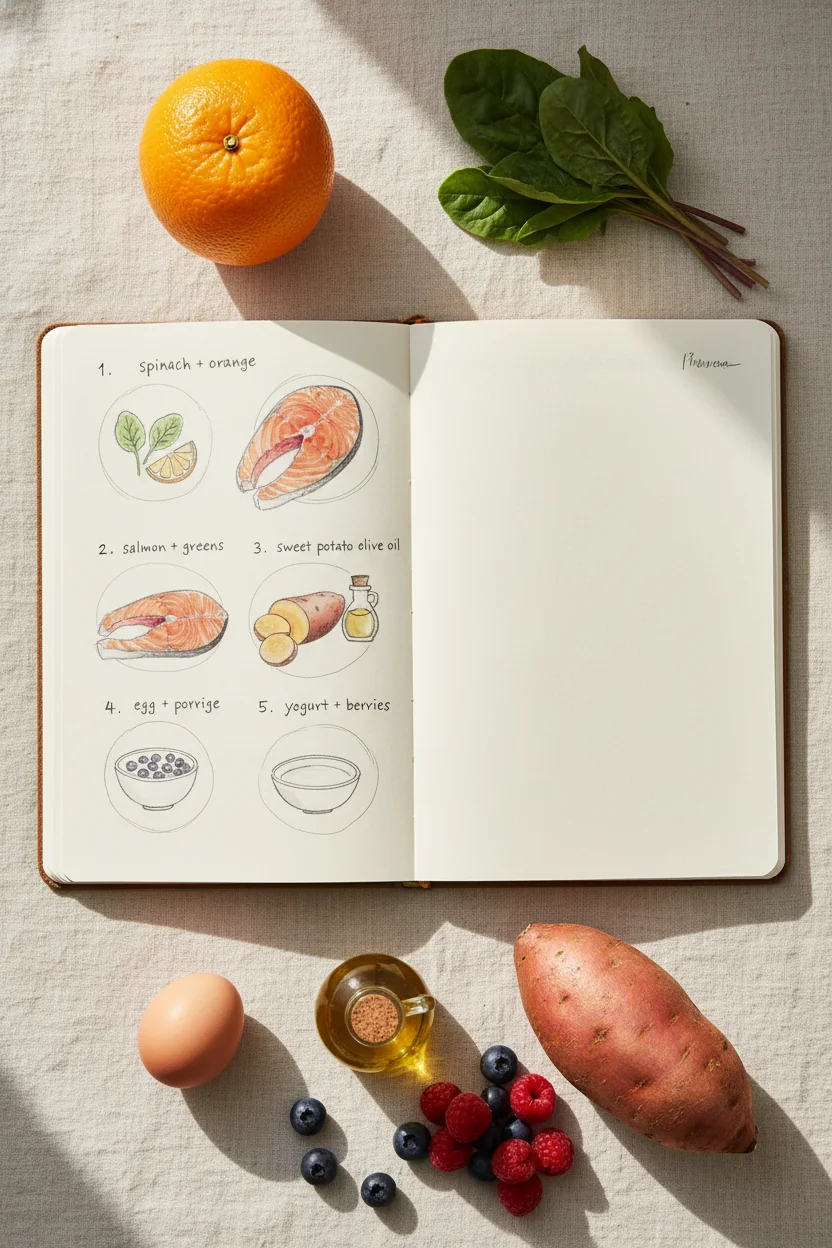
There are five pairs that, eaten in rotation across a normal week, cover roughly ninety percent of what a healthy adult needs from food. Five pairs, ten food combinations, no chart, no spreadsheet, no app.
The 5 Synergy Pairs At a Glance
| # | Pair | Nickname | TCM Organ | The Quick Combo |
|---|---|---|---|---|
| 1 | Vitamin C + Iron | The Blood Builder | Liver Blood (Can huyết) | Cooked spinach with a squeeze of lemon |
| 2 | Vitamin D + Calcium + K2 | The Bone Triad | Kidney governs Bones (Thận chủ cốt) | Sardines with bones + fermented vegetables |
| 3 | Vitamin A + Healthy Fat | The Skin & Vision Pair | Lung governs Skin (Phế chủ bì mao) | Roasted sweet potato with olive oil |
| 4 | B12 + Folate + B6 | The Energy & Nerve Triad | Spleen-Stomach (Tỳ Vị) | Soft-boiled egg over sautéed greens |
| 5 | Vitamin E + Vitamin C | The Antioxidant Tag-Team | Heart governs Shen (Tâm chủ huyết) | Plain yogurt + blueberries + almonds |
You don’t need to memorize a chart. You need to memorize five pairs.
— Mr. Anh, Founder of Essential Wellness AZ
That is the headline. The rest of this pillar shows you why each pair works (with concrete examples), what symptoms suggest you might be running low, and the five specific situations where food alone is not enough and a supplement becomes genuinely necessary.
Why Your Body Cannot Function Without Vitamins
A reasonable first question is: why does it matter? If I eat reasonably and I’m not visibly sick, why should I care about any of this?
The honest answer is that “essential” in nutrition has a precise meaning, and the consequences of getting it wrong are larger than most casual articles let on. An essential nutrient is one your body cannot manufacture on its own — it has to come in from outside, through food, every week. There are thirteen essential vitamins by this definition. Skip them for long enough and four big jobs stop happening:
- ⚡ Cofactor for enzymes. Your body runs somewhere between 5,000 and 7,000 enzyme reactions every second. A large fraction of those enzymes physically require a vitamin docked into them before any chemistry can happen. Pull the vitamin out and the enzyme sits inert. Pull enough out and entire metabolic pathways slow down.
- ⚡ Antioxidant defense. Every breath your cells take produces a small number of unstable molecules (free radicals) as side effects. Vitamins C, E, and A — along with non-vitamin allies — neutralize them before they damage DNA, proteins, and cell membranes.
- ⚡ Hormone signaling. Vitamin D is technically a steroid hormone, regulating more than 200 genes. Vitamin A’s active form does similar genetic work. These are not “support nutrients.” They are switches.
- ⚡ Structural building blocks. Vitamin C builds the collagen that holds skin, blood vessels, and bones together. Vitamin K activates the proteins that clot blood and mineralize bone. Vitamin A combines with retinal protein to let you see in low light.
The point is simple: vitamins are not “bonus.” They are the hard requirement for your biology to run. When supply runs short, the price is real — and the next section is five historical cases that show, in concrete terms, exactly what “real” means.

Five Diseases That Show What Vitamin Deficiency Actually Costs
Four of these five still occur in the twenty-first century, in populations that look like real people you might know. They are not historical curiosities.
Scurvy (Vitamin C). Between 1500 and 1800, scurvy killed more sailors on long voyages than every other cause combined. After six to eight weeks without fresh fruit, bleeding gums appeared. Then teeth fell out. Then old scars opened spontaneously as the collagen holding them shut dissolved. In 1747, James Lind ran what is now considered the first controlled clinical trial — twelve sailors, six pairs, six treatments. The pair given oranges and lemons recovered in six days. Still occurs today: older adults living alone on processed-food diets, severe alcoholics, occasional anorexia cases.
Rickets (Vitamin D). When the Industrial Revolution pulled European children indoors into smoky factory towns, their bones bent under their own weight. Without ultraviolet sunlight on skin, the body could not synthesize Vitamin D, and without D, calcium could not mineralize a growing skeleton. They called it “the English disease.” Still occurs today: subclinical Vitamin D deficiency runs at roughly one in four American adults, climbing higher in darker-skinned populations and in office workers above the 37th parallel through winter.
Beriberi (Vitamin B1). When mechanical rice mills swept Asia in the late 1800s, they polished off the bran layer where almost all of the thiamine was concentrated. The Japanese army in the 1904–05 Russo-Japanese War lost about 27,000 men to beriberi — more than to Russian fire. The Japanese navy, on a more varied diet, lost almost none. Still occurs today: heavy alcoholics (because alcohol blocks B1 absorption) are still admitted to ERs with Wernicke encephalopathy, the acute neurological form. Patients after certain bariatric surgeries are another modern risk group.
Pellagra (Vitamin B3). In the early 1900s American South, a strange epidemic ravaged sharecroppers eating corn-dominated diets. Niacin in corn is chemically locked unless the corn is treated with alkali — a step Mesoamerican cultures had used for centuries but European-American corn culture had lost. The signature was the “four D’s”: Dermatitis, Diarrhea, Dementia, Death. By 1915, pellagra was killing tens of thousands of Americans every year. Still occurs today: rare in the U.S. thanks to flour fortification with niacin since 1938; still seen in parts of sub-Saharan Africa and in heavy alcoholics.
Pernicious anemia (Vitamin B12). Until 1926, this was uniformly fatal — patients deteriorated over two to five years and died. The cause turned out to be an autoimmune attack on intrinsic factor, the stomach protein needed to absorb B12. The 1934 Nobel Prize went to the team that proved feeding large amounts of liver reversed the disease. Still occurs today — and is the most common modern vitamin deficiency: strict vegans who don’t supplement, adults over 60 (intrinsic factor declines with age), long-term users of proton pump inhibitors and metformin. Critically, nerve damage from prolonged B12 deficiency does not fully reverse — patients diagnosed late retain some permanent numbness or balance problems.
These are not history. Four of the five still happen now. The lesson isn’t to panic — it’s that chronic shortfall has a real price, often invisible until it isn’t.
— Mr. Anh
Three Foundations You Need Before the Five Pairs
Quick, but worth getting right. Most vitamin articles skip these and the consequences are real.
Water-Soluble vs Fat-Soluble — The Storage Question
The thirteen vitamins split into two groups by what dissolves them.
Water-soluble (Vitamin C and the eight B-vitamins) are not stored in significant amounts. Excess passes into urine. You need roughly daily intake, but you almost cannot overdose from food alone.
Fat-soluble (A, D, E, K) are stored in liver and body fat for weeks to months. You can take Vitamin D weekly instead of daily and your reserves hold steady. The flip side: high doses of fat-soluble vitamins from supplements can accumulate to toxic levels. Vitamin A as preformed retinol is especially risky at high doses — liver damage and birth defects are documented at chronic intakes above the Upper Limit.
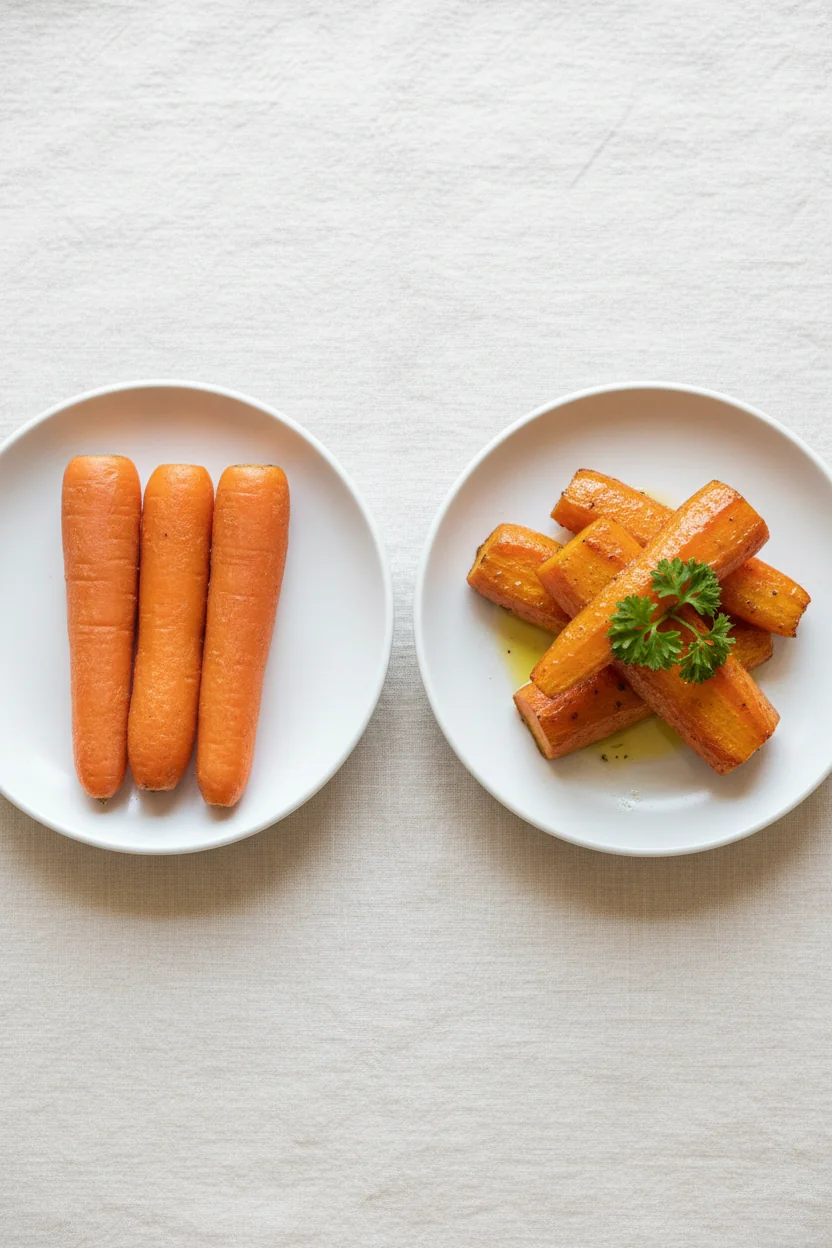
The single practical implication: fat-soluble vitamins need fat in the same meal to absorb. A raw carrot eaten alone delivers 5–15% of its Vitamin A. The same carrot cooked with olive oil delivers 50–65%. Same carrot. Same milligrams on any chart. Four to ten times the actual delivery. This is the single most important fact most charts leave out.
Bioavailability — The Hidden Multiplier
The number on a nutrition chart is the amount in the food. The amount your body absorbs and uses is something else entirely, and the ratio between them can swing wildly:
- Non-heme iron from spinach absorbs at 5–10% alone, triples with Vitamin C in the same meal, drops 30–40% with coffee or tea.
- Calcium depends on Vitamin D for absorption — without D, intake of any size delivers a fraction.
- B12 absorption depends on intrinsic factor, which declines with age and is impaired by common medications.
- Beta-carotene absorption swings 5× depending on whether the carrot is cooked and whether fat is present.
The takeaway: when you eat foods in synergy pairs, you push bioavailability up automatically without doing any calculation. That is what the five pairs are designed to do.
(For a deeper dive into RDA / DV / UL label-reading, see our spoke article How to Read a Vitamin Label.)
Why the Standard Chart Quietly Pushes You Toward Pills
This part is short because it doesn’t need much. Every top-ranked vitamin article (Mayo, Harvard, WebMD, Healthline) uses the same architecture: fourteen vitamins × five food sources × milligrams per serving. The facts are correct. The teaching strategy is the problem.
Three things go wrong:
- Cognitive overload. Seventy data points in front of you, your brain shuts down, and you reach for the multivitamin as a shortcut.
- Missing context. The chart tells you spinach has iron. It doesn’t tell you coffee within an hour cuts that iron absorption by 40%, or that Vitamin C in the same meal triples it. The single most useful piece of information about a food — what to eat with it — is exactly what the chart format strips away.
- The slow push to pills. “Talk to your doctor and consider a supplement” is the only line most readers remember after the chart fades. The chart format is, structurally, a soft advertisement for the supplement aisle.
I am doing the opposite. Five pairs. Five stories. The pairs work because the body — not the chart — designed them. Here is how.
How Synergy Actually Works (90 Seconds)
Nutrient synergy: when two or more nutrients eaten together produce a biological effect larger than the sum of their separate effects. Standard math: 1 + 1 = 2. Synergy math: 1 + 1 = 3. A 2023 review in Frontiers in Nutrition called this “an underexplored frontier in nutrition science” — academic-speak for “the mainstream still treats vitamins as if they worked alone, while the biology has been saying otherwise for decades.”
Three mechanisms cover almost all of it:
| Mechanism | What it does | Textbook example |
|---|---|---|
| Co-absorption | One nutrient helps another cross the gut wall | Vitamin C tripling non-heme iron absorption; fat carrying Vitamins A/D/E/K |
| Co-activation | One nutrient switches another on once both are in the body | B6 + folate + B12 sharing the methylation cycle; K2 directing absorbed calcium into bones |
| Co-protection | Two nutrients defend each other from degradation | Vitamin C recycling oxidized Vitamin E in cell membranes |
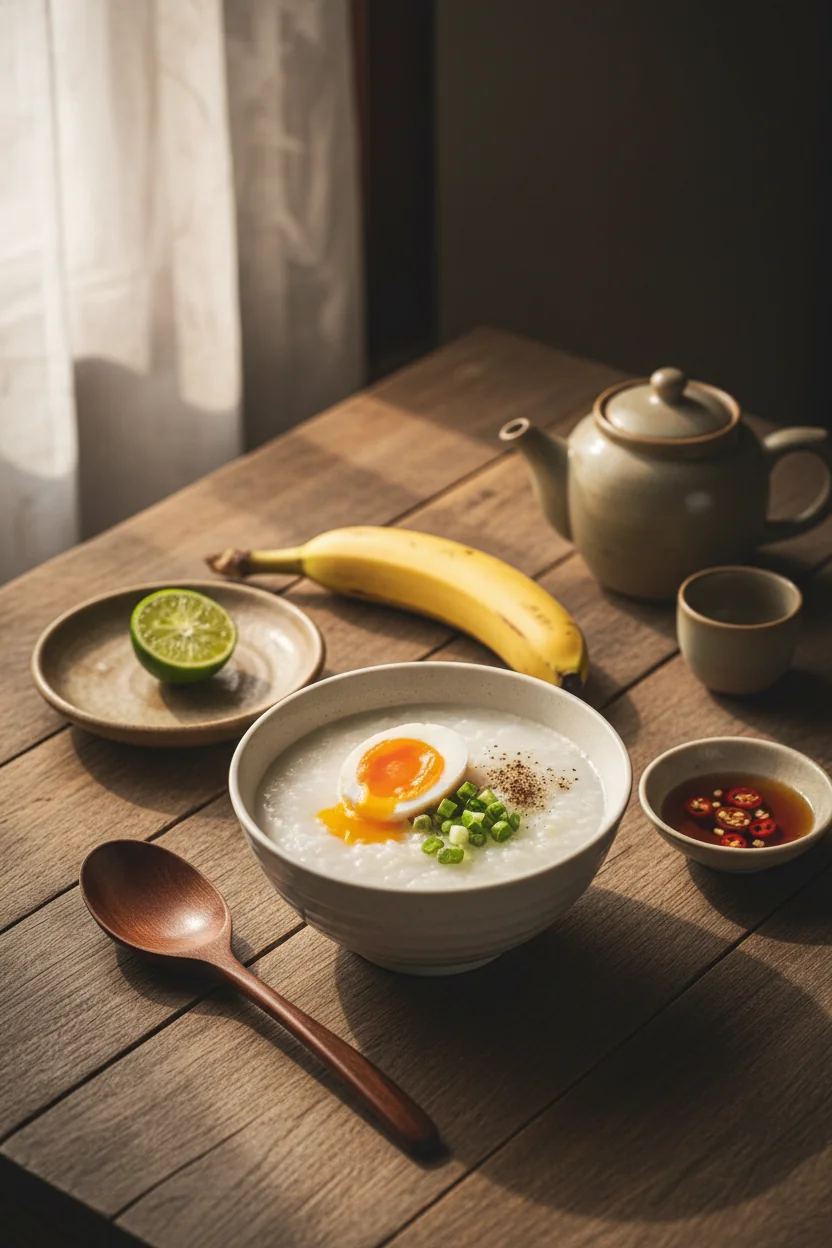
Traditional Vietnamese-Chinese medicine has had a name for this principle for two thousand years: thực tổ hợp (食组合), “food combinations.” Every classical herbal formula follows a related framework — sovereign, minister, assistant, courier — where multiple ingredients balance each other rather than acting alone. The same instinct shows up in everyday meals: a Vietnamese breakfast of rice porridge + soft egg + green onion + a pinch of salt-pepper-lime is a synergy pair on autopilot. Nobody who made it knew anything about B12 cobalamin. The combination simply emerged, over generations, as something that left people feeling well.
Western research took twenty years to define “nutrient synergy.” Vietnamese kitchens have been cooking by it for twenty centuries.
— Mr. Anh
Now — the five pairs themselves.
The 5 Synergy Pairs
Each pair below follows the same compact format: how it works, who is likely low, the exact food combination, what I do personally, and when food alone is not enough. You can scan straight down or read fully — both work.
1. Vitamin C + Iron — The Blood Builder ❤️🩸
The single most important pair in the guide, especially for women. Iron deficiency is the most common nutritional deficiency in the world.
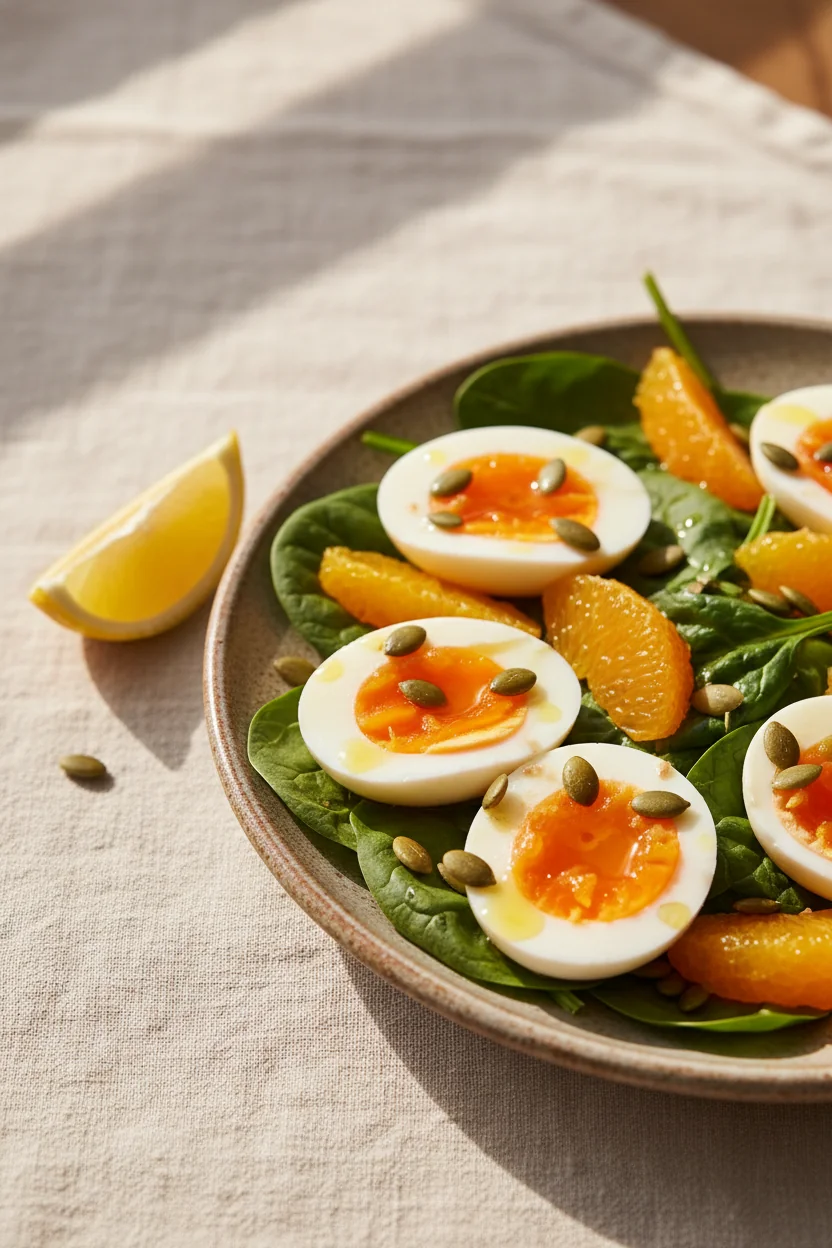
How it works. Iron in plant foods (non-heme) is in a chemically oxidized form your gut absorbs poorly — 5–10% on its own. Vitamin C in the same meal reduces it to the absorbable form, and intake triples. Coffee, tea, and dairy in the same meal do the opposite — tannins and calcium block iron at the gut wall. In TCM, this pair feeds Can huyết (Liver Blood) — the same picture Western medicine calls iron-deficiency anemia.
You might be running low if:
- ☐ Unexplained fatigue, especially 2–3 hours after meals
- ☐ Vertical ridges in your fingernails, brittle and dry
- ☐ Pale tongue with tooth marks along the edges
- ☐ Periods lasting more than 7 days or soaking through quickly
- ☐ Craving ice (pica — a red flag of significant deficiency)
📋 Recipe — Two Versions of the Same Pair
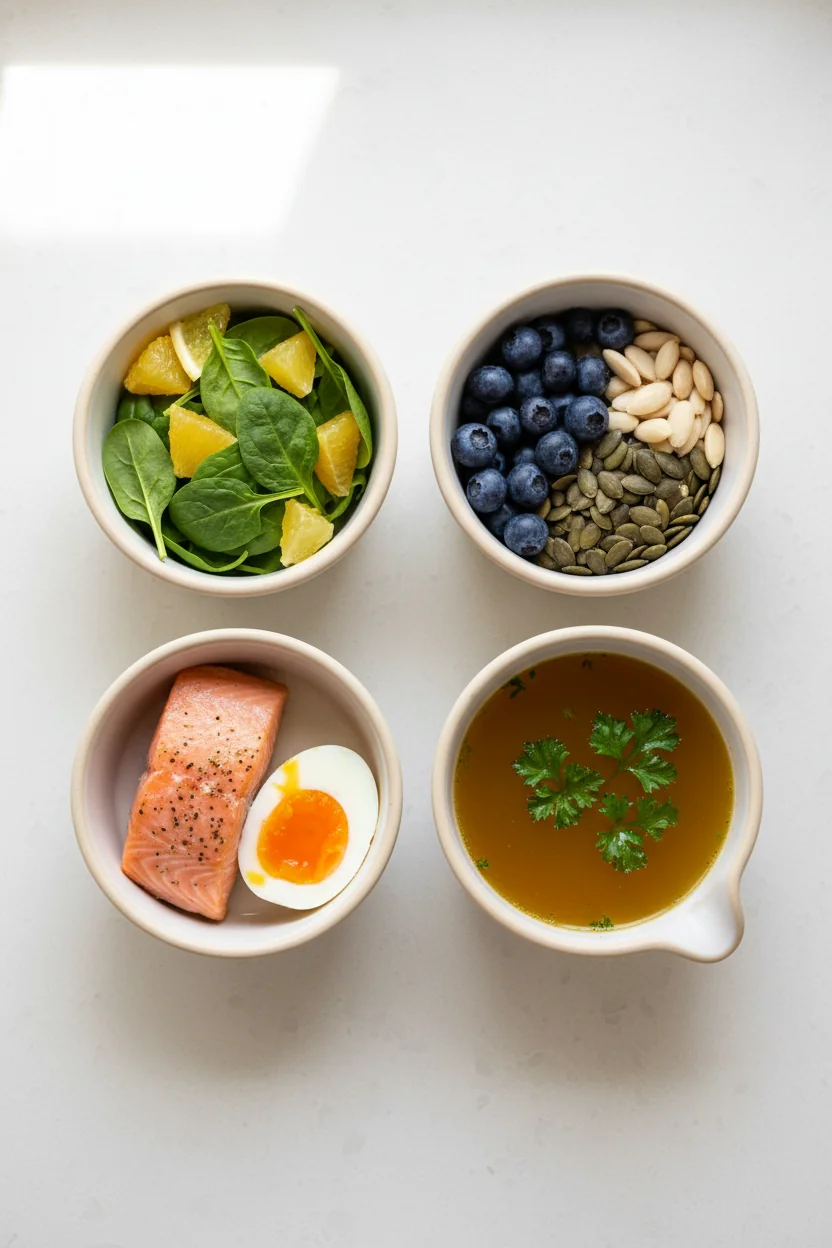
Western style: Spinach lightly wilted in the heat of one sliced soft-boiled egg, segments from a navel orange, a quarter cup of pumpkin seeds, a tablespoon of olive oil, a squeeze of lemon.
Vietnamese style: Rau muống xào tỏi (water spinach stir-fried with garlic) + a fried egg + a small bowl of rice + nước mắm chấm chanh (fish sauce with fresh lime) + a peeled orange afterward.
What I do. I made one specific change five years ago that did more for my iron status than anything else: I moved coffee to mid-morning, at least an hour after breakfast. Drinking it with the meal was costing me roughly a third of every iron-rich plate I ate, and I had no idea.
When food is not enough. Women with heavy menstrual periods can outpace any reasonable diet. A ferritin blood test below 30 ng/mL usually means iron supplementation under medical guidance. Pregnancy roughly doubles iron needs — a prenatal vitamin with iron and folate is the standard call.
A squeeze of lemon on cooked spinach triples the iron you actually get from that plate.
— Mr. Anh
2. Vitamin D + Calcium + K2 — The Bone Triad 🦴
This is the pair most articles get wrong by leaving out the third member. K2 is what tells absorbed calcium to go into bones — not into arteries.
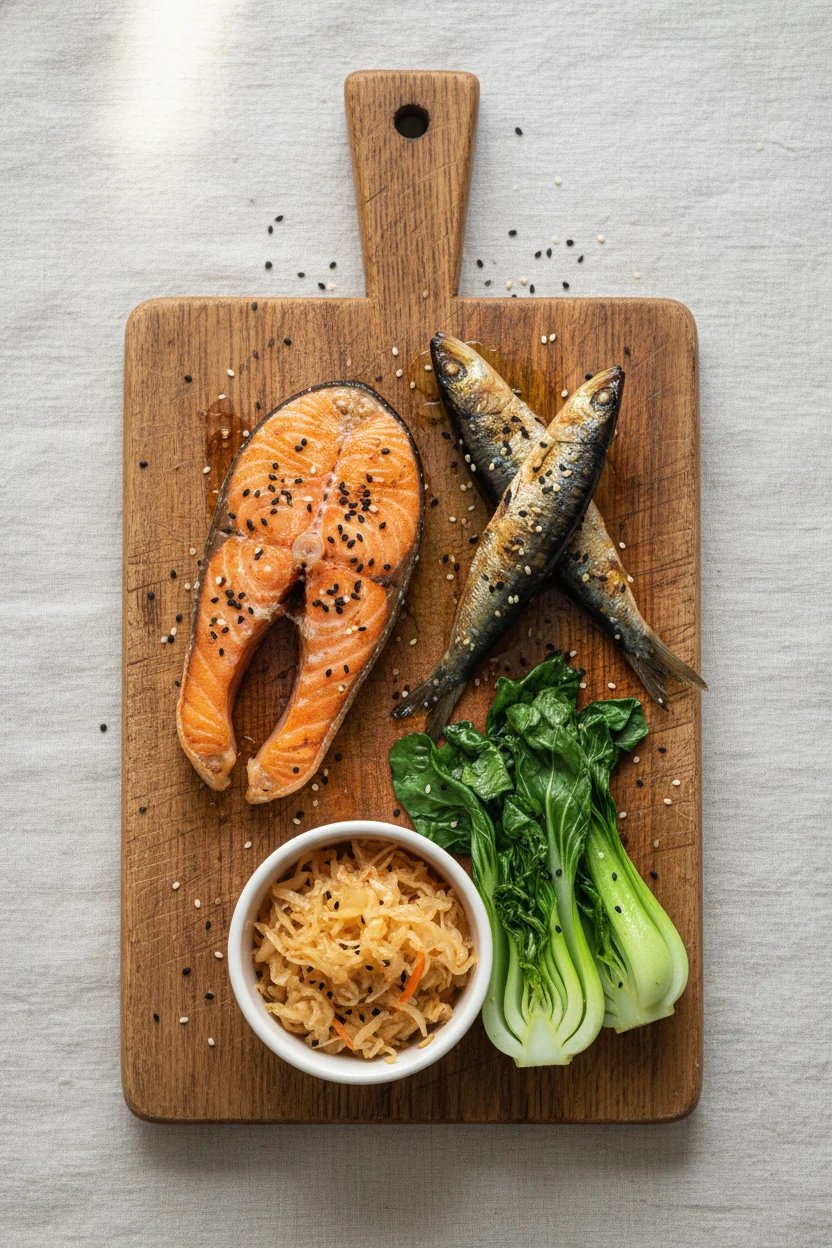
How it works. Vitamin D opens absorption channels in the gut, so calcium can come in. K2 then activates Matrix Gla Protein, which directs that calcium into bone tissue instead of soft tissue or arterial walls. Without K2, calcium still gets absorbed — it just ends up in the wrong places. A 2010 BMJ meta-analysis raised concerns about calcium-only supplementation and cardiovascular risk; the K2 mechanism is part of the likely explanation. In TCM, this triad feeds Thận chủ cốt — “the Kidney governs the bones” — and traditional kidney-essence tonic foods (black sesame, fermented vegetables, bone broth, sardines with bones) map almost exactly onto the modern bone triad list.
You might be running low if:
- ☐ Chronic lower back ache, especially first thing in the morning
- ☐ Sensitive or repeatedly chipping teeth
- ☐ History of stress fractures or “broke from a small fall”
- ☐ Winter mood that lifts only in spring (D pattern)
- ☐ Thigh weakness when climbing stairs
📋 Recipe — Two Versions of the Same Pair
Western style: Baked salmon over steamed bok choy, sprinkled with sesame seeds, a side of unpasteurized sauerkraut, a drizzle of olive oil.
Vietnamese style: Cá kho củ cải (sardines or small whole fish braised with daikon, eaten with bones) + stir-fried Chinese broccoli + a small portion of dưa cải chua (fermented mustard greens) + brown rice + a sprinkle of black sesame.
What I do. Every winter, October through March, I take 1,000–2,000 IU of Vitamin D3 with my breakfast. I live in Arizona, where indoor sunlight is mild but indoor lifestyle still blocks enough UVB that food alone cannot keep my 25(OH)D in the healthy range. This is not a shortcut. It is honest acknowledgment that biology beats geography sometimes.
When food is not enough. Vitamin D from October through March, in nearly all of North America above the 37th parallel. Postmenopausal women may need DEXA scanning and pharmaceutical treatment beyond food and basic supplementation.
Vitamin D opens the door for calcium. K2 tells calcium which room to go to — the bone room, not the artery room.
— Mr. Anh
3. Vitamin A + Healthy Fat — The Skin & Vision Pair ✨
Almost everyone gets this pair wrong by eating carrot sticks and “carrot juice” with no fat in sight.
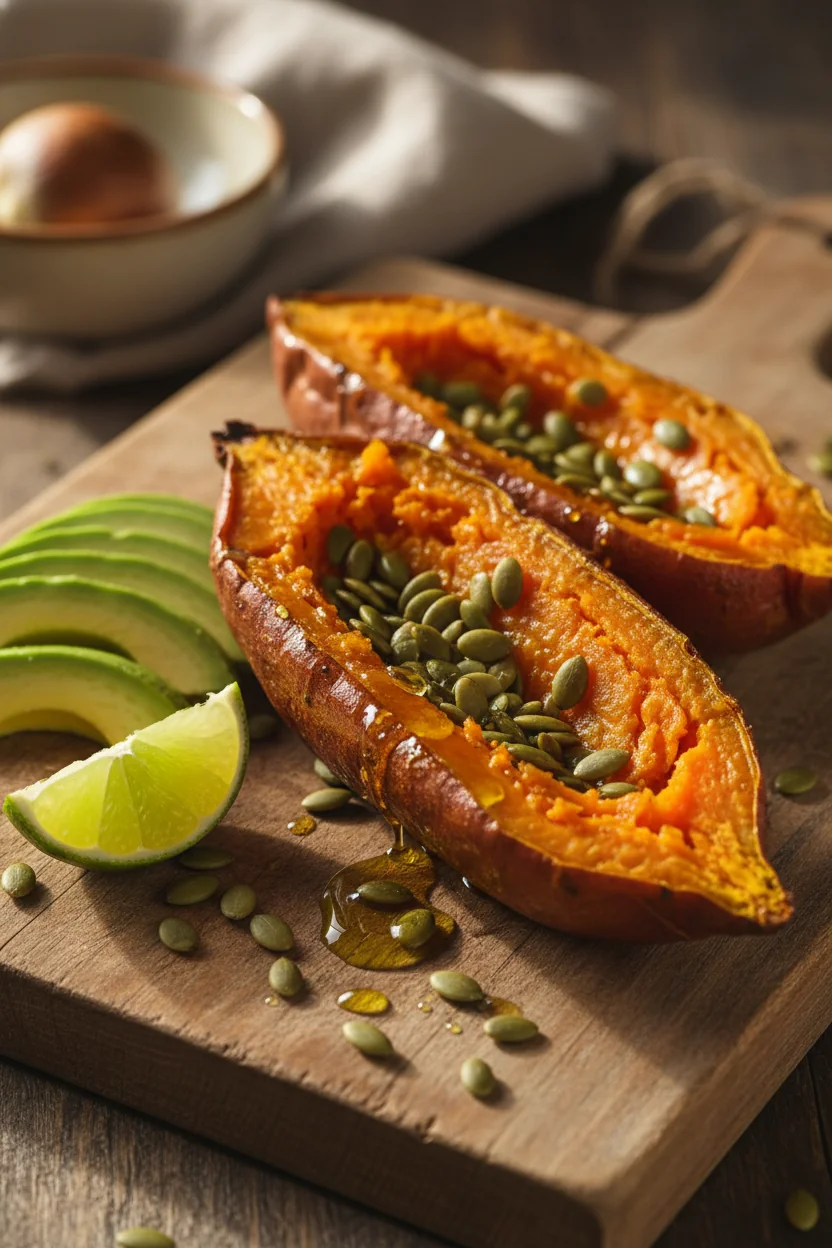
How it works. Beta-carotene (the plant precursor your body converts to Vitamin A) is locked inside tough plant cell walls and is fat-soluble. Eat a raw carrot with no fat: you absorb 5–15%. Cook it until soft, eat with a tablespoon of olive oil: 50–65%. Same carrot. Four to ten times the delivery. In TCM, this pair feeds Phế chủ bì mao — “the Lung governs skin and body hair” — and Lung Yin deficiency shows up as dry skin, dry eyes, dull hair, and the dry-air struggles of winter.
You might be running low if:
- ☐ Persistently dry skin no topical product fixes
- ☐ Difficulty seeing or adjusting to low light
- ☐ Chronically chapped lips
- ☐ Brittle, dull hair
- ☐ Frequent slow-clearing respiratory infections
📋 Recipe — Two Versions of the Same Pair
Western style: A roasted sweet potato (200°C / 25 min) tossed with a tablespoon of olive oil, topped with a quarter avocado sliced, pumpkin seeds, sea salt, and a squeeze of lime.
Vietnamese style: Canh cà rốt bí đỏ rim mè — carrot and pumpkin slow-stewed with a teaspoon of toasted sesame oil added at the end, served with rice and a small piece of pan-fried tofu or pork.
What I do. My wife used to drink raw carrot juice as her “healthy” morning drink. After I showed her the absorption numbers, she switched to slow-stewed carrot and pumpkin with sesame as a side dish at lunch. Her winter skin dryness, which she had blamed on Arizona air for years, eased by the second month.
When food is not enough. Frank Vitamin A deficiency is rare in well-fed adults. The exceptions: chronic fat malabsorption (celiac, severe IBD, post-bariatric), and certain pediatric populations in low-income countries. Avoid high-dose retinol supplements during pregnancy — preformed Vitamin A is a known teratogen above the Upper Limit.
A raw carrot is a salad ingredient. A roasted carrot with olive oil is medicine for skin and eyes.
— Mr. Anh
4. B12 + Folate + B6 — The Energy & Nerve Triad ⚡🧠
The B-complex story is the largest failure of the standard chart format. The three core B-vitamins share one metabolic pathway. Pull any one out and the whole thing slows down.
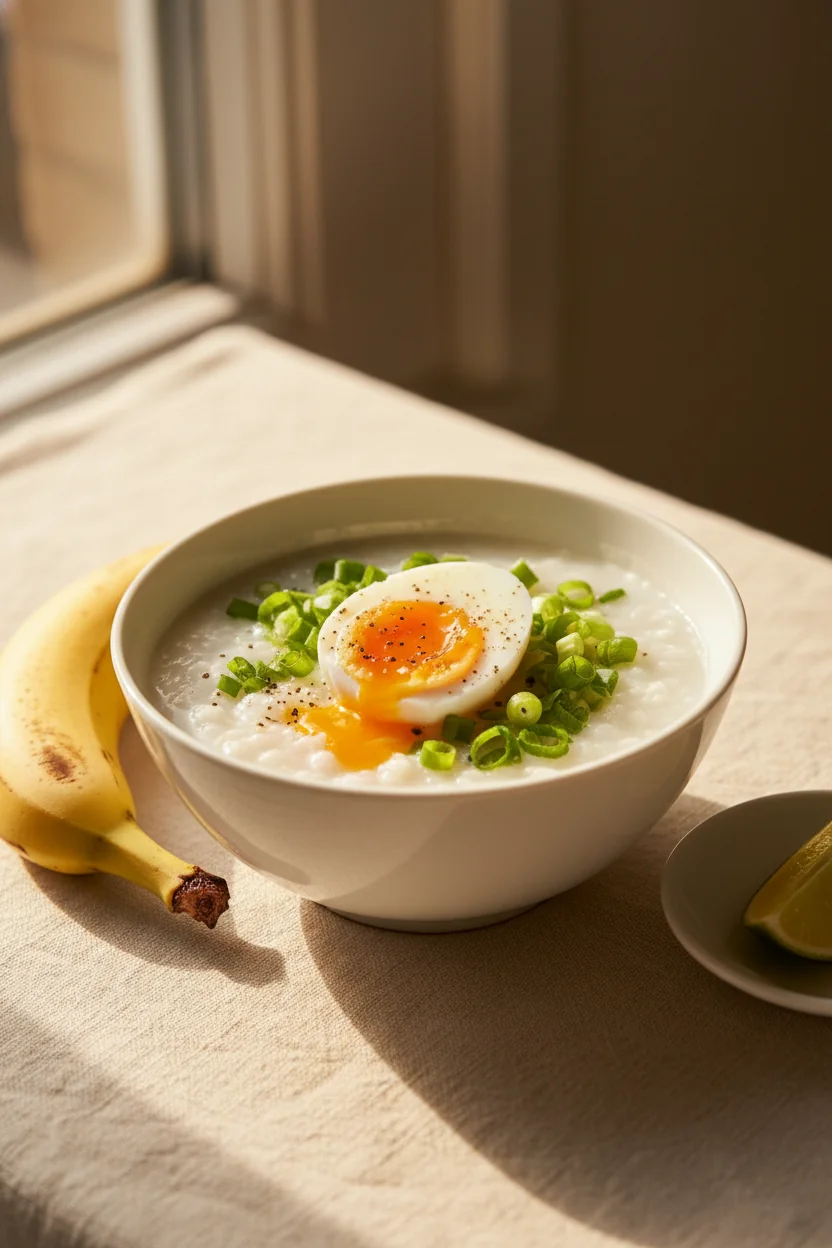
How it works. Folate (B9), B12, and B6 run the methylation cycle — the chemistry that builds DNA, synthesizes serotonin and dopamine, produces energy, and clears the cardiovascular risk factor homocysteine from the blood. The three vitamins do not work in parallel; they hand chemistry to each other in sequence. Miss one and the cycle backs up. In TCM, this triad feeds Tỳ Vị (Spleen-Stomach) — the central digestive engine. The classic Vietnamese breakfast of rice porridge + soft egg + green onion + banana is a textbook Tỳ Vị meal that, not coincidentally, delivers all three B-vitamins.
You might be running low if:
- ☐ Afternoon fatigue, especially 2–3 hours after lunch
- ☐ “Brain fog” — diffuse difficulty concentrating
- ☐ Tingling or numbness in fingers or toes (B12 specifically, urgent)
- ☐ Low mood that doesn’t fit your circumstances
- ☐ Swollen, smooth, painful tongue (atrophic glossitis — classic B12 sign)
📋 Recipe — Two Versions of the Same Pair
Western style: Two soft-scrambled eggs in butter over sautéed spinach and garlic, a slice of whole-grain sourdough toast, half a banana on the side.
Vietnamese style: Cháo trứng hành — rice porridge with a soft-boiled egg, sliced green onion, a sprinkle of black pepper, a squeeze of lime, and a fresh banana afterward.
What I do. My mother is in her late sixties. After I read the literature on age-related intrinsic-factor decline, I quietly added a 500 mcg methylcobalamin sublingual to her morning routine three years ago. Her annual B12 panel has stayed in the healthy range since. Food alone, at her age, was no longer doing the job — and there is no scenario in which “wait until classic symptoms appear” is a reasonable approach to B12 in older adults.
When food is not enough. Strict vegans and vegetarians — B12 supplementation is non-negotiable. Adults over 60 — annual B12 testing recommended. Long-term users of PPIs or metformin — both impair B12 absorption and the deficiency builds quietly over years.
If you are a strict vegan and don’t supplement B12, you are running a nutritional emergency, not a lifestyle choice.
— Mr. Anh
5. Vitamin E + Vitamin C — The Antioxidant Tag-Team 🌟
The most subtle of the five pairs. Symptoms are diffuse, not dramatic. But this is the pair behind “skin from the inside.”
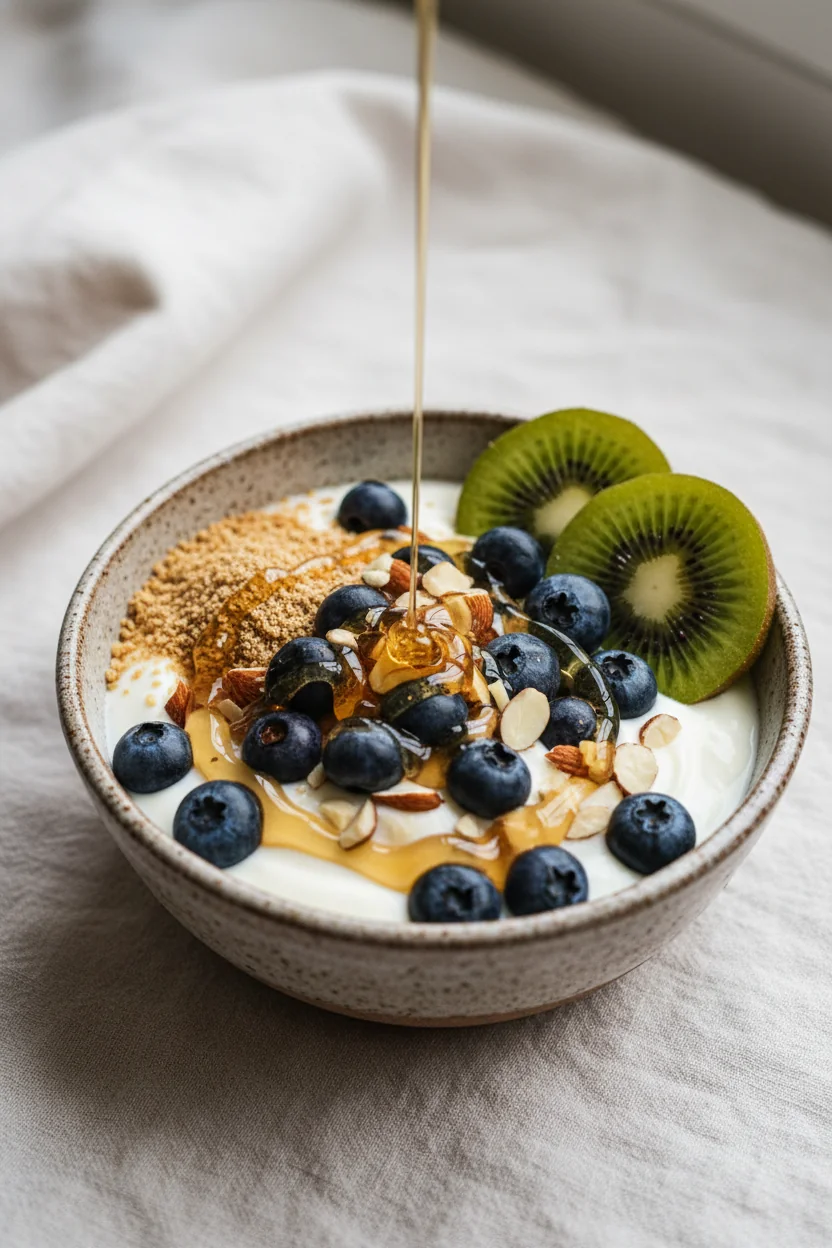
How it works. Vitamin E lives in cell membranes (fat-soluble) and Vitamin C lives in the watery interior of cells (water-soluble). When E neutralizes a free radical in the membrane, it becomes oxidized and inactive. Vitamin C then donates an electron back to oxidized E, recycling it into the active form. The pair runs a continuous protective loop across the boundary between fat and water in every cell. Take one out and the system runs down. Take a high-dose E supplement alone without C and you can actually get pro-oxidant behavior — oxidized E with nothing to recycle it. In TCM, this pair feeds Tâm chủ huyết (Heart governs blood) and Shen (the spirit-mind), and the traditional Heart-Shen tonic foods — lotus seeds, red dates, goji berries, almonds — are densely supplied with both E and C.
You might be running low if:
- ☐ Skin that has lost springiness, slow to recover from stretching
- ☐ Small wounds healing more slowly than they used to
- ☐ Brittle, frayed hair despite oil treatments
- ☐ Mild tingling or weakness in extremities (advanced E deficiency)
- ☐ Easy bruising
- ☐ A general sense that recovery from exercise or illness is slow
📋 Recipe — Two Versions of the Same Pair
Western style: Plain whole-milk Greek yogurt + half a cup of blueberries + an ounce of almonds + a tablespoon of ground flax + a few slices of kiwi + a drizzle of raw honey.
Vietnamese style: Chè hạt sen táo đỏ — a quarter cup of dried lotus seeds + five red Chinese dates + a tablespoon of goji berries + a tablespoon of slivered almonds + a small amount of rock sugar, all simmered for 30 minutes.
What I do. I keep a small jar of raw almonds in the refrigerator (oxygen and light spoil Vitamin E fast — pantry storage is a quiet mistake) and a bag of frozen blueberries in the freezer. A handful of each into morning yogurt takes ten seconds and covers this pair without thinking.
When food is not enough. Genuine E or C deficiency severe enough to need supplementation is rare in people eating any reasonable variety. The exceptions are extreme low-fat diets (E disappears with the fat) and strict ketogenic diets that exclude almost all fruit (C drops). For most readers, food handles this pair fully.
This is not skincare. This is the antioxidant defense system that lives inside every cell — and it works better as a duo than as a soloist.
— Mr. Anh
When Food Alone Is Not Enough — The 5 Cases I Take Seriously
I am not anti-supplement. I am anti-default. The default in modern wellness is “if in doubt, add a pill” — and for most healthy adults eating in synergy pairs, that default is wrong. But there are five specific situations where food cannot reasonably get the job done, and in those five cases, a supplement is not a shortcut. It is the food-first approach extended one step further.
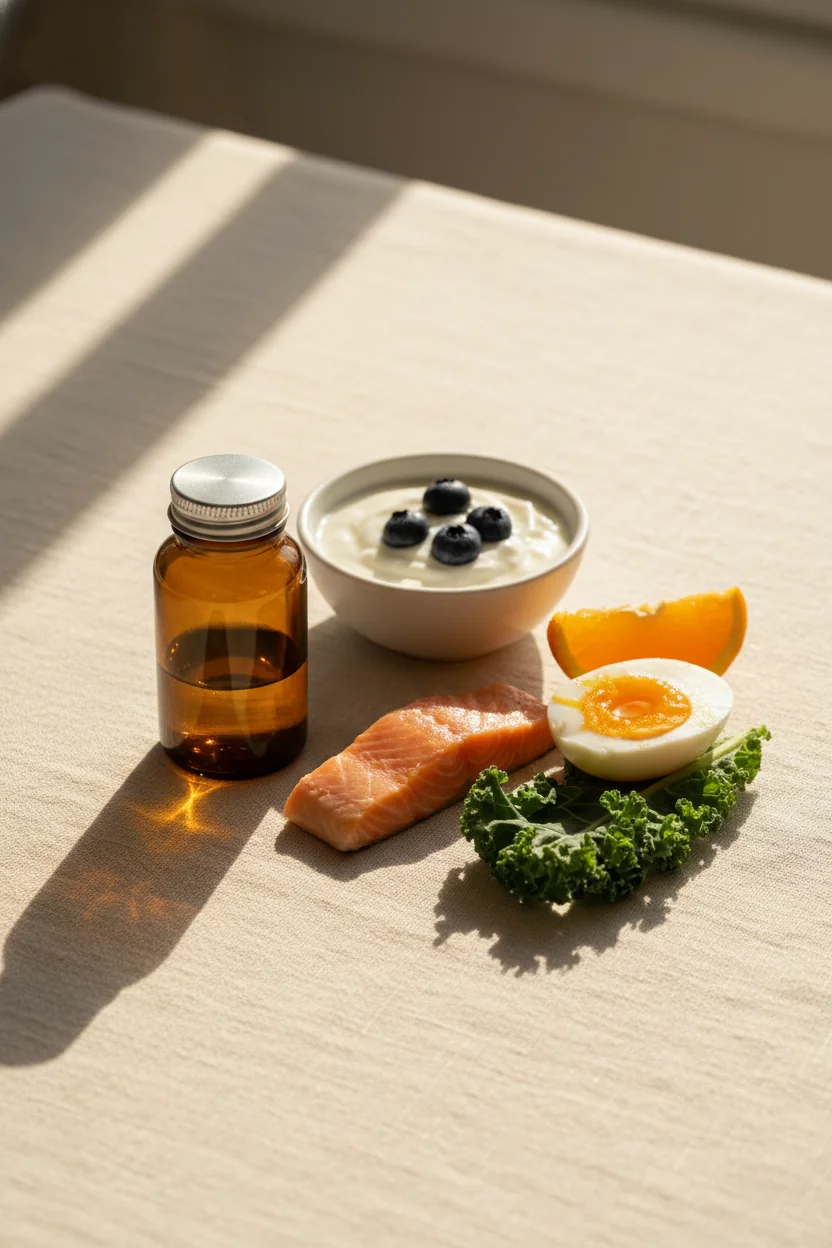
Also note: Vitamin K does not fit into a clean pair like the other five. It deserves its own short paragraph here, because the most common mistake — telling warfarin patients to “avoid all greens” — is genuinely dangerous.
Vitamin K — Stability, Not Avoidance
Vitamin K comes in two forms. K1 from leafy greens (kale, spinach, parsley, broccoli) supports the body’s clotting machinery; K2 from fermented foods (natto, sauerkraut, certain cheeses) directs absorbed calcium into bones, as covered in Pair 2. The critical safety point: if you take warfarin or another vitamin-K-antagonist blood thinner, the goal is not to avoid Vitamin K — that’s the common mistake. The goal is to keep your intake stable from day to day so your physician can dose warfarin accurately. Erratic intake (heavy greens one day, nothing the next) is what destabilizes INR. Talk to your pharmacist about your specific routine.
The 5 Cases Where Supplementation Is Genuinely Needed
| # | Situation | What to take | Why food can’t do it |
|---|---|---|---|
| 1 | Pregnancy or planning pregnancy | Prenatal vitamin (folate 400–800 mcg, iron, choline, DHA), starting ≥3 months before conception | Folate needs exceed what most diets reliably deliver; neural tube formation is non-negotiable |
| 2 | Strict vegan or vegetarian | B12 (250–1,000 mcg methylcobalamin daily, or 2,000 mcg twice weekly) | Plant foods contain effectively zero bioactive B12 — including spirulina, nutritional yeast (unless fortified), and seaweed |
| 3 | Adults 60 and over | Annual B12 testing; supplement 250–500 mcg if levels trend low. Vitamin D as below | Intrinsic factor declines with age — food-source B12 absorption drops 30–50% even with adequate intake |
| 4 | Northern winter (Oct–Mar, latitudes above ~37°) | Vitamin D3 1,000–2,000 IU daily | UVB radiation is too weak to drive skin synthesis regardless of time spent outside |
| 5 | Warfarin / blood thinner users | Stable daily Vitamin K intake — work with pharmacist on routine | Erratic K intake destabilizes anticoagulant dosing |
What I do. I take Vitamin D3 (2,000 IU with breakfast) from October through March. That’s it. No multivitamin. No “wellness stack.” Five years ago, when I started tracking my own 25(OH)D blood levels, I learned that even my mostly-outdoor lifestyle in Arizona could not keep me in the healthy range through winter. The supplement is honest acknowledgment that geography beats lifestyle here. Outside of winter, I drop it.
I’m not against supplements. I’m against defaults. When food-first can’t reach — because biology, geography, or life stage takes it out of food’s range — supplements become food-first, extended.
— Mr. Anh
Self-Audit — Where Are You Right Now?
You can read about deficiency consequences from the outside, or you can look at the signs in your own body. This part is for the second.
There is a useful timeline to keep in mind: vitamin deficiency does not arrive overnight, and it does not become irreversible immediately. There is almost always a fix-window, and most readers are sitting inside it without knowing it.
The 3-Tier Timeline
| Tier | Duration of shortfall | What you’d notice | Reversibility |
|---|---|---|---|
| 🟡 Subclinical | A few weeks to a few months | Vague fatigue, mild dry skin, brittle nails, low-grade mood dip, lighter sleep, more frequent minor colds | Fully reversible in 4–8 weeks with diet correction. This is where ~80% of readers are. |
| 🟠 Clinical | 6 months to 2 years | Confirmed anemia on bloodwork, low bone density on DEXA, mild peripheral neuropathy, slow wound healing, persistent low mood | Mostly reversible with targeted supplementation + diet over 3–6 months |
| 🔴 Chronic | 2+ years of unaddressed deficiency | Osteoporosis, chronic B12 neuropathy, age-related macular degeneration, early dementia patterns, arterial calcification | Partial or no full recovery — supplementation halts further progression but doesn’t reverse accumulated damage |
The most important practical point: the fix-window for 🟡 is short and cheap. Four to eight weeks of eating in synergy pairs corrects most subclinical deficiencies. The price climbs steeply once you cross into 🟠 (requires testing + targeted supplementation + months of correction) and steeply again once you cross into 🔴 (where supplementation only halts the slide, not reverse it). The best time to address vitamin status is when symptoms are still vague — that is, exactly when most people ignore them.
Quick Symptom Decoder
| If you notice… | Most likely culprit | First move |
|---|---|---|
| Fatigue + pale skin + ridged nails | Iron + B12 | Pair 1 + Pair 4 for 4 weeks. If no improvement, ferritin + B12 test. |
| Bone aches + winter low mood | Vitamin D | Test 25(OH)D. Likely need D3 supplement. |
| Dry skin + poor night vision + dull hair | Vitamin A + healthy fat | Pair 3 for 6 weeks. |
| Tingling hands/feet + brain fog + sore tongue | B12 (urgent) | Test now — especially if vegan, over 60, or on PPI/metformin. |
| Slow wound healing + bleeding gums | Vitamin C (severe → consider scurvy) | More fresh fruit immediately. |
| Low mood + poor sleep + irregular cycles | B-complex + magnesium | Pair 4. Test if persistent beyond 6 weeks. |
| White spots on nails | Zinc (or trauma) | Pumpkin seeds, oysters, lentils. |
When You Should Test, and When You Don’t Need To
| You probably don’t need a test if… | You probably should test if… |
|---|---|
| You feel mostly fine, eat varied foods, and are not in a risk group | Symptoms persist >2 months after 4-week diet correction |
| You can do a 4-week diet experiment first | You’re vegan / vegetarian (B12 + D + iron yearly) |
| Your symptoms are mild and fit the 🟡 tier | You’re over 60 (B12 + D yearly) |
| You have heavy menstrual periods (ferritin every 1–2 years) | |
| You’re pregnant or planning pregnancy | |
| You have a GI condition (celiac, IBD, post-bariatric) |
Red Flags That Skip the Diet Experiment Entirely
If any of these are happening, see a doctor sooner rather than later:
- ☐ Severe fatigue lasting more than a month
- ☐ Numbness or weakness on one side of the body, or confusion (can be severe B12 + emergency)
- ☐ Unusual bleeding (gums, nose, very heavy menstrual flow)
- ☐ Strong craving for ice, dirt, or paper (pica — significant iron deficiency)
- ☐ A child with delayed growth, or an older adult losing weight quickly
The Weekly Rotation Plan — 7 Days, 5 Pairs, No Spreadsheet
The whole point of the synergy-pair framework is that you do not have to count anything. Pick foods so that most days hit at least two of the five pairs, and the week covers all five at least twice. Here is what that actually looks like.
| Day | Breakfast | Lunch | Dinner | Pairs hit |
|---|---|---|---|---|
| Mon | Eggs + sautéed spinach + whole-grain toast + banana | Spinach + orange + pumpkin seed salad + EVOO | Salmon + bok choy + sesame + rice | 1, 2, 4 |
| Tue | Greek yogurt + blueberries + almonds + flax | Roasted sweet potato + lentils + bell peppers + EVOO | Rice porridge + soft egg + scallion + banana | 5, 3, 4 |
| Wed | Smoothie: kiwi + spinach + ½ avocado + chia | Avocado + bell pepper + chicken sandwich + lentil side | Bone broth + braised radish + sardines (with bones) + rice + sesame | 1, 3, 2 |
| Thu | Lotus seed + red date + almond + goji porridge | Lentil noodles + water spinach stir-fry + orange | Roasted sweet potato + sardines + kale with garlic | 5, 1, 2, 3 |
| Fri | Boiled eggs + avocado + sourdough + banana | Mediterranean salad: feta + olives + tomato + EVOO + sardines | Braised tofu + mushrooms + spinach + brown rice + sauerkraut | 4, 3, 2 |
| Sat | Yogurt + berries + walnut + honey | Vietnamese sour fish soup + rice + orange | Tofu + bell peppers + cashews + EVOO + bok choy | 5, 1, 3 |
| Sun | Rice porridge + soft egg + scallion + pepper + banana | Kale + roasted pumpkin + pumpkin seeds + EVOO | Salmon + steamed bok choy + sesame + rice + natto or sauerkraut | 4, 3, 2 |
A Two-Minute Shopping List
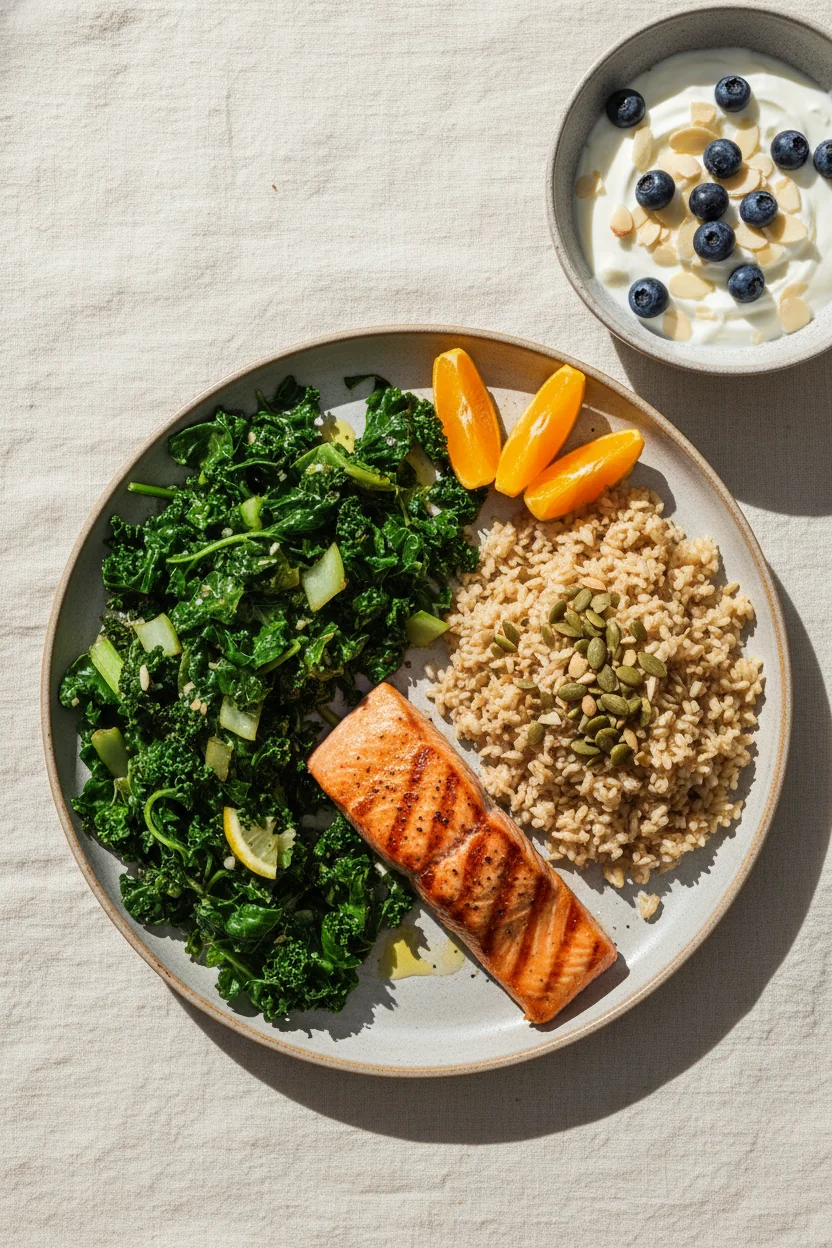
📋 Weekly fresh: 2 dark leafy greens; 1 orange / kiwi / strawberry pack; 1 red bell pepper; 1 banana bunch; 1 sweet potato; 1 portion fatty fish (~200g salmon or 2 cans sardines)
📋 Every two weeks: 1 dozen eggs, plain Greek yogurt, EVOO, toasted sesame, almonds, pumpkin seeds, sauerkraut or kimchi
📋 Pantry (months): dried lentils, brown rice, red dates, goji berries, dried lotus seeds, black sesame
Nothing fancy. Nothing expensive. The pantry items are roughly $30–40 once and last a season. The fresh items are a normal weekly grocery run.
An Eastern Lens — Why a Whole Orange Beats a Vitamin C Tablet
Most of this guide has been Western mechanism with Eastern footnotes. Let me close the loop the other way.
In traditional Vietnamese and Chinese medicine, food carries two things modern nutrition science is still learning to measure: Khí (vital force, what we might now call the metabolic activity of fresh food) and Tinh (essence, the dense nutritional substrate that built the plant or animal in the first place). When you eat a whole orange, you absorb Vitamin C — yes — but you also absorb 60+ flavonoids that protect the C molecule from oxidation, pectin fiber that paces your blood sugar, small amounts of folate and B6, and a complex of minor compounds whose individual effects we are still cataloguing. A 1,000 mg Vitamin C tablet preserves the molecule and discards everything else. The Vietnamese saying is older than the science: thuốc không bằng thực — medicine is not as good as real food.
Three practical implications follow.
Synergy beats isolation. A vitamin in food rides in with cofactors that recycle, protect, and activate it. A vitamin in a tablet rides alone.
Variety beats megadose. Your gut microbiome itself synthesizes Vitamin K2, biotin, and part of your B12 — but only when fed varied fiber. A multi-vitamin pill can’t replicate this. A varied plate can.
How you cook matters as much as what you cook. Light steaming preserves Vitamin C; gentle roasting with fat unlocks A and E from plant cells; soaking grains before cooking reduces phytate that blocks iron. TCM has called this “preserving the Khí of the food” for two thousand years. Western nutrition is now arriving at the same conclusion by a different route.
Thuốc không bằng thực, và thực không bằng thực ăn đúng bộ.
— Mr. Anh, Founder of Essential Wellness AZ
(Medicine is not as good as food, and food is not as good as food eaten in the right combination.)
What I Watched Happen in My Own Circle
A close friend of mine, in his early forties, had been on a stack of five supplements — a daily multivitamin, Vitamin D, B12, magnesium, and a fish oil — for almost two years. About $80 a month. He couldn’t honestly say he felt any different. One evening I asked him: would he commit, for three months, to a deliberate experiment? Keep only the Vitamin D (Arizona winters indoors still need it). Drop everything else. In return, eat in rotation across the five pairs — two leafy greens a week, one orange a day, sardines or salmon twice, eggs most mornings, a small handful of almonds and pumpkin seeds in his yogurt.
Three months in, his report was unspectacular and that was exactly the point: “Energy feels steadier. I don’t crash in the afternoon. Sleep is deeper. I’m not spending the eighty bucks.” That has held for the year since.
I want to be careful with this story. It is one case. It does not mean your case will go the same way. A vegan, a pregnant woman, an older adult with declining intrinsic factor, or someone with a malabsorption condition would have needed supplements regardless of how perfectly they ate. The five-case framework above is exactly the boundary line. Outside the five cases, food-first usually does what supplements promise to. Inside the five cases, food-first runs out of road and supplements take over the rest of the journey.
Frequently Asked Questions
Can I just eat the five pairs and skip supplements completely?
For most healthy adults outside the five cases, yes. For anyone inside the five cases (pregnancy, strict vegan, 60+, northern winter, warfarin), no — those cases need supplements regardless.
How long until I notice a difference from food-first eating?
Four to eight weeks is typical for changes in energy, sleep, skin, and nails. There is no “magic seven days” — that’s marketing. Biology runs on weeks, not on Instagram timelines.
Is a multivitamin harmful?
Not at standard doses. But it can’t replicate the synergy of food (it lacks fiber, flavonoids, the food matrix). Useful as a backstop, not a foundation. The exception: skip it during pregnancy (use a prenatal instead) and skip it if you’re taking individual targeted supplements for a specific deficiency.
Are natural-source vitamins better than synthetic?
For most vitamins, the molecule is identical and your body cannot tell them apart. Three exceptions worth knowing: natural Vitamin E (d-alpha-tocopherol) absorbs roughly 2× better than synthetic dl-alpha; methylated folate works better than folic acid for the ~30–40% of people with MTHFR mutations; methylcobalamin B12 may be preferable to cyanocobalamin for some users. (Full breakdown in our spoke article “Natural vs Synthetic Vitamins.”)
Can I overdose on vitamins from food?
Almost never. Fat-soluble vitamins from supplements (especially A as preformed retinol, D, E, B6) have meaningful Upper Limits and can accumulate to toxic levels if megadosed. Iron supplements are the #1 cause of accidental pediatric poisoning in the U.S. Food rarely gets close to these limits. (See spoke: “Can You Overdose on Vitamins? The UL Guide.”)
Is IV vitamin therapy worth the money?
For most healthy people, no. The marketing exceeds the evidence by a wide margin, and $150–$300 per session adds up fast. It can be genuinely useful for people with severe malabsorption (post-bariatric, IBD flares) where oral routes fail. For everyone else, food and oral supplements do the same work for a small fraction of the cost.
I’m tired all the time. Is it definitely a vitamin issue?
Possibly, but not necessarily. B12, D, iron, and folate are the four most common nutritional causes. But persistent fatigue is also a hallmark of poor sleep, chronic stress, undiagnosed sleep apnea, hypothyroidism, and depression. Try the four-week diet experiment first. If it doesn’t move the needle, get bloodwork. (See spoke: “Fatigue Decoder: Vitamin, Sleep, Stress, or Something Else?”)
How often should I get vitamin blood tests?
Healthy adults with no risk factors: every 2–3 years for a comprehensive panel. Anyone in the five-case bucket (vegan, 60+, pregnant, heavy menses, GI disease, on metformin or PPIs): annually. (See spoke: “When to Test Your Vitamin Levels.”)
The Bottom Line
Three takeaways. That’s it.
1. Your body absorbs vitamins in pairs, not as isolated molecules. Eat in five pair combinations across a normal week and you cover roughly 90% of what a healthy adult needs from food.
2. Five cases need supplements — no negotiation. Pregnancy, strict vegan, adults 60+, northern winter, warfarin users. Outside those five, food-first usually does the work. Inside them, supplements are food-first extended.
3. The fix-window for early shortfall is short and cheap. Most readers are in the 🟡 Subclinical tier without knowing it. Four to eight weeks of synergy-pair eating handles it. Wait two years and the price climbs sharply.
How to Start This Week
Pick Pair 1 and only Pair 1 for the first week. The simplest version: add a squeeze of lemon (or a piece of orange, or a few strawberries) to whatever leafy green you would have eaten anyway, and move coffee at least an hour away from that meal. That single change moves more iron into your bloodstream than any list-based article you’ve read.
Then add Pair 2 the following week. Then 3, then 4, then 5. After five weeks you have a rotating system that runs on autopilot.
Where to Read Next — The Vitamin Cluster Roadmap
This pillar is the root. Deeper articles will branch off it. The ones I would read first, depending on where you are right now:
| If you’re concerned about… | Read next… |
|---|---|
| Your own subtle symptoms | “Subclinical Deficiency: 5 Signs Before Lab Tests Catch Up” |
| Energy crashes | “Fatigue Decoder: Vitamin, Sleep, Stress, or Something Else?” |
| Iron status (women especially) | “Iron-Rich Foods for Women: The 4-Week Recovery Plan” |
| Winter mood + bone health | “Vitamin D + Sunshine: The Complete Guide” |
| Being a vegan or vegetarian | “Vegan Vitamin Survival: B12, D, and Omega-3” |
| Older parents | “B12 Deep Dive: Vegan, Aging, and Medication Users” |
| Pregnancy planning | “Pregnancy Nutrition: The Honest Supplement Guide” |
| Warfarin or anticoagulants | “Vitamin K + Warfarin: Stability Over Avoidance” |
| Reading supplement labels honestly | “How to Read a Vitamin Label: RDA, DV, and UL Decoded“ |
Final note: I trained in traditional Vietnamese medicine. I do not practice clinically. Everything in this pillar is education — reflection on modern research, the framework I grew up with, and the patterns I have watched in my own family and friends. It is not medical advice. If you have a diagnosed deficiency, an autoimmune condition, are pregnant, on blood thinners, or over 60 — anchor your decisions with your doctor or a registered dietitian. This pillar is the soil where the rest of the cluster will grow. Read the spokes as they roll out, and come back to the self-audit every few months to check where you are.
You don’t need to memorize a chart. You need to memorize five pairs. And — just as important — you need to know the five times food cannot do it alone.
— Mr. Anh, Founder of Essential Wellness AZ

About Mr. Anh
We turn solid evidence into everyday habits Americans can actually do—plain English, cups/oz, grocery-aisle swaps, and routines that fit real life. Our editorial process: Experience—we road-test tips in real schedules…