Acupressure for Digestion: 5 Points and a Safe Routine
Learn five traditional acupressure points, what evidence can and cannot establish, and how to try a short, gentle routine safely.
When your stomach feels tight after a meal, it is understandable to want something gentle you can try right away. Acupressure for digestion is a traditional self-care practice in which you use a finger or thumb to press specific points on the body. It may feel calming, and the P6 wrist point has the clearest practical support for nausea. It is not a “reset button,” a cure, or a substitute for medical care.
This guide explains five points commonly used in Traditional Chinese Medicine (TCM), how to locate them, and how to practice without turning traditional theory into a medical promise. The evidence for acupressure varies by symptom and setting, so the point descriptions below separate traditional use from what research can establish.
What Acupressure Can—and Cannot—Do for Digestion
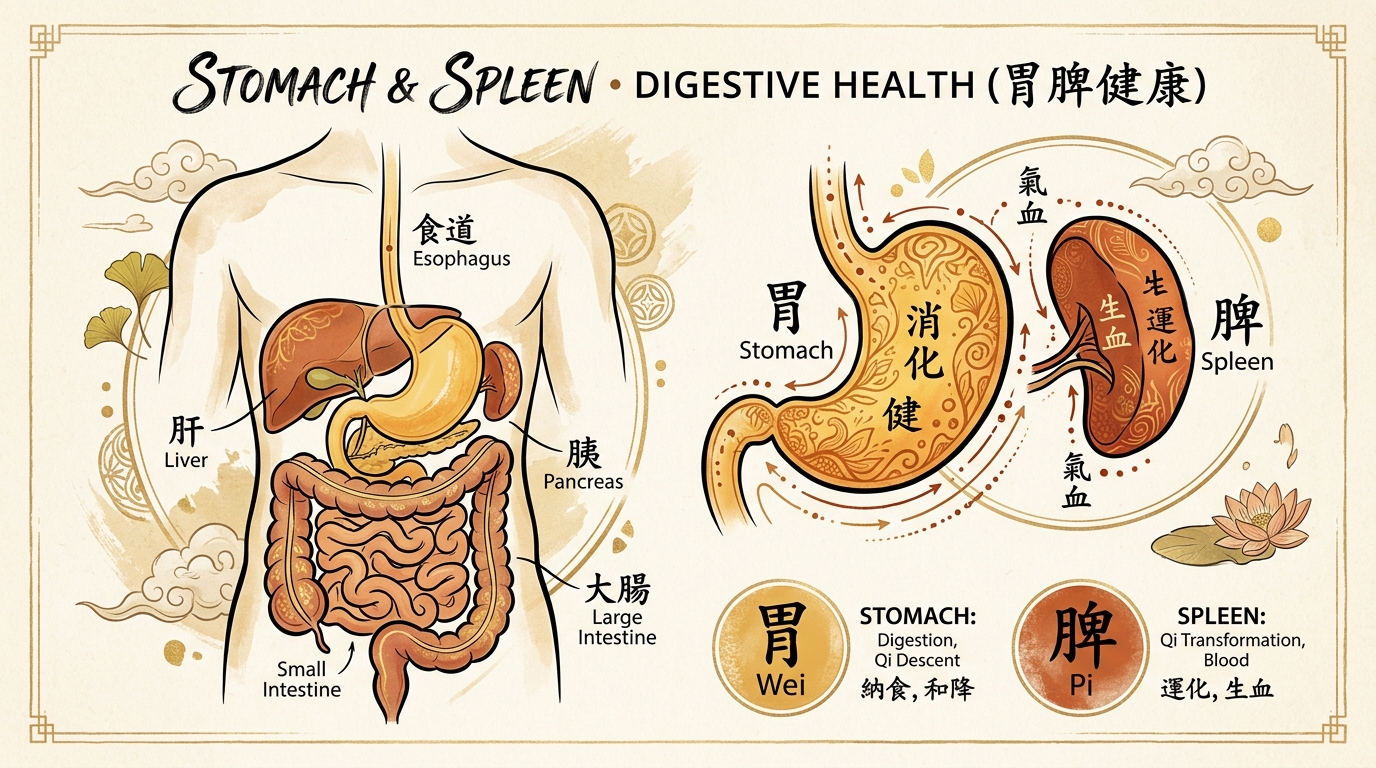
In TCM, digestion is described through the paired functions of the Spleen and Stomach and the movement of qi. These are concepts within a traditional medical system. “Spleen qi deficiency” does not mean that the anatomical spleen has been diagnosed as weak or damaged. Our spleen qi deficiency diet guide explains that distinction in more detail.
Acupressure uses touch rather than needles. People may use it as a complementary comfort practice, but studies of acupuncture, acupressure and different digestive conditions cannot be treated as interchangeable. A review of acupressure after abdominal surgery reported possible benefits for postoperative nausea and vomiting, while also noting substantial risk of bias in the included studies. A newer review of acupuncture for functional gastrointestinal disorders rated the overall certainty from very low to moderate. Neither review proves that pressing the five points on this page will treat everyday bloating, reflux, IBS or abdominal pain.
The clearest self-care guidance concerns P6 for nausea. Memorial Sloan Kettering Cancer Center teaches patients how to locate and press P6, and MedlinePlus describes it as an option that may help mild nausea. Use acupressure alongside appropriate care and prescribed treatment, not in place of them.
A Map of 5 Acupressure Points for Digestion
| Point | Where it is | Traditional use | Practical caution |
|---|---|---|---|
| ST36 (Zusanli) | Below the knee, beside the shinbone | Digestive support and general vitality | Do not claim it “boosts” an organ or cures fatigue |
| CV12 (Zhongwan) | Upper abdomen on the midline | Fullness and upper-abdominal discomfort | Avoid deep abdominal pressure and do not use it for unexplained acute pain |
| ST25 (Tianshu) | On either side of the navel | Bowel regularity | It is not proven to “switch” diarrhea or constipation on and off |
| P6 (Neiguan) | Inner forearm between two tendons | Nausea and queasiness | Best-supported point here, but it does not replace anti-nausea treatment |
| SP6 (Sanyinjiao) | Inner lower leg above the ankle | Abdominal and digestive complaints | Skip during pregnancy unless a qualified clinician specifically advises it |
Finger-width measurements are approximate because hands and bodies differ. If you need precise point location for treatment, ask a licensed acupuncturist rather than relying on a web diagram.
1. Zusanli (ST36): below the knee
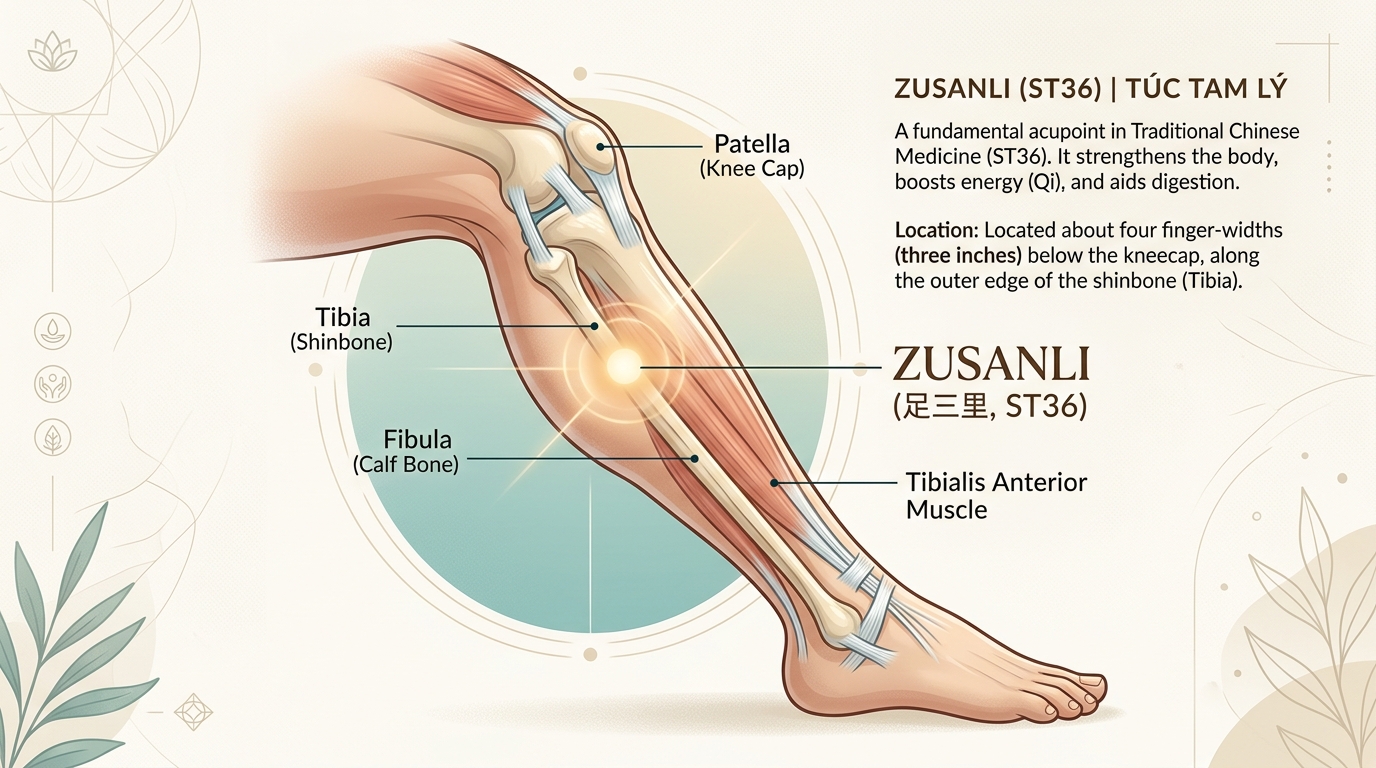
Sit with your knee bent. Place four fingers across the leg just below the kneecap, then move toward the outside of the shinbone. ST36 is commonly described in the muscle beside the tibia. Traditional practice associates this point with digestion and general vitality. That tradition does not establish that pressing it improves nutrient absorption, raises “Spleen qi,” or treats a digestive disease.
Use the pad of your thumb to apply comfortable pressure for 30 to 60 seconds, release, and repeat once or twice. Try the point on both legs. If you feel numbness, sharp pain or tingling traveling down the leg, stop and reposition or skip it.
2. Zhongwan (CV12): the upper abdomen
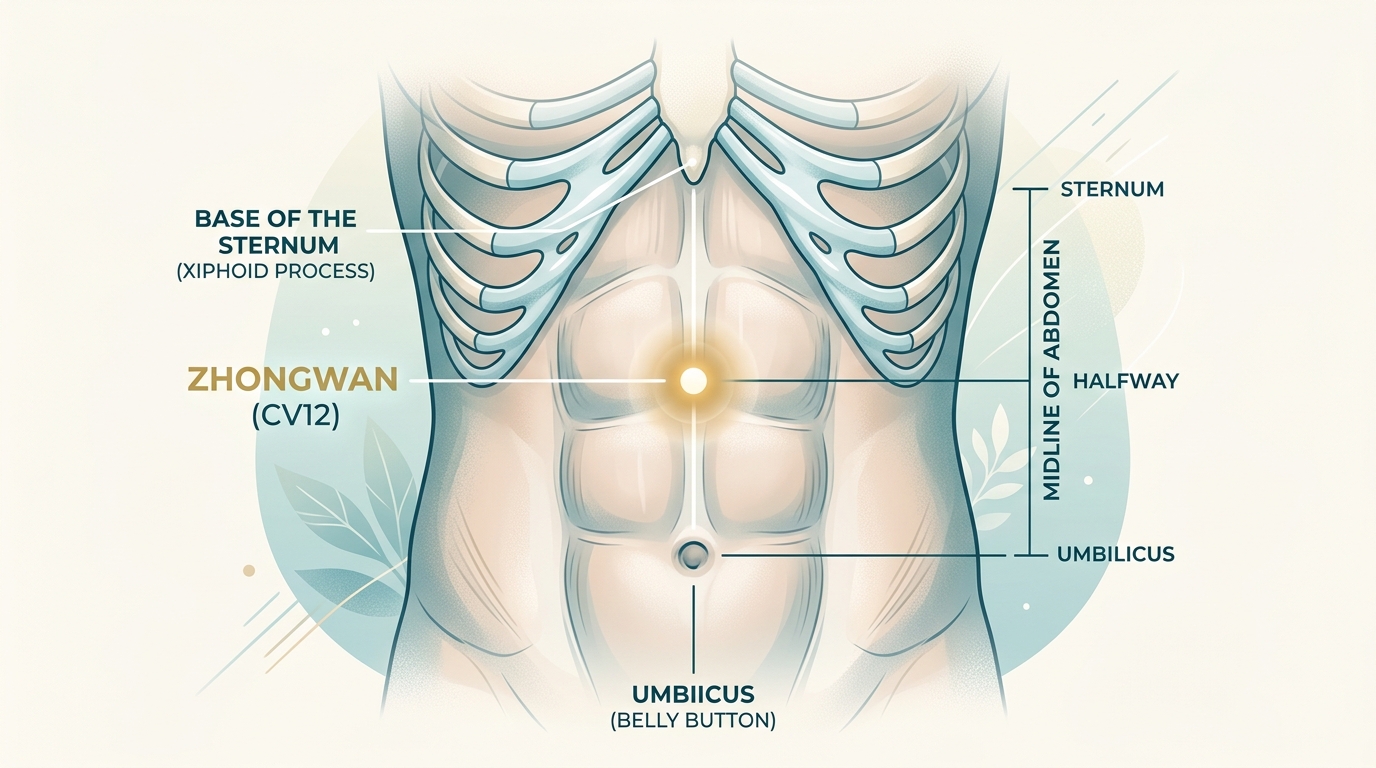
CV12 is on the midline of the upper abdomen, approximately halfway between the navel and the lower end of the breastbone. It is traditionally selected for fullness and discomfort in the upper abdomen.
Use only light, comfortable contact here. Do not press deeply after a large meal or on a painful, swollen or tender abdomen. Sudden or severe abdominal pain needs assessment; it is not a cue to press harder. If you are pregnant, have had recent abdominal surgery, have a hernia or have been told to avoid abdominal massage, skip abdominal points unless your clinician says they are appropriate.
3. Tianshu (ST25): beside the navel
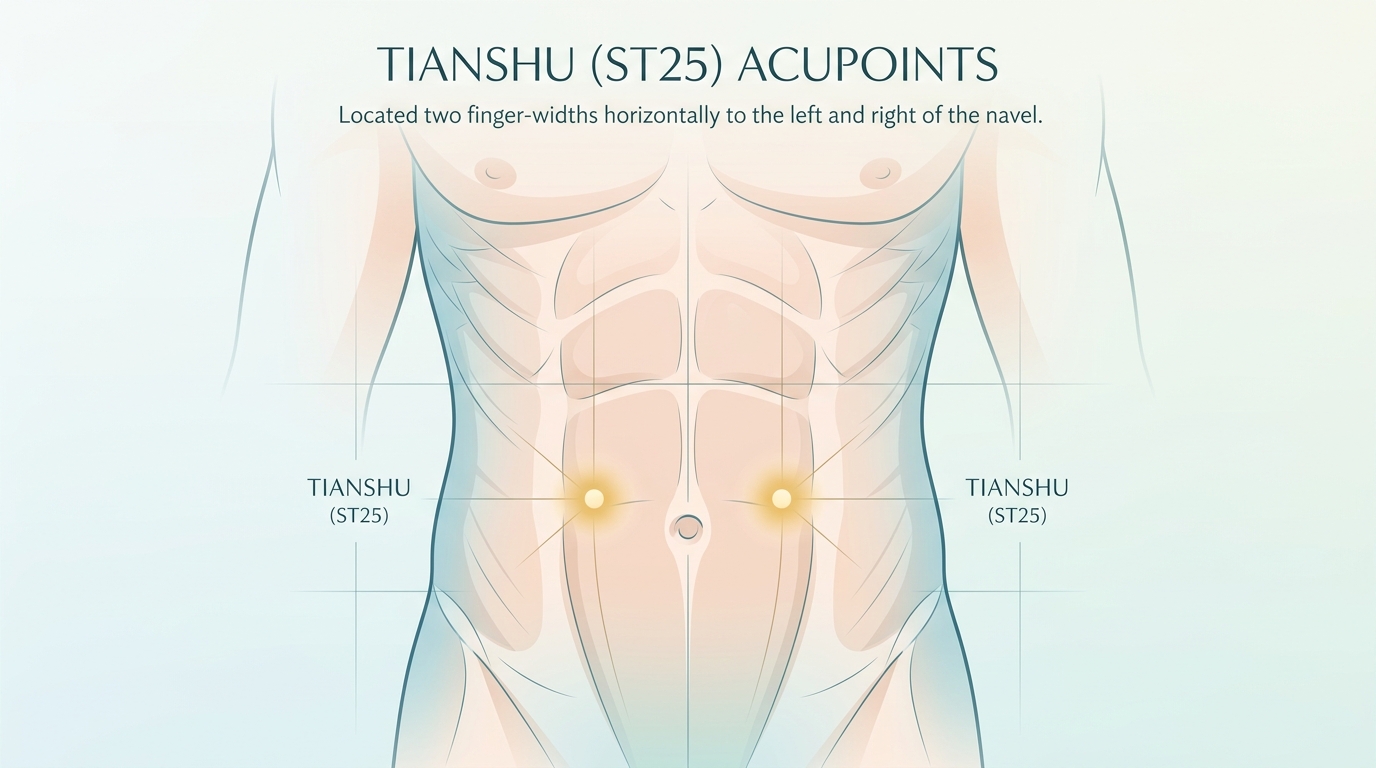
ST25 is found on both sides of the navel, about two thumb-widths away in many self-care descriptions. TCM traditionally connects the point with bowel function. It is more accurate to present this as traditional use than to call ST25 a regulator proven to stop diarrhea or trigger a bowel movement.
Rest two or three fingertips over one side and make small circles with gentle pressure for 30 to 60 seconds. Repeat on the other side. For constipation, acupressure should not delay basics such as reviewing fluids, food, activity and medications with an appropriate professional. Our guide to food guide for constipation offers a broader starting point.
4. Neiguan (P6): the nausea point on the wrist
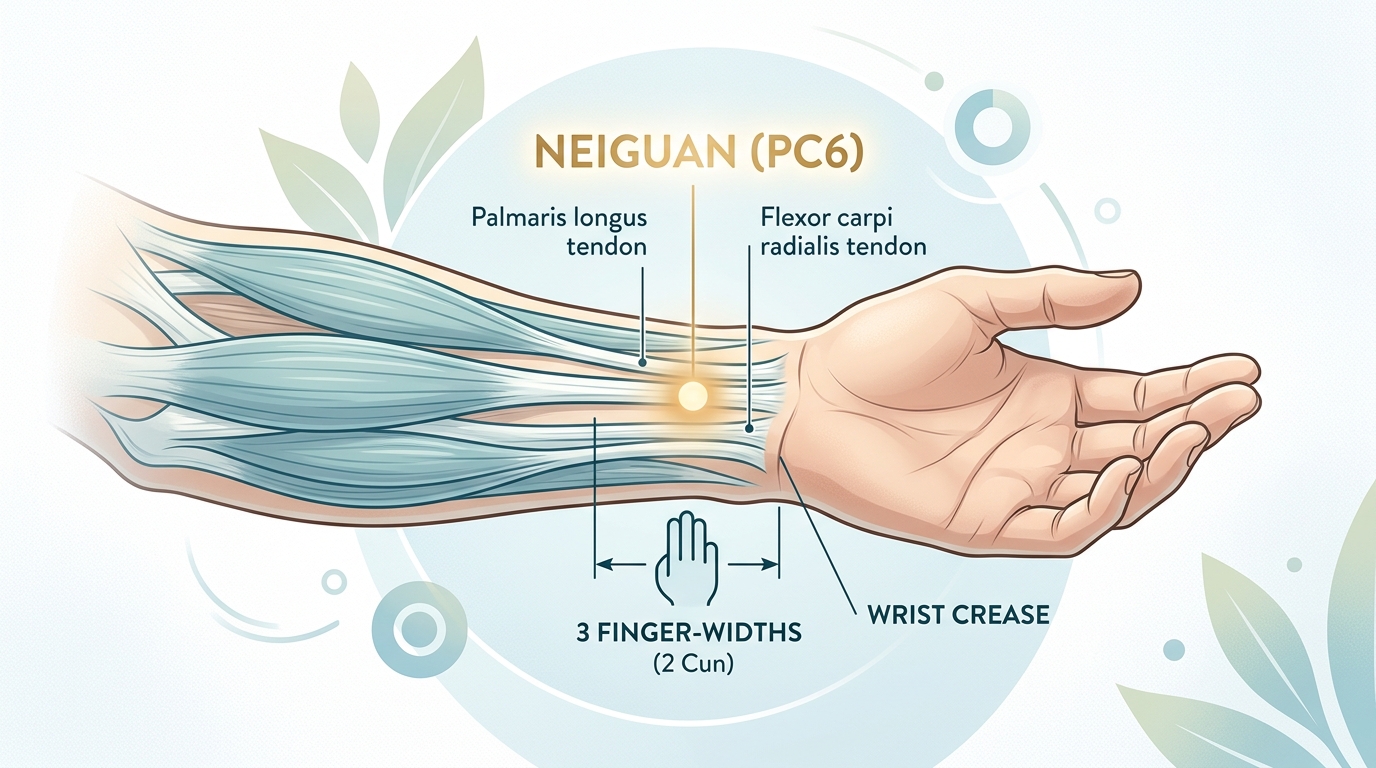
Turn one palm toward you. Place the first three fingers of your other hand across the wrist just below the wrist crease. Put your thumb below the index finger, between the two prominent tendons. This is P6.
Press with your thumb and make slow circles for two to three minutes, then repeat on the other wrist. Firm pressure is fine; pain means you are pressing too hard. P6 is the point in this guide with the most direct patient-facing support for nausea, including guidance from Memorial Sloan Kettering and MedlinePlus. Evidence in one setting does not prove it will resolve every cause of nausea.
5. Sanyinjiao (SP6): above the inner ankle
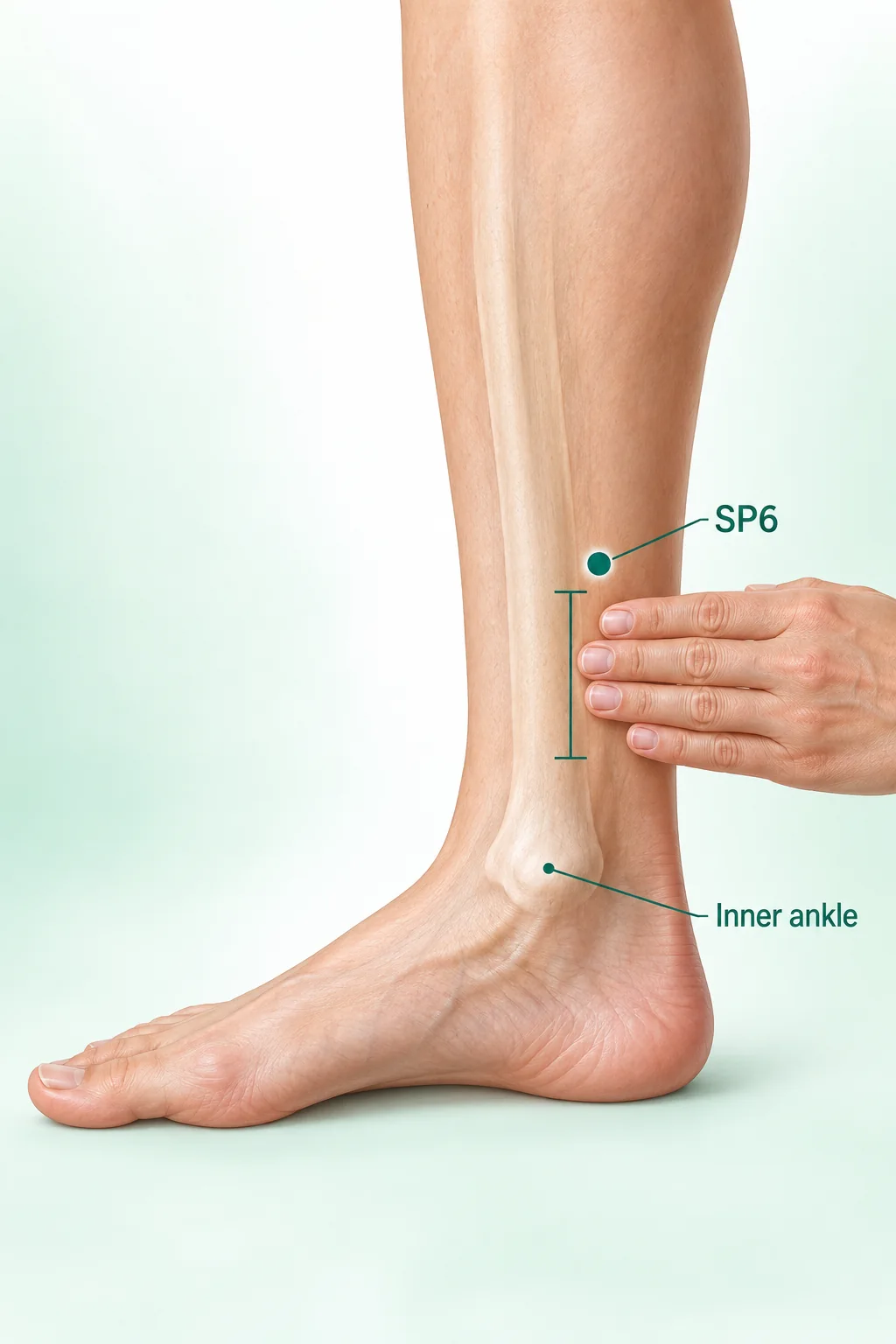
Find the highest point of the inner ankle bone. Place four fingers above it, then feel just behind the inner edge of the shinbone. SP6 is traditionally used for abdominal, digestive and gynecologic concerns, but this article does not claim that self-pressure at SP6 treats those conditions.
Apply gentle pressure for 30 to 60 seconds and repeat on the other leg. Because SP6 is also traditionally used in obstetric contexts, avoid self-stimulating it during pregnancy unless your qualified healthcare professional has specifically advised you to do so.
A Gentle 5-Minute Acupressure Routine
- Pause and check the symptom. If it is sudden, severe or accompanied by a red flag listed below, seek care instead of beginning the routine.
- Start with P6. Press each wrist for one minute while breathing normally.
- Choose one non-abdominal point. Try ST36 or SP6 for 30 to 60 seconds on each side.
- Add abdominal touch only if it feels appropriate. Use light contact at CV12 or ST25; never force pressure into a tender abdomen.
- Stop and record what happened. Note the symptom, the point, the duration and whether you felt better, the same or worse. A single change helps you observe without calling the result proof.
You do not need to press every point. One or two comfortably located points are enough for a first session. There is no evidence-based rule in the sources here that clockwise circles are universally better than counterclockwise circles. Comfort and safety matter more than direction.
Safety: When to Skip Acupressure
Acupressure is generally a low-intensity touch practice, but “natural” does not mean suitable for every situation.
- Do not press over an open wound, rash, blister, infection, swelling or irritated skin. Memorial Sloan Kettering gives the same precautions for P6.
- Avoid IV lines, PICC lines, recent surgical sites, fractures, blood clots or areas where a clinician has told you not to massage.
- Use less pressure if you bruise easily, take blood-thinning medication or have reduced sensation. Ask your clinician when unsure.
- Skip abdominal pressure during pregnancy, after recent abdominal surgery, or when the abdomen is acutely painful or swollen unless a qualified professional has cleared it.
- Do not stop prescribed medication or delay diagnostic care because acupressure temporarily changes how you feel.
Seek urgent medical help for vomiting blood, vomit that looks like coffee grounds, black or tarry stool, fainting, confusion or severe ongoing abdominal pain. Constipation with constant abdominal pain, inability to pass gas, vomiting, fever or unintentional weight loss also needs prompt medical attention. Persistent indigestion, trouble swallowing, frequent vomiting or unexplained weight loss should be discussed with a healthcare professional.
How to Combine Acupressure With Everyday Digestive Care
Acupressure is one optional layer. Your meals, symptom pattern, activity, sleep, medications and diagnosed conditions may matter more. If bloating is your main concern, begin with our guide to bloating after eating. For a wider framework, use the food-first gut health guide.
Try pairing one acupressure session with one familiar meal rather than creating a complicated wellness routine. If you are testing cooked food ideas, the guides to foods for gut health and cooked versus raw foods can help you make a practical choice without assuming one temperature or food fixes every digestive problem.
Frequently Asked Questions
Which pressure point is best for nausea?
P6 on the inner wrist has the strongest practical support among the five points in this guide. It may help some people with nausea, but it cannot identify or treat the cause. Repeated vomiting, dehydration, blood or severe pain needs medical care.
Can acupressure relieve bloating immediately?
Some people may feel calmer or more comfortable after gentle touch, but the evidence here does not support promising immediate bloating relief. Bloating has many possible causes, and temporary comfort does not show that the cause has been corrected.
How hard should I press?
Use firm but comfortable pressure. A mild ache or tenderness can occur, but sharp pain, numbness or worsening discomfort means stop. More pressure is not necessarily more effective.
How often can I use these points?
For a cautious start, try one short session and note how you respond. P6 patient guidance commonly uses two to three minutes per wrist and allows repetition during the day. There is no single researched schedule that applies equally to all five points and all digestive symptoms.
Does acupressure treat IBS, reflux or constipation?
This article does not establish acupressure as a treatment for those conditions. Research varies by method and diagnosis, and acupuncture trials are not direct proof of self-administered pressure. Use acupressure as optional complementary self-care and follow medical advice for a diagnosed condition.
Your Next Step
Choose one point that matches your situation and is safe for you to touch. Record the symptom, press gently for the suggested time, and note the result. If the symptom keeps returning, use the note to support a conversation with a qualified healthcare professional rather than adding more points or more pressure.
Health disclaimer: Mr. Anh was trained in traditional medicine in Vietnam but is not currently practicing medicine. This article is for education and general self-care information. It does not diagnose a TCM pattern, treat a digestive disease or replace care from a licensed healthcare professional.
References
- World Health Organization: Standard Acupuncture Nomenclature
- NCCIH: Acupuncture—Effectiveness and Safety
- NCCIH: Traditional Chinese Medicine—What You Need To Know
- Memorial Sloan Kettering Cancer Center: Acupressure for Nausea and Vomiting
- MedlinePlus: Nausea and Acupressure
- Liu et al.: Systematic review of acupressure for postoperative gastrointestinal symptoms
- Wan et al.: Systematic review of acupuncture for functional gastrointestinal disorders
- NIDDK: Symptoms and Causes of Constipation
- NIDDK: Symptoms and Causes of GI Bleeding
- NIDDK: Diagnosis of Indigestion

About Mr. Anh
We turn solid evidence into everyday habits Americans can actually do—plain English, cups/oz, grocery-aisle swaps, and routines that fit real life. Our editorial process: Experience—we road-test tips in real schedules…