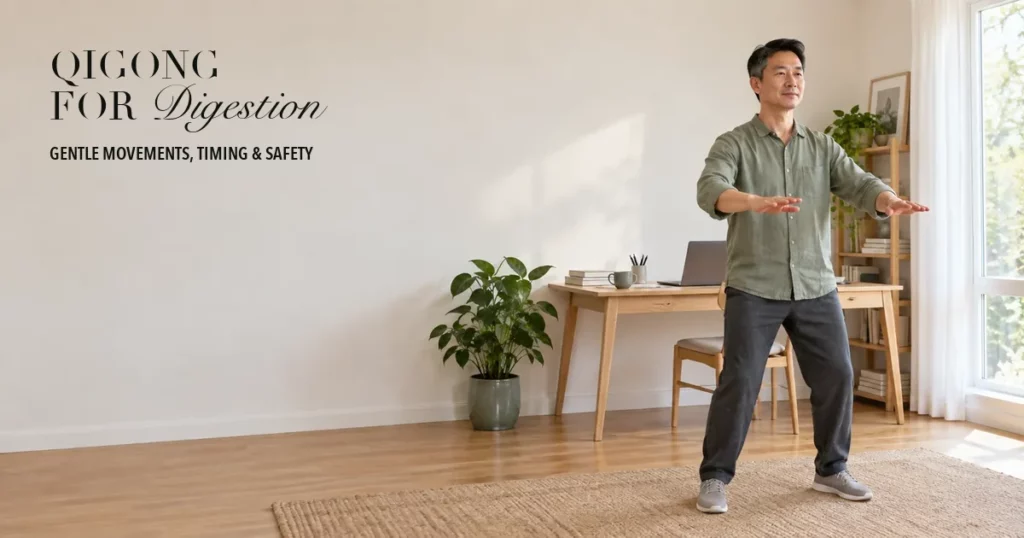
Qigong for Digestion: Gentle Movements, Timing, and Safety
Try a gentle two-minute seated qigong practice or an eight-minute beginner routine, with honest evidence limits, meal timing options, and clear reasons to stop.
- Can Qigong for Digestion Actually Help? The Honest Answer
- Start Here: A Two-Minute Seated Qigong Practice
- An Eight-Minute Beginner Qigong for Digestion Routine
- When Should You Practise Around Meals?
- What to Notice Without Turning It into a Diagnosis
- Qigong Safety: When to Modify, Stop, or Get Help
- Frequently Asked Questions
- The Bottom Line
- References
Editorial note: This guide is educational and describes a gentle mind-body practice. It is not personal medical advice or a substitute for appropriate care.
Affiliate disclosure: This article contains no affiliate links.
You want something gentler than a workout after lunch, so you search for qigong for digestion. Then the promises pile up. One movement will “wake up” your digestion. Another will massage your organs or flip on your vagus nerve.
The moves look approachable. The explanations often run well ahead of the evidence.
So let’s slow this down. You’ll get a two-minute seated practice, an eight-minute beginner routine, sensible options around meals, and clear reasons to stop. You’ll also see what the research can—and can’t—support. No mat, special clothes, or perfect breathing required.
Quick takeaways
- Qigong commonly combines posture, gentle movement, breathing, and focused attention.
- Research specific to digestive symptoms remains limited.
- Start with the two-minute seated version and keep every breath unforced.
- Do not work through pain, dizziness, nausea, or worsening symptoms.
- Persistent or concerning digestive symptoms need proper assessment, not another exercise routine.
Can Qigong for Digestion Actually Help? The Honest Answer
The honest answer is that we don’t know yet. There isn’t enough direct evidence to say a short qigong routine improves bloating, constipation, reflux, IBS, or another digestive problem. You can still use qigong as a gentle mind-body activity if it feels comfortable and fits your circumstances.
The National Center for Complementary and Integrative Health describes qigong as a practice involving the regulation of the mind, breath, movement, and posture. Movements are usually gentle and smooth. Some forms are active. Others use almost no body movement and can be practised in a position you can maintain.
A systematic review of exercise for IBS included walking, yoga, tai ji, and Baduanjin qigong among 14 trials. Exercise looked promising overall, but the studies carried a high risk of bias. The authors couldn’t draw firm conclusions. And because those trials mixed several activities, they can’t validate the short sequence on this page.
There’s another easy trap here. The Prolong Life With Nine Turn Method paper is a research protocol involving people with chronic fatigue syndrome. At publication, the analysis wasn’t complete. A protocol tells us what researchers plan to test. It doesn’t tell us that the method worked.
Two different lenses
| Traditional qigong and TCM lens | Biomedical evidence lens |
|---|---|
| Traditional teaching may describe the practice through Qi and the functions of the Spleen and Stomach. These ideas belong to a traditional system. | Research assesses a defined routine, population, comparison, and measurable outcome. Current evidence does not establish that the movements below change digestive function. |
The vagus nerve does matter in brain–gut communication, as this review of vagal pathways explains. But a plausible pathway isn’t proof that belly breathing or an arm movement changes digestion. Here, breath is part of the practice—not a shortcut to a medical conclusion.
My training in traditional medicine makes this distinction especially important to me. Traditional language can be useful when it is clearly labeled. It becomes misleading when we quietly turn it into a claim about anatomy.
Start Here: A Two-Minute Seated Qigong Practice
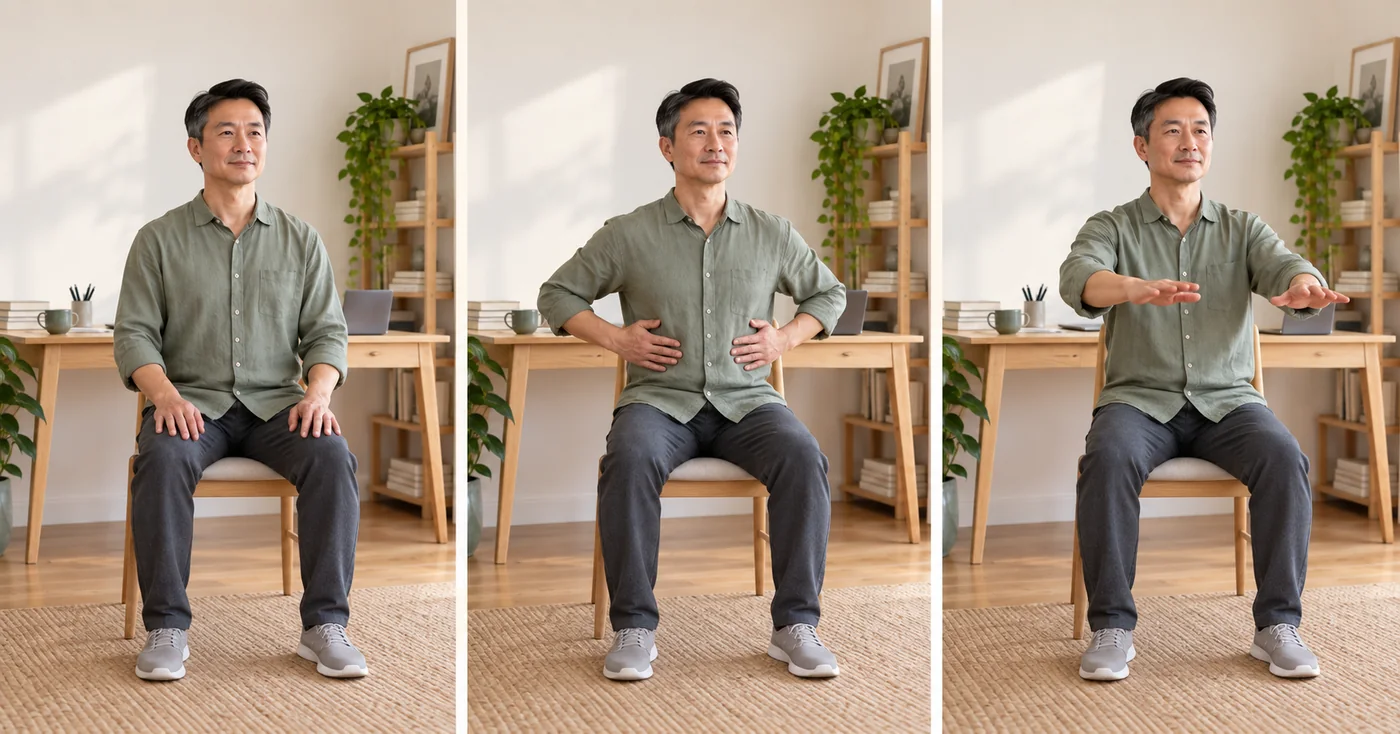
Start small. This beginner adaptation uses posture, comfortable breathing, and slow movement. Choose a stable chair without wheels. Plant both feet, and use the chair back if sitting upright makes you less comfortable.
Step 1: Settle into the chair — 30 seconds
Rest your hands on your thighs. Unclench your jaw. Let your shoulders drop as far as feels natural. You’re not posing for a posture photo. There’s no need to pull them back or hold your spine perfectly straight.
Breathe normally. Notice the support under your feet and seat. If you feel dizzy, faint, unsteady, or more nauseated, stop here.
Step 2: Use an easy lower-rib breath — 45 seconds
Keep your hands on your thighs or lower ribs. Let the ribs and abdomen move on their own. Don’t deliberately push the belly out, squeeze it in, hold your breath, or chase a target count.
Step 3: Let your hands rise and fall — 45 seconds
Turn your palms slightly upward. On a comfortable inhale, float your hands toward the lower chest. On the exhale, turn the palms down and let them drift toward your thighs.
Use a smaller range if your shoulders feel tight. Finish with your hands on your thighs and notice whether you feel steady.
That’s the whole two-minute version. It’s a mindful-movement break, not a proven answer to a digestive symptom. Its first test is much simpler: can you do it comfortably, and will it fit into a real day?
An Eight-Minute Beginner Qigong for Digestion Routine
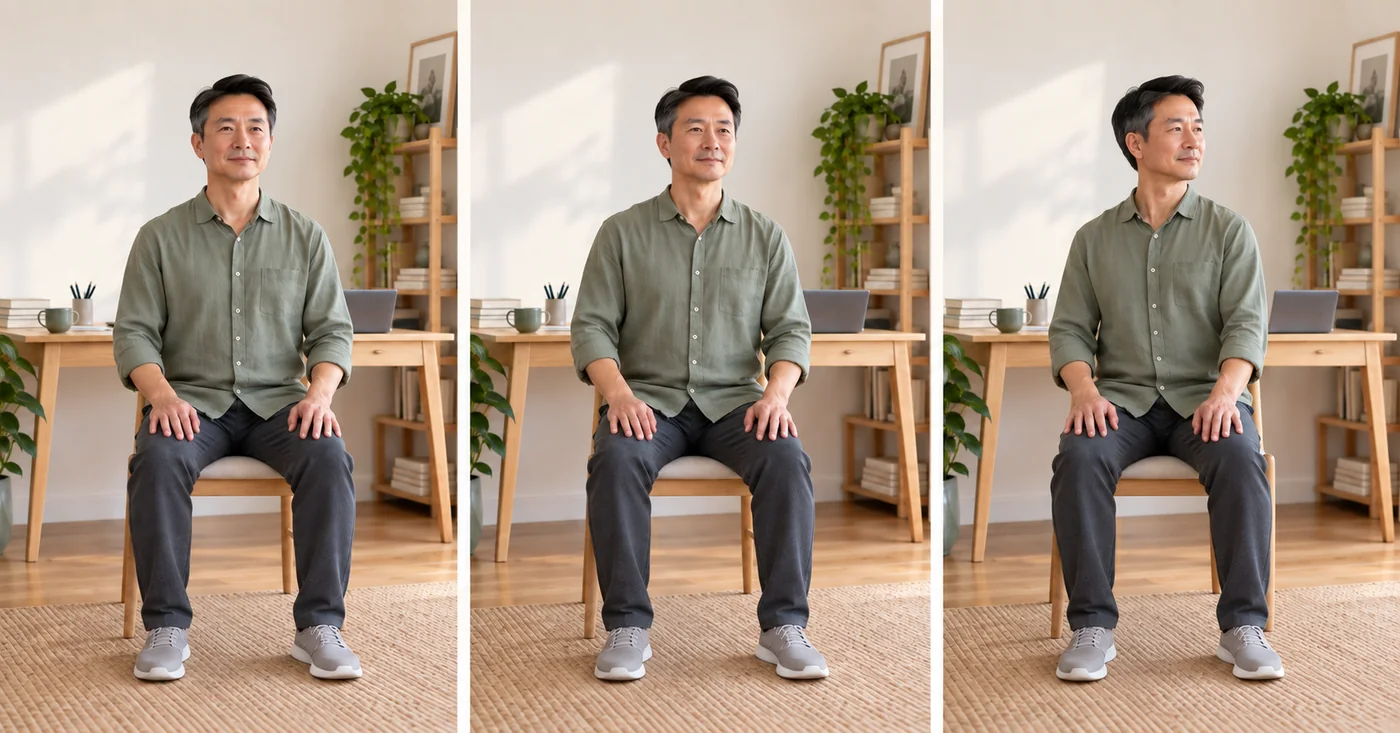
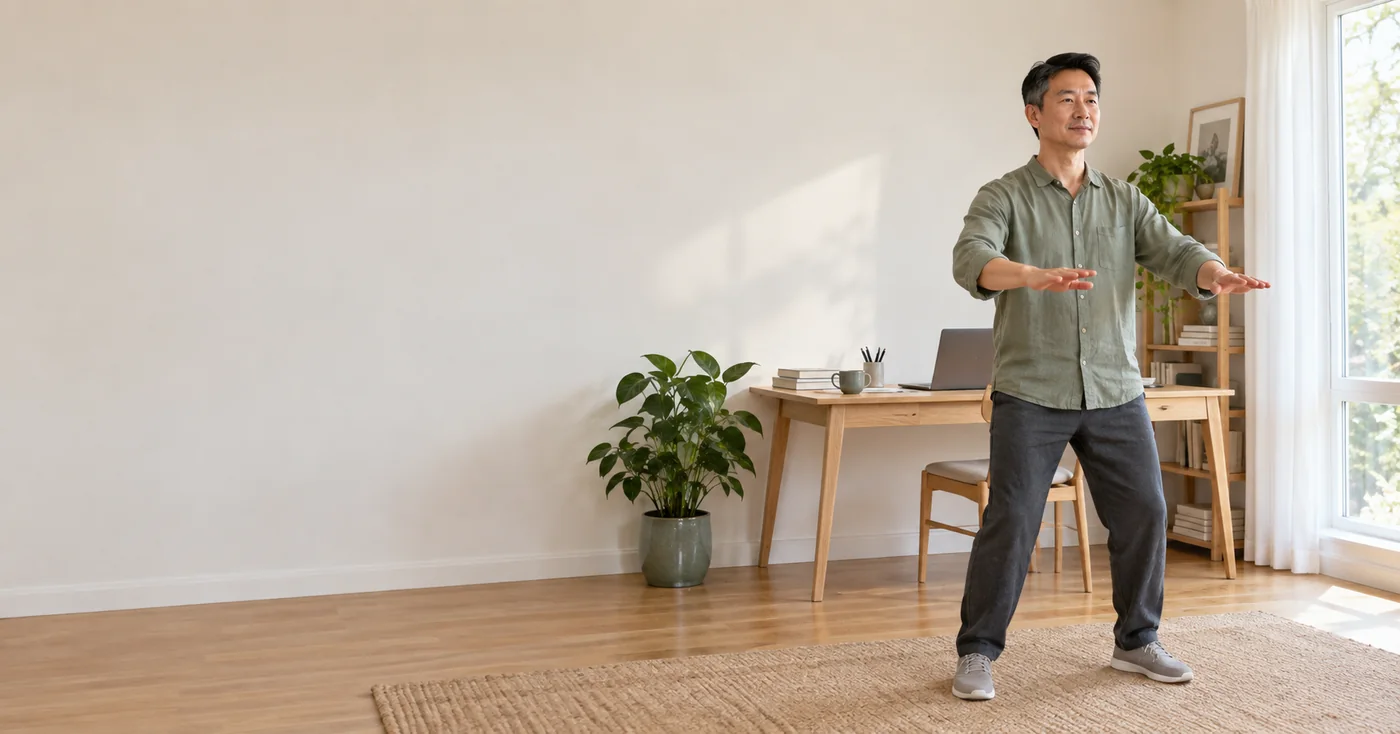
Ready for a little more? The longer version builds on the same pattern, either seated or standing. Use support whenever you need it. “For digestion” describes why you came here; it doesn’t turn the sequence into a digestive protocol.
1. Arrive in stillness — about 1 minute
- Start position: Sit with both feet supported, or stand with your feet at a comfortable width and knees unlocked.
- Motion: Make small adjustments and release unnecessary effort.
- Breath: Let it move naturally. Do not force depth or pace.
- Duration: About one minute, or less if uncomfortable.
- Seated option: The seated version is already complete; no extra movement is required.
- Stop or skip: Stop if you feel unstable, dizzy, faint, or in pain.
Traditional qigong may call a quiet standing position wuji. Mastery is not required here.
2. Raise and lower the hands — about 90 seconds
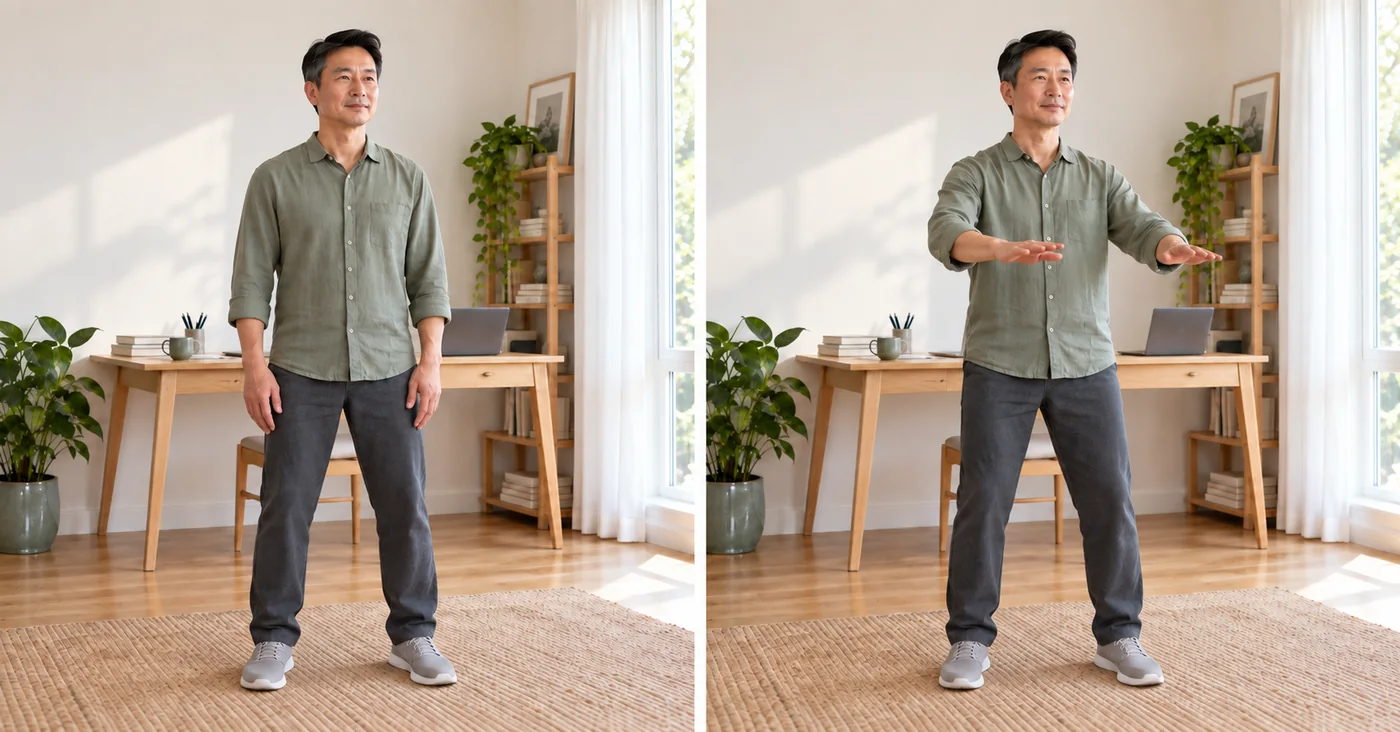
- Start position: Let your arms rest by your sides, or place your hands near your thighs when seated.
- Motion: Float both hands forward comfortably, then turn the palms down and lower them.
- Breath: Rise on an easy inhale and lower on an easy exhale, or let breath run independently.
- Duration: Continue slowly for about 90 seconds.
- Seated option: Use the same arm path with both feet supported.
- Stop or skip: Reduce the height or stop if your shoulders, neck, or back hurt.
Keep it quiet and smooth. Waist height still counts.
3. Shift gently from side to side — about 90 seconds
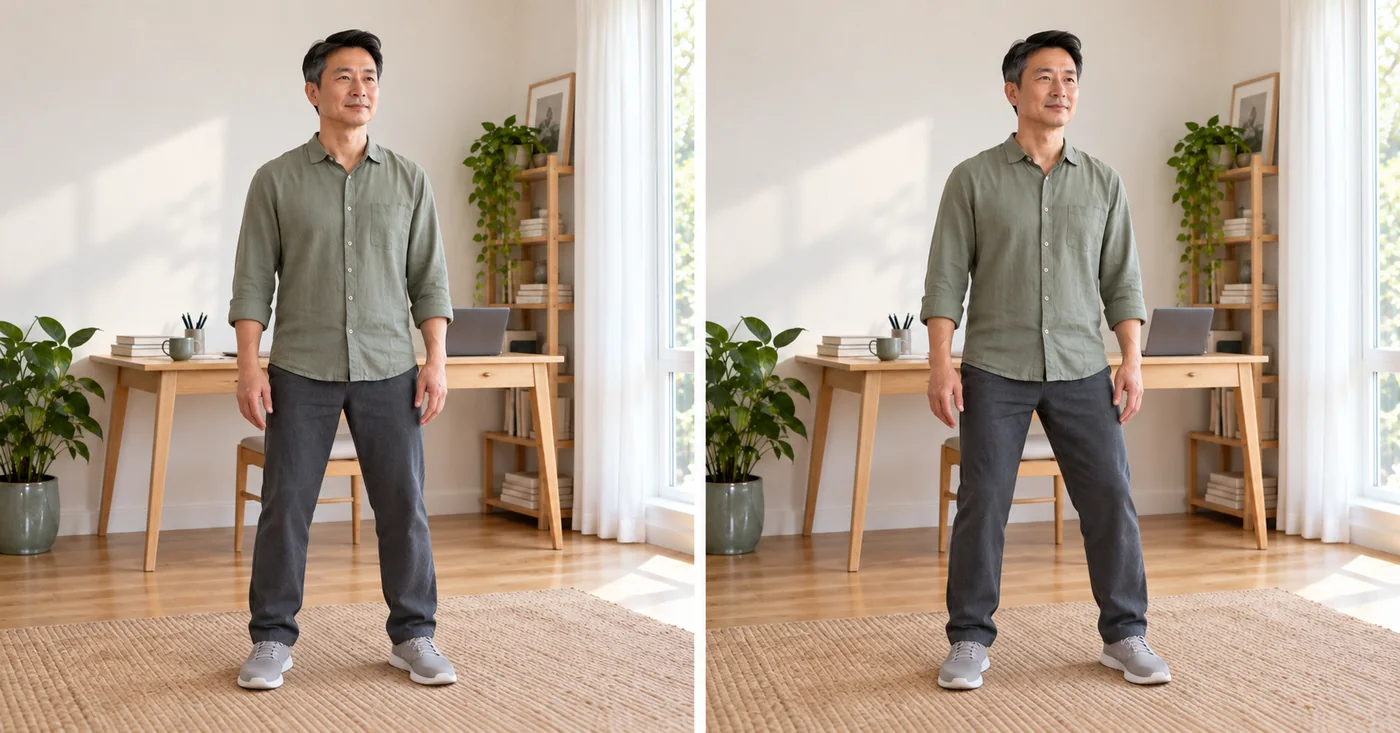
- Start position: Stand with a chair within reach, or sit toward the middle of a stable seat.
- Motion: Shift slightly to one side, return to center, then change sides.
- Breath: Keep breathing normally. Avoid holding your breath as you move.
- Duration: Alternate sides for about 90 seconds at an unhurried pace.
- Seated option: Shift gently from one sitting bone to the other.
- Stop or skip: Stop if the movement affects your balance or produces hip, back, or abdominal pain.
Think of this as a balance and awareness movement. It isn’t a way to push gas or stool.
4. Make small waist turns — about 90 seconds
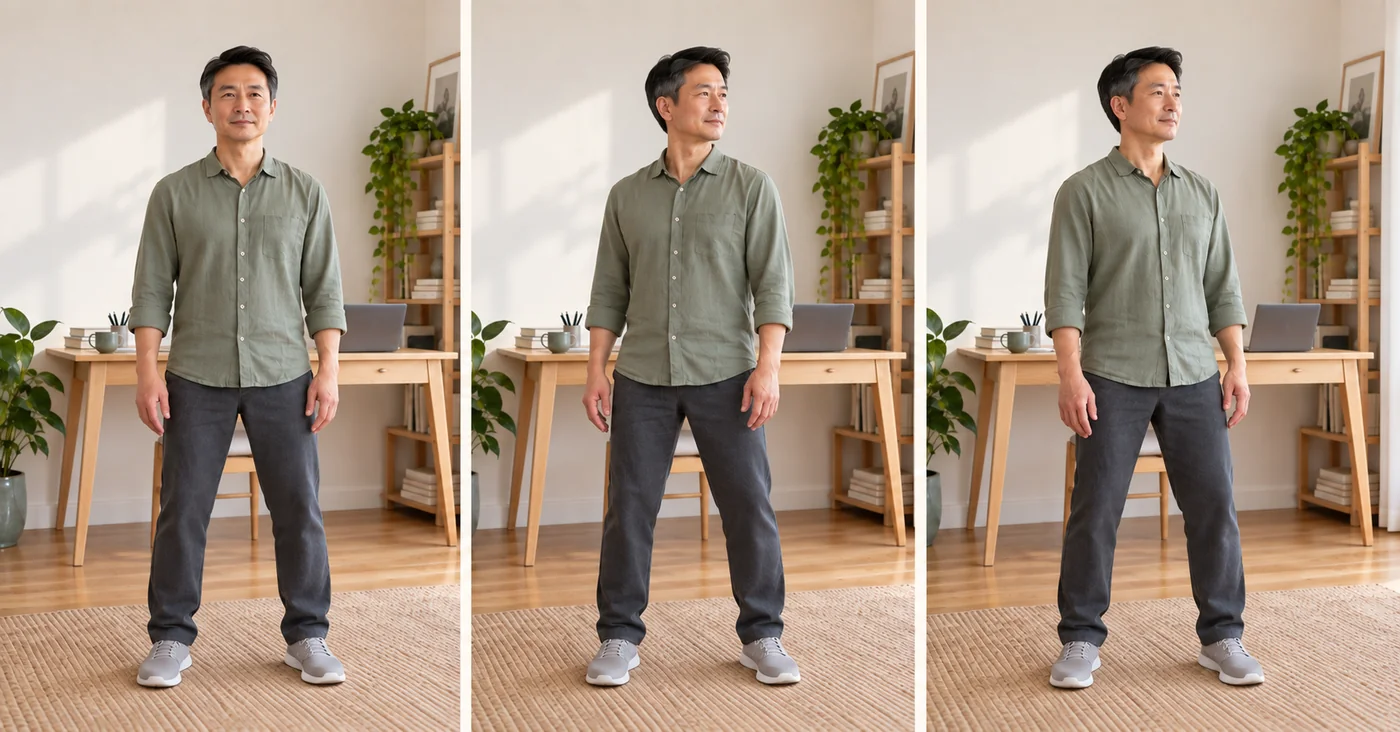
- Start position: Let your arms hang loosely while standing, or rest your hands on your thighs while seated.
- Motion: Turn slightly left, return to center, then turn right.
- Breath: Exhale or inhale as comfortable. Never force the breath to match the turn.
- Duration: Continue for about 90 seconds.
- Seated option: Make a smaller rotation and keep both feet supported.
- Stop or skip: Skip rotation if it conflicts with guidance following surgery or injury. Stop if it creates pain, pressure, dizziness, or nausea.
You may have seen twisting compared with wringing out a sponge or massaging the organs. It’s a memorable picture, but it isn’t a demonstrated mechanism. Use the turn as a gentle movement—not as an attempt to manipulate your intestines.
5. Gather and close — about 2½ minutes
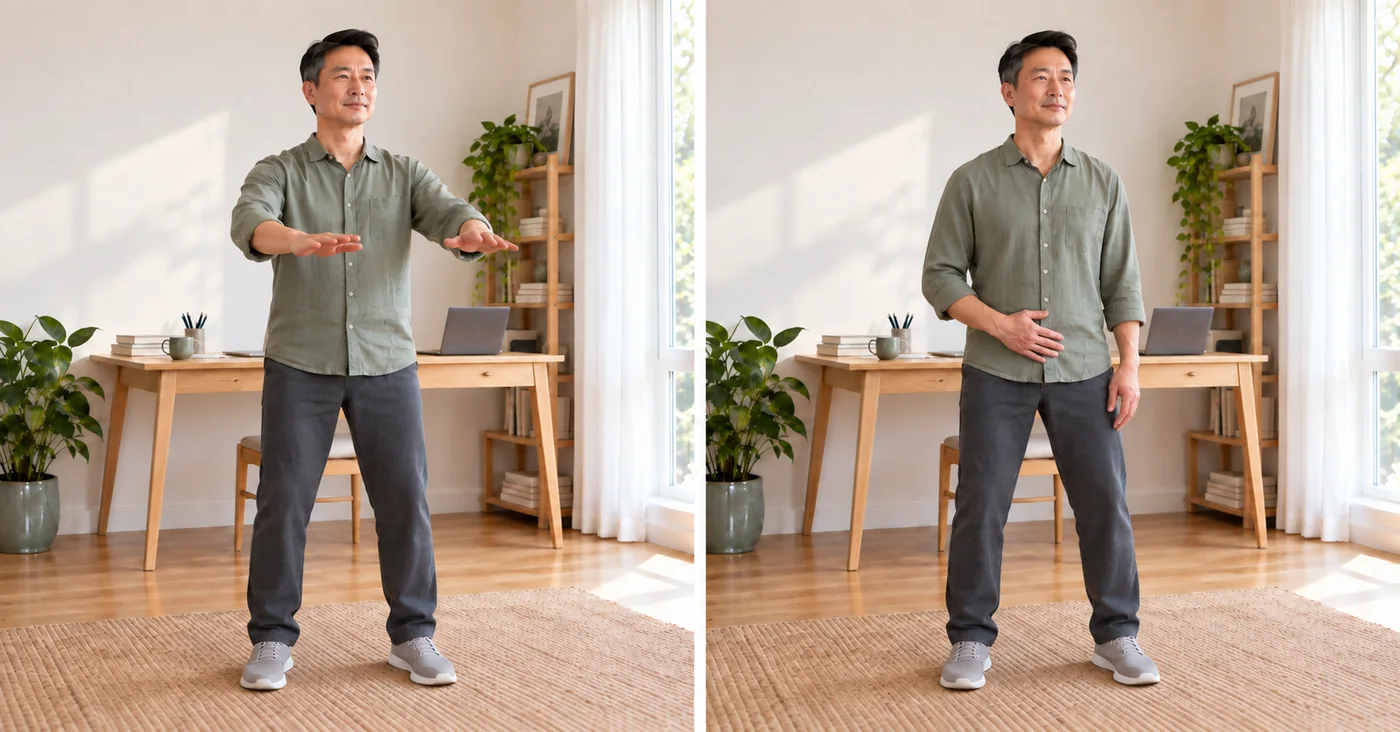
- Start position: Return to a neutral seat or easy standing position.
- Motion: Repeat small hand rises and falls, then gradually come to rest.
- Breath: Keep it quiet and unforced.
- Duration: Up to 2½ minutes, including brief stillness.
- Seated option: Keep your hands on your thighs for the final few breaths.
- Stop or skip: End immediately if stillness or focused breathing makes you feel unwell.
You may rest a hand lightly over the lower abdomen as a pressure-free traditional closing gesture, not massage.
When you finish, ask three plain questions: Do I feel steady? Was anything uncomfortable? Would a smaller version fit better next time? A bowel movement is not the pass–fail test.
When Should You Practise Around Meals?
This is where online advice gets oddly confident. Some traditional teachers say to practise directly after eating. Other wellness pages tell you to wait a fixed number of minutes. There is no well-established universal schedule for qigong and digestion.
Use comfort and common sense to choose the shorter or longer version.
| Situation | Practical option | Useful modification | What it does not mean |
|---|---|---|---|
| Before a meal | Try either version if you feel well | Keep the pace easy | The practice prepares your organs or increases nutrient absorption |
| Shortly after a light meal | Choose the seated version or quiet standing if comfortable | Use smaller motions and no abdominal pressure | Directly after eating is medically best |
| After a large meal or marked fullness | Wait until movement feels comfortable | Avoid deep bends, forceful twists, or compressed positions | Everyone needs the same waiting period |
| Between meals | Use either version | Choose sitting or standing based on balance and energy | An empty stomach makes qigong more effective |
| Active pain, vomiting, inability to pass gas, or worsening symptoms | Do not use the routine to troubleshoot the problem | Seek appropriate advice | Qigong can clear an obstruction |
If you feel pleasantly settled afterward, write that down. Just don’t turn one good session into proof that the routine changed your digestion.
Walking is a separate activity with its own pace and safety questions. For a broader view beyond this routine, see these everyday ways to improve gut health.
What to Notice Without Turning It into a Diagnosis
Memory gets fuzzy fast. A short note helps you remember what actually happened. It can’t show that qigong caused a change because meals, stress, sleep, medication, illness, and ordinary day-to-day variation may all play a part.
Use one line after the practice:
| Time and meal context | Version used | Comfort before | Comfort after | Other context |
|---|---|---|---|---|
| 1:15 p.m.; lunch 30 minutes earlier | 2-minute seated | Write what you noticed | Write what you noticed | Sleep, stress, unusual food, or another relevant detail |
Start by measuring usability, rather than chasing a result:
- Was the routine comfortable?
- Could you breathe without force?
- Did you need the seated modification?
- Would two minutes fit more reliably than eight?
- Did anything feel worse during or after the practice?
You don’t need to score your “Qi” or decide whether your Spleen is stronger. And don’t repeat a movement that hurt simply to test it again.
If you want one place to keep meals and workday symptoms together, use the free 5-Day Workday Gut Trigger Journal. Five days may reveal details you would otherwise forget. It still can’t diagnose a condition or prove that one movement caused a change.
Food context may be especially useful if you are also exploring a spleen qi deficiency diet. Keep the two ideas separate: one page explains a traditional food framework; this page focuses on gentle movement and honest observation.
Qigong Safety: When to Modify, Stop, or Get Help
NCCIH says qigong appears generally safe. Studies that reported unwanted effects included examples such as muscle pain, soreness, and headache. Generally safe doesn’t mean every movement suits every body.
Use a stable chair or support if your balance is uncertain. Stay within a pain-free range. If an instructor or article says pain means energy is moving, don’t take that as a reason to continue. Pain is a reason to stop and reassess.
End the session if you develop pain, dizziness, faintness, worsening nausea, unusual shortness of breath, or another symptom that concerns you. If you are recovering from surgery or an injury, follow the movement guidance given by the clinician responsible for that care.
Pregnancy also deserves individual guidance. NCCIH notes that research on qigong safety during pregnancy is very limited and recommends speaking with a health care provider before starting. Some movements may need modification.
Digestive warning signs are a different issue. The National Institute of Diabetes and Digestive and Kidney Diseases advises prompt medical attention when constipation occurs with signs such as rectal bleeding or blood in the stool, constant abdominal pain, inability to pass gas, vomiting, fever, or unintentional weight loss. Symptoms that persist, worsen, or repeatedly interfere with daily life also deserve proper assessment.
Don’t use qigong to delay needed care. EWA’s guide to acupressure for digestion follows the same boundary: traditional self-care education, not emergency guidance.
Frequently Asked Questions
Can qigong help with bloating or constipation?
We don’t have enough evidence to say this routine improves either symptom. General advice about physical activity can’t prove a specific qigong sequence works. Seek assessment for persistent or concerning symptoms.
Is qigong safe to do after eating?
A seated practice may feel comfortable after a light meal, but there is no universal best time. When very full, wait until movement feels comfortable and avoid force, deep bends, or abdominal pressure.
How long should I practise qigong for digestion?
Start with two comfortable minutes. Progress only if it feels steady and easy. No specific duration is established as a digestive dose.
Is seated qigong still qigong?
NCCIH notes that passive qigong may be practised in any maintainable posture. This seated beginner adaptation uses posture, breath attention, and slow movement.
Does belly breathing stimulate the vagus nerve?
Breathing and the vagus nerve are active areas of research, but a general brain–gut mechanism does not prove that this exercise produces a meaningful digestive effect. Keep the breath comfortable and use it as part of the practice, not as a guaranteed biological switch.
Is qigong better than walking or yoga for digestion?
There is not enough evidence to name one universal winner. Your choice depends on comfort, balance, preference, and medical context. EWA’s gentle yoga routine for constipation covers a distinct practice; do not combine both routines at once if you are still learning what feels comfortable.
The Bottom Line
Qigong brings together attention, posture, breathing, and gentle movement. That can make it approachable for beginners, including anyone who prefers to sit. It still doesn’t give us grounds to promise a digestive result.
Begin with the two-minute seated sequence. Keep the breath easy, use a small range, and stop when something feels wrong. If you continue, let the eight-minute routine grow from that same comfortable foundation.
Your first useful win may simply be finding a movement break that fits your workday. Record when you practised, what you ate, and how the routine felt. The Workday Gut Trigger Journal gives you one simple place to keep those notes.
Traditional practices can offer useful ways to pay attention to your body. Clear evidence boundaries make that exploration safer and more honest.
References
- NCCIH — Qigong: What You Need To Know
- PubMed — Exercise therapy for irritable bowel syndrome: systematic review
- PubMed — Prolong Life With Nine Turn-Method Qigong study protocol
- PMC — The vagus nerve at the interface of the microbiota–gut–brain axis
- NIDDK — Constipation symptoms and causes
- NIDDK — Constipation care guidance
Mr. Anh is trained in traditional medicine in Vietnam but is not currently practising medicine or providing personal diagnosis through this website. This article is educational and reflective. It should not replace assessment or care from a licensed health professional. Seek appropriate help when symptoms are severe, persistent, worsening, or accompanied by warning signs.

About Mr. Anh
We turn solid evidence into everyday habits Americans can actually do—plain English, cups/oz, grocery-aisle swaps, and routines that fit real life. Our editorial process: Experience—we road-test tips in real schedules…