Yoga for Constipation: The 5-Minute In-Bed Routine
You know that movement helps digestion. But when your stomach is bloated, hard as a rock, and bubbling with trapped...
You know that movement helps digestion. But when your stomach is bloated, hard as a rock, and bubbling with trapped gas, the very last thing you want to do is go to a crowded yoga studio. The fear of accidentally passing gas in a room full of strangers is enough to keep anyone at home.
Here is the good news: the absolute best yoga for constipation isn’t done in a studio.
The most effective routine is a quick, 5-minute series of stretches done in the total privacy of your own bed, the moment you wake up. By taking advantage of your body’s natural morning reflexes, you can mechanically force trapped gas and stool out before your feet even touch the floor.
But before you start twisting, you need to know the Golden Rule of constipation yoga: If you twist the wrong way, you are pushing stool backwards.
The Science: Why “Twisting” is Wringing the Towel
When you are constipated, your colon needs mechanical compression.
According to gastroenterology experts at Johns Hopkins Medicine, yoga twists and folds physically squeeze your digestive organs. Think of your intestines like a dirty, wet sponge. When you compress the sponge, you force the old, stagnant water out. When you release it, fresh blood rushes back in. This physical “wringing” manually pushes stool forward.
But there is a catch: You must breathe.
When your abdomen hurts, your natural instinct is to hold your breath and tense your stomach muscles. This is a fatal mistake. Holding your breath shuts down the Vagus nerve, signaling to your body that you are under attack. As noted by Harvard Medical School, to get relief, you must breathe deeply into your belly to trigger the “rest and digest” parasympathetic nervous system.
The Golden Rule: Right Side First!
Your large intestine is a one-way street. Stool travels UP the right side of your abdomen (the ascending colon), ACROSS the top (transverse colon), and DOWN the left side (descending colon) to the exit.
If you lay on your back and pull your left knee to your chest first, you are trying to squeeze stool out of the exit before clearing the pathway behind it. It’s like trying to push a traffic jam through a closed door.
The Rule: You must always compress your RIGHT SIDE FIRST to move matter up, and then compress your LEFT SIDE SECOND to push it down and out.
The 5-Minute In-Bed Routine
Do these three poses while you are still lying in bed. Keep your eyes closed, breathe deeply, and move slowly.
Pose 1: Pawanmuktasana (The Wind-Relieving Pose)
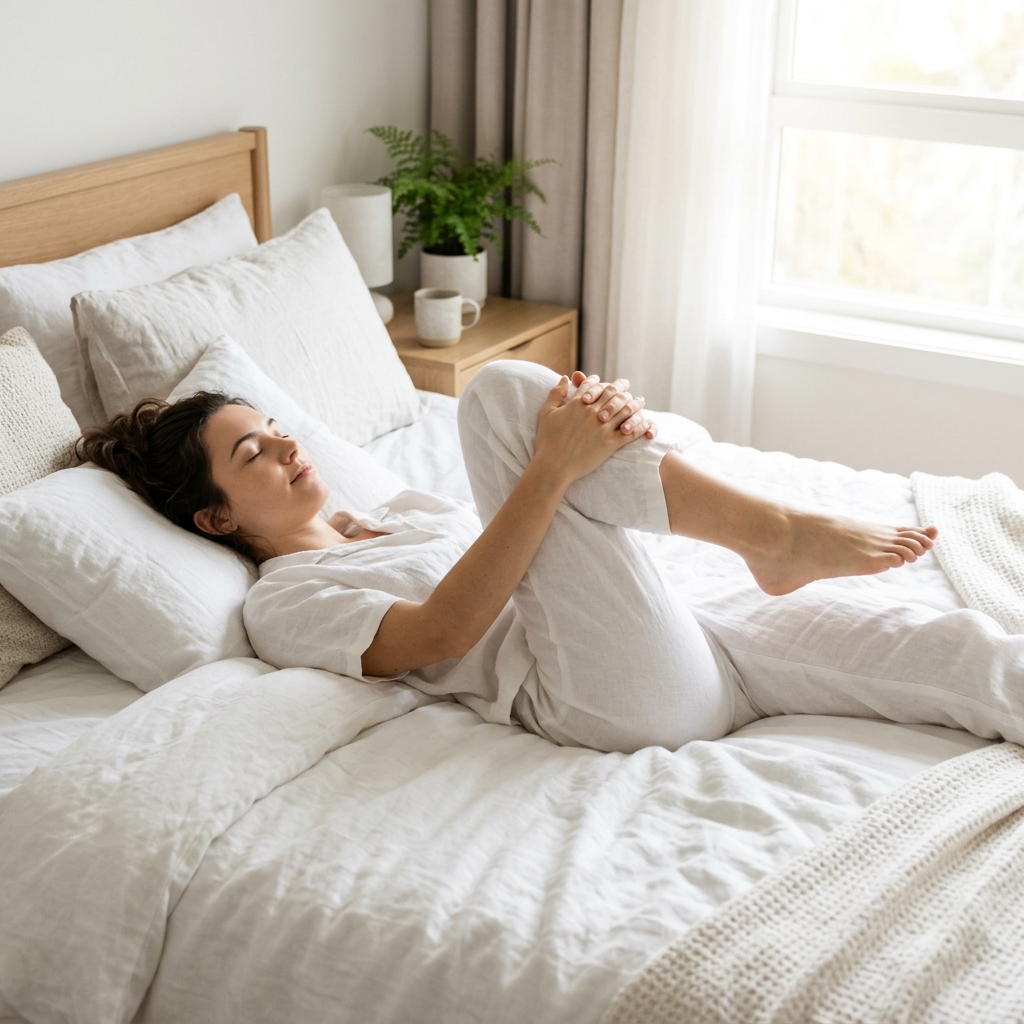
This pose is famous for doing exactly what its name suggests: forcing trapped gas out of the colon. Anatomical breakdowns confirm its effectiveness when done correctly.
- Lie flat on your back.
- Bend your RIGHT knee and pull it gently toward your right armpit (avoiding direct pressure on the center of your bloated stomach). Hold for 5 deep breaths.
- Release the right leg. Now, bend your LEFT knee and pull it toward your left armpit. Hold for 5 deep breaths.
- Finally, pull BOTH knees to your chest, wrap your arms around your shins, and gently rock side to side for 5 breaths.
Pose 2: Supta Matsyendrasana (Supine Spinal Twist)

This gentle twist acts as the “sponge wringing” mechanism for your transverse colon.
- While lying on your back, bend both knees and place your feet flat on the mattress.
- Extend your arms out like a “T”.
- Slowly drop both knees to the RIGHT side. This stretches the left side of your abdomen while deeply compressing the right. Hold for 5 breaths.
- Engage your core, bring your knees back to the center, and drop them to the LEFT side. Hold for 5 breaths.
Pose 3: Balasana (Supported Child’s Pose)

This final pose creates a gentle, soothing compression across your entire pelvic region.
- Roll over and come to your hands and knees.
- Bring your big toes together and widen your knees.
- Sit your hips back onto your heels and stretch your arms out in front of you, resting your forehead on the mattress.
- Crucial Step: Let your belly hang completely heavy between your thighs. Breathe deeply so that you feel your lower back expand. Hold for 10 slow breaths.
The Aftermath: Water and Gravity
Once you finish these three poses, do not lie back down. It is time to let gravity take over.
Sit up and immediately drink a large glass of warm water (or warm lemon water). Warm liquids on an empty stomach trigger the gastrocolic reflex—a neurological signal that tells your colon to make room for a new meal by emptying the old one.
Walk straight to the bathroom. If you have a step stool or a Squatty Potty, use it to elevate your knees above your hips, maintaining that perfect colon compression.
If the yoga poses loosened things up but you still feel like a stubborn block of stool is trapped right at the exit, you need targeted manual pressure. Read our guide on How to Do a Stomach Massage for Constipation to learn the exact physical therapy technique to manually push the final blockage out.
To ensure your colon remains clear long-term, make sure you are eating plenty of high-fiber foods for constipation throughout the day. Additionally, if constipation is a chronic issue, it may be a sign of poor gut health. Consider looking into the difference between prebiotics and probiotics to help restore your gut microbiome.
Disclaimer: This content is for informational purposes only and is not intended as medical advice. If you experience severe pain during stretching or chronic constipation, please consult your healthcare provider.

About Mr. Anh
We turn solid evidence into everyday habits Americans can actually do—plain English, cups/oz, grocery-aisle swaps, and routines that fit real life. Our editorial process: Experience—we road-test tips in real schedules…