Fat-Soluble Vitamins: Why a Fat-Free Salad Wastes Them
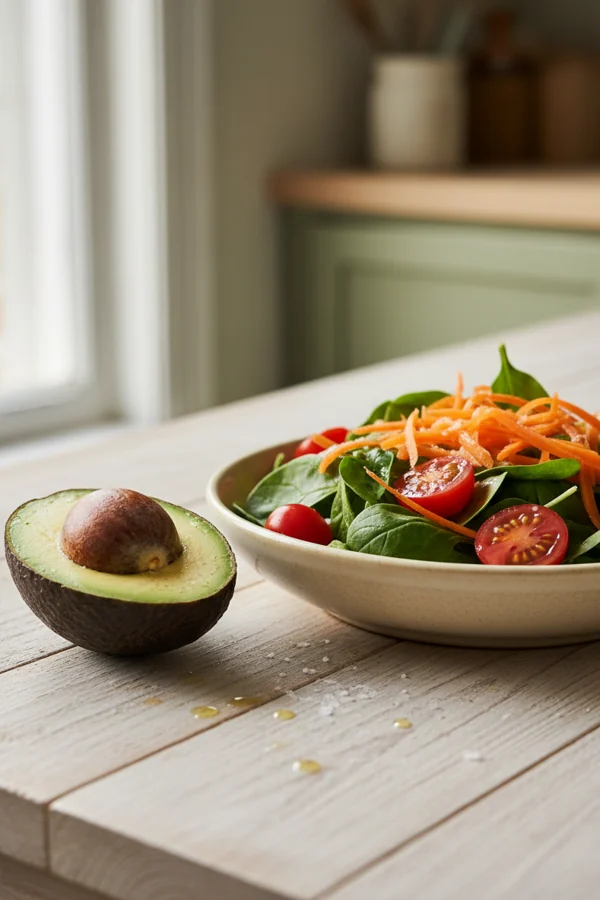
Vitamins A, D, E and K need fat to be absorbed. Adding avocado to a salad raised beta-carotene absorption 15 times. Here is how much fat, and when it matters.
You built the salad properly. Spinach, carrots, tomatoes, peppers — every colour on the plate.
Then you skipped the dressing, because that felt like the healthier choice.
It wasn’t. Most of what made that salad worth eating just passed straight through you.
Quick Takeaways:
– Vitamins A, D, E and K and all carotenoids need fat in the same meal to be absorbed
– Adding 150 g of avocado to a salad raised beta-carotene absorption 15.3×
– It scales — absorption climbed at every step from no dressing to 6 g to 28 g of fat
– Vitamin D3 taken with a fat-containing meal peaked 32% higher in the blood
– But more absorption doesn’t automatically mean better blood levels. That part is less settled
This is about how absorption works, not about diagnosing anything. If you think you’re low on something, that’s a blood test conversation with your doctor.
What “fat-soluble” actually means for your plate
Nutrients split into two camps by what they dissolve in.
Water-soluble ones — vitamin C, the B vitamins — travel fine on their own. Your gut is a wet place; they’re already in their element.
Fat-soluble ones are the problem. Vitamins A, D, E and K don’t dissolve in water, and neither do carotenoids, the pigments that make carrots orange, tomatoes red and kale dark green. They need fat as a carrier to cross the intestinal wall. No fat in the meal, no ride, and most of them leave the way they came.
This is one of the three mechanisms behind every pairing rule — I laid out the full framework in the three rules behind every food pairing.
The number that should change how you dress a salad
Researchers fed volunteers the same salad twice: once plain, once with 150 g of avocado added as a fat source. Then they measured what actually reached the bloodstream. (Unlu et al., 2005, Journal of Nutrition)
| Compound | Absorption vs. the fat-free salad |
|---|---|
| Beta-carotene | 15.3× |
| Alpha-carotene | 7.2× |
| Lutein | 5.1× |
Fifteen times. Not fifteen percent.
Read the top row slowly, because it’s easy to skim past. The same vegetables, eaten without fat, delivered a small fraction of what was sitting on the fork.
Even the smaller dose moved things a long way — 75 g of avocado still raised beta-carotene absorption by 1360%.
How much fat is enough?
There’s no clean cut-off. Earlier work stepped salad dressing from fat-free to 6 g to 28 g, and carotenoid absorption rose at every step. More fat kept helping across the range tested.
In practice you don’t need to measure. A drizzle of olive oil, a few slices of avocado, a scattering of nuts or seeds — any of those puts real fat in the meal. The failure mode isn’t too little fat, it’s none at all.
Vitamin D behaves the same way
The carotenoid numbers get the attention, but the same rule quietly applies to supplements.
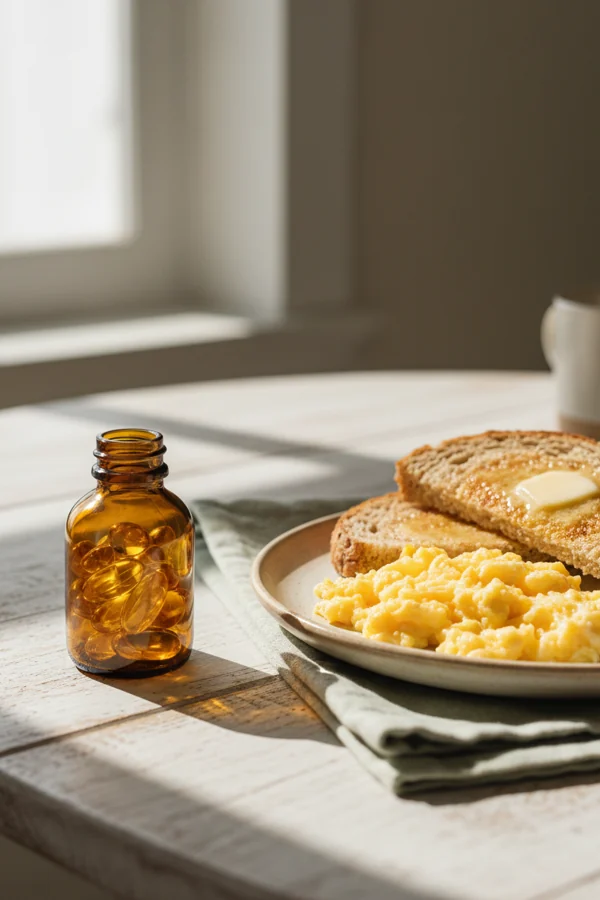
In a trial of 62 older adults taking 50,000 IU of vitamin D3, the peak blood level was 32% higher when the dose was taken with a fat-containing meal instead of a fat-free one. Absorption measured at 10 hours was 40% higher, and at 14 hours 25% higher. (Dawson-Hughes et al., 2014)
Which is a good argument for not swallowing a vitamin D capsule with your morning coffee on an empty stomach.
The caveat nobody mentions
Here’s where I have to slow down, because the same research group found something inconvenient.
In a related study, greater absorption of the supplement did not translate into higher plasma 25(OH)D levels — the marker clinicians actually use to judge vitamin D status. (Dawson-Hughes et al., 2013)
So the honest version is: taking vitamin D with fat gets more of it into your blood in the short term. Whether that reliably moves the number on a lab report is a separate question, and it isn’t settled.
That distinction matters. Absorption is not the same thing as status, and a lot of nutrition writing quietly treats them as identical.
If you take supplements at all, it’s worth knowing how to read a supplement label — and I’ve written separately about vitamin D.
Why the low-fat era made this worse
For about thirty years, “fat-free” was shorthand for “better for you”, and the food industry obliged. Fat-free dressings. Fat-free yoghurt to eat with fruit. Low-fat everything.
The calories came down. So, quietly, did the usable nutrition in whatever those products were served alongside.
That’s the part the labels never carried. A fat-free dressing is genuinely lower in calories, and it is also the reason the carotenoids in the salad underneath it largely went unabsorbed. Nobody was lying — the number on the pack was true. It just wasn’t the whole picture of what the meal delivered.
I’m not arguing for pouring oil on everything. I’m arguing that fat in a meal does a job, and removing it removes the job too.
Where this bites in real meals
Four situations where the fat is missing and the food goes to waste.
| The meal | What’s lost | The fix |
|---|---|---|
| Fat-free dressing on a salad | Carotenoids from every coloured vegetable | Olive oil, avocado, nuts, seeds |
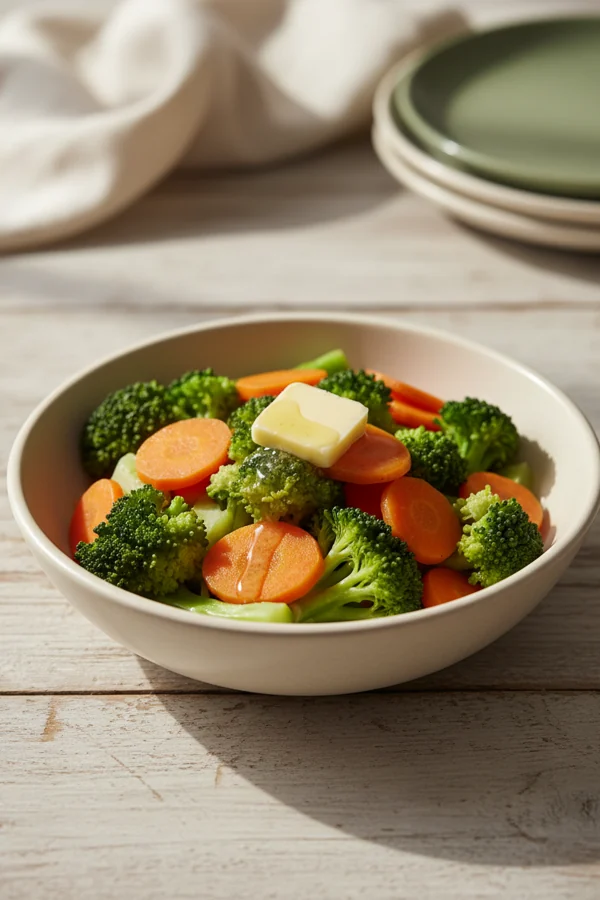
| Steamed vegetables, plain | Beta-carotene from carrots, squash, greens | A knob of butter or a drizzle of oil |
| Green smoothie, no fat added | Lutein from spinach and kale | A spoon of nut butter, some avocado |
| Vitamin D capsule on an empty stomach | A third of the peak blood level | Take it with the fattiest meal of the day |
Notice none of these ask you to eat more. They ask you not to strip the one component that makes the rest usable.
The iron-rich plant foods rule works the other way round — that one needs vitamin C, not fat, and I covered it in vitamin C and iron in the same meal. Two different mechanisms, two different partners. Some of these anti-inflammatory breakfast ideas already handle both without trying.
Frequently Asked Questions
Which vitamins need fat to be absorbed?
Vitamins A, D, E and K, plus carotenoids like beta-carotene, alpha-carotene and lutein. Water-soluble vitamins such as C and the B group do not need fat.
How much fat do I need in the meal?
There’s no established minimum. In one study, carotenoid absorption rose at every step from a fat-free dressing to 6 g and then 28 g of fat. A drizzle of oil or a few slices of avocado is enough to matter — the problem is having none at all.
Does a fat-free salad dressing really matter that much?
It appears to. Adding 150 g of avocado to a salad raised beta-carotene absorption 15.3 times compared with the same salad eaten fat-free.
Should I take vitamin D with food?
A fat-containing meal raised peak vitamin D3 blood levels 32% in one trial. Worth noting the same group found that higher absorption didn’t necessarily raise plasma 25(OH)D, so treat it as a sensible habit rather than a guaranteed result.
Does the type of fat matter?
Less than whether fat is present at all. The trials used avocado, avocado oil and standard salad dressings, and all of them worked. Nobody has shown one fat is clearly superior for this purpose.
The Bottom Line
Colour on the plate is only worth what you can absorb, and absorbing it takes fat.
A drizzle of olive oil. A few slices of avocado. A spoon of nut butter in the smoothie. That’s the whole intervention, and it turns a salad from decorative into useful.
I spent years ordering dressing on the side and feeling virtuous about it. What I was actually doing was paying for vegetables and then throwing away most of what was in them.
You can read more about how I work through this on the about the author page.
References
- Unlu NZ, Bohn T, Clinton SK, Schwartz SJ. Carotenoid absorption from salad and salsa by humans is enhanced by the addition of avocado or avocado oil. J Nutr 2005;135:431-436. — https://pubmed.ncbi.nlm.nih.gov/15735074/
- Dawson-Hughes B, et al. Dietary fat increases vitamin D-3 absorption. J Acad Nutr Diet 2014. — https://www.jandonline.org/article/S2212-2672(14)01468-3/abstract
- Dawson-Hughes B, et al. Meal conditions affect the absorption of supplemental vitamin D3 but not the plasma 25-hydroxyvitamin D response to supplementation. 2013. — https://pubmed.ncbi.nlm.nih.gov/23427007/
Everything I share here is educational and reflective, not medical advice. It should not replace diagnosis, treatment, or care from a licensed healthcare professional. See the full medical disclaimer.

About Mr. Anh
We turn solid evidence into everyday habits Americans can actually do—plain English, cups/oz, grocery-aisle swaps, and routines that fit real life. Our editorial process: Experience—we road-test tips in real schedules…