Tea and Coffee vs Iron: Why the Timing Rules Are Opposite
Tea and coffee both block iron, but not the same way. Tea an hour after a meal is fine; coffee an hour after is not. Here is the research, and the fix for each.
You already moved your coffee to after the meal.
That was the wrong direction.
Most of us learned one rule: don’t drink tea or coffee with food. So we push them to afterwards and figure the problem’s handled. For tea, it is — an hour later and you get essentially all your iron back.
For coffee? An hour afterwards blocks just as much iron as drinking it with the meal. And an hour beforehand costs you nothing at all.
Two drinks. Two opposite instructions. Both measured in controlled studies. Here’s which is which.
Quick Takeaways — the whole rule in four words: Tea after. Coffee before.
– Tea: wait an hour after the meal. Absorption comes back to the same level as plain water
– Coffee: drink it before the meal, not after. An hour after inhibits as much as drinking it alongside
– A cup of coffee cut absorption from a meal by about 39%; tea by about 64%
– Green tea inhibits roughly half as much as black tea
– Milk helps a little. Moving the cup helps far more
This is about how absorption works, not about diagnosing anything. If you think your iron is low, that’s a blood test conversation with your doctor.
The rule everyone gets half right
The advice to keep tea and coffee away from meals is sound. Both are loaded with polyphenols, and polyphenols grab iron in your gut before you can absorb it.
Where it falls apart is the word away.
Most people hear that and move the cup later. It feels like the safe direction — give the meal a head start, then bring the drink in behind it. That instinct is right for one drink and backwards for the other.
One thing worth knowing before we go further: this only applies to plant iron. Iron from meat, poultry and fish barely notices. If you want the fuller picture of how plant iron behaves, I covered how vitamin C changes iron absorption separately.
Tea: an hour is enough
Researchers gave twelve women a standardised porridge meal labelled with a stable iron isotope, on three separate occasions. (American Journal of Clinical Nutrition, 2017)
| Condition | Iron absorbed |
|---|---|
| Meal with water | 5.7% |
| Meal with tea, same time | 3.6% |
| Meal with tea, one hour later | 5.7% |
Tea with the meal cut absorption by roughly a third. Tea an hour afterwards landed on exactly the water figure.
Measured as inhibition, the effect fell from 37.2% to 18.1% — cut in half by waiting.
Now, be straight about the size of this: twelve participants, one standardised meal, one kind of tea. It’s a small study. But it points the same way as the wider polyphenol research, and the intervention costs nothing, so it’s worth acting on while better data catches up.

Coffee: an hour after does not help
Here’s where the symmetry breaks.
A dual-isotope study measured coffee against iron absorption from a meal, testing three timings. (Morck, Lynch & Cook, 1983)
| When the coffee was drunk | Effect on iron absorption |
|---|---|
| One hour before the meal | No measurable decrease |
| With the meal | Cut by about 39% |
| One hour after the meal | Same inhibition as drinking it with the meal |
Read that last row again. An hour of waiting bought nothing.
The same study measured how much strength matters, too:
| What was drunk with the meal | Iron absorbed |
|---|---|
| Nothing (baseline) | 5.88% |
| Drip coffee | 1.64% |
| Instant coffee | 0.97% |
| Double-strength instant | 0.53% |
From 5.88% down to 0.53%. That’s not a rounding error.
For scale: the same researchers put tea at roughly a 64% reduction against coffee’s 39%. So cup for cup, tea is the stronger blocker — but tea gives you an escape route that coffee doesn’t.
What I noticed:
“I wrote a few weeks ago that I’d moved my tea to an hour after lunch, and I assumed my coffee habit was covered by the same logic. It isn’t. I had the rule right for one drink and exactly backwards for the other.”
But what about coffee on an empty stomach?
Fair question. If the advice is “coffee before the meal”, then for a lot of us that means coffee on an empty stomach — and that deserves a real answer, not a shrug.
A narrative review of coffee and the gastrointestinal tract is reassuring on the big fear. (Effects of Coffee on the Gastro-Intestinal Tract, 2022)
- Ulcers: most studies found no association between coffee and peptic ulcers. Around 90% of ulcer-related symptoms trace back to NSAIDs, H. pylori or smoking. Chlorogenic acids in coffee may even be mildly protective
- Gastric emptying: coffee doesn’t speed up how fast your stomach empties, so it isn’t rushing the meal through either
Three honest caveats, though.
Coffee does raise stomach acid. It stimulates gastrin, and ground caffeinated coffee does this more than instant or decaf. On reflux the evidence is genuinely split — the review counted 15 studies finding no association, 2 finding a protective effect, and 11 finding it made things worse. Two meta-analyses found no significant link overall. So if you already get reflux, this is a personal experiment, not a rule.
About 29% of people get a colonic response within four minutes. That’s the familiar effect of coffee sending you looking for a bathroom. Decaf does it too — so caffeine isn’t the culprit, and chlorogenic acids are the likely suspect.
Roast matters. Dark roast stimulates acid less than lighter roasts, and instant less than ground. If your mornings feel rough, that’s a gentler lever to pull than giving up the habit.

Why the two behave differently
Both drinks work through polyphenols — just not the same ones. Tea’s inhibition comes mainly from tannins. Coffee’s comes largely from chlorogenic acids.
Why one seems to clear the gut within an hour and the other doesn’t isn’t settled.
And here’s the honest part: these two findings come from studies 34 years apart, using different meals, different doses, different methods. Nobody’s run the clean head-to-head.
There’s a specific hole worth naming — nobody has measured tea taken an hour before a meal. So the tidy symmetry, tea after and coffee before, is stitched together from two half-experiments rather than one complete one.
That doesn’t make the advice wrong. It makes it the best available reading of imperfect data, which is what most nutrition advice actually is.
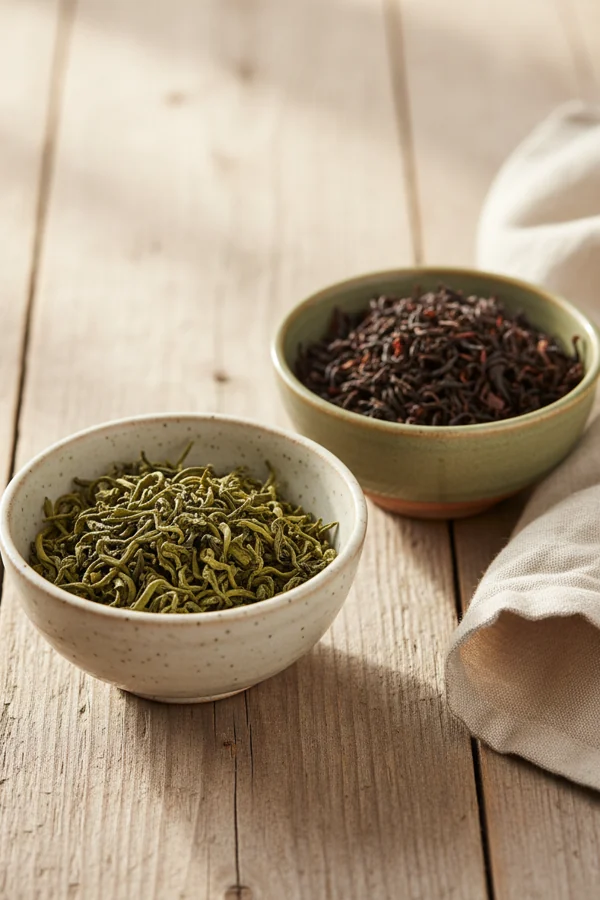
Not all tea is the same
Tea type changes the size of this quite a lot.
Green tea reduces iron absorption by roughly 30%; black tea by roughly 60%. Studies on polyphenol-containing beverages have measured black tea cutting non-heme iron absorption by 79–94% in some meal contexts.
What drives it is tannin dose, and it climbs steeply (polyphenol beverages and iron absorption):
| Tannin in the meal | Iron absorption reduced by |
|---|---|
| 5 mg | 20% |
| 25 mg | 67% |
| 100 mg | 88% |
Herbal infusions sit in a different category altogether. Most contain no tea tannins at all, so peppermint or ginger alongside a meal isn’t the same problem. If you want alternatives, I’ve written more about drinks and gut health.
Does adding milk help?
A little. Casein in milk binds some of the tea polyphenols, which leaves fewer of them free to grab iron.
But it’s a partial fix at best — and there’s a catch. Milk brings calcium, and calcium competes with iron for the same absorption pathway. You may just be swapping one inhibitor for another.
Moving the cup is simply more effective than trying to neutralise what’s in it.
What this looks like in a normal day
| Time | What | Why |
|---|---|---|
| Morning | Coffee before breakfast | An hour ahead of the meal costs nothing |
| Breakfast | Overnight oats with fruit | Iron plus vitamin C on the same plate |
| Lunch | Iron-rich plant foods with peppers or citrus | Same-meal pairing |
| An hour after lunch | Tea | Absorption’s already done |
Notice there’s nothing here you have to give up. Nobody loses a drink. The order changes, and that’s the whole intervention.
If you’re curious where your intake sits generally, low-level nutrient gaps are worth understanding — and it’s a genuinely useful skill to know how to read a supplement label before buying anything.
Frequently Asked Questions
How long should I wait to drink tea after a meal?
About an hour. In the 2017 trial, tea an hour after the meal produced the same iron absorption as plain water — 5.7% either way.
Is coffee before or after a meal worse for iron?
After is worse, which catches most people out. In the 1983 dual-isotope study, coffee an hour after the meal inhibited absorption just as much as coffee drunk alongside it, while coffee an hour before produced no measurable decrease at all.
Does green tea block iron as much as black tea?
No. Green tea reduces absorption by roughly 30% against black tea’s roughly 60%. Lower polyphenol load, smaller effect.
Does adding milk to tea help iron absorption?
Slightly. Milk proteins bind some polyphenols, but the effect is modest — and milk adds calcium, which competes with iron itself. Timing beats milk.
Does herbal tea affect iron absorption?
Generally not in the same way. Most herbal infusions carry no tea tannins, so they don’t bring the same inhibition.
Does decaf coffee still cause the bathroom effect?
Yes. Decaffeinated coffee produces the same colonic response, which is exactly why researchers point at chlorogenic acids rather than caffeine.
The Bottom Line
Tea after. Coffee before. That’s the whole article in four words.
Tea an hour after a meal brings absorption back to the water baseline. Coffee an hour after does nothing useful — move it ahead of the meal instead, where it costs you nothing.
Neither change asks you to give anything up, buy anything, or track anything. You reorder two cups. Timing is one of the three rules behind every food pairing, alongside changing a nutrient’s form and giving it a ride in fat.
I wrote a few weeks ago that I’d moved my tea to an hour after lunch. That part still holds. What I got wrong was assuming coffee worked the same way — it doesn’t, and the fix runs in the opposite direction. That’s the thing about reading the studies instead of the summaries: sometimes they correct you.
You can read more about how I work through this kind of thing on the about the author page.
References
- A 1-h time interval between a meal containing iron and consumption of tea attenuates the inhibitory effects on iron absorption. AJCN, 2017. Full text
- Morck TA, Lynch SR, Cook JD. Inhibition of food iron absorption by coffee. AJCN 1983;37(3):416-20. PubMed
- Inhibition of non-haem iron absorption in man by polyphenolic-containing beverages. PubMed
- Effects of Coffee on the Gastro-Intestinal Tract: A Narrative Review and Literature Update. 2022. PMC
- Comparative evaluation of green and black tea consumption on the iron status of omnivorous and vegetarian people. ScienceDirect
Everything I share here is educational and reflective, not medical advice. It should not replace diagnosis, treatment, or care from a licensed healthcare professional. See the full medical disclaimer.

About Mr. Anh
We turn solid evidence into everyday habits Americans can actually do—plain English, cups/oz, grocery-aisle swaps, and routines that fit real life. Our editorial process: Experience—we road-test tips in real schedules…