Iron and Vitamin C: The 50 mg Rule for the Same Meal
Vitamin C helps you absorb plant iron, but how much do you actually need? The research points to about 50 mg per meal — and it only works if the vitamin C is on the same plate.
You squeeze lemon over your spinach because someone told you vitamin C helps iron absorption. You’ve got no idea if a squeeze is enough. Nobody ever said how much.
That gap bugged me for years.
The advice to “pair iron with vitamin C” is everywhere. The number behind it is almost nowhere. So I went digging for the actual research — and it turns out the number exists, it’s been measured carefully across hundreds of people, and it’s smaller than most of us assume.
There’s also a second rule nobody mentions. Get that one wrong and the first one stops mattering.
By the end of this you’ll know how much vitamin C to aim for, why more stops helping, what’s quietly blocking your iron right now, and one adjustment that takes an hour and zero effort.
Quick Takeaways:
– About 50 mg of vitamin C per main meal is enough for the full effect
– The relationship is log/log — doubling the dose doesn’t double absorption
– It has to be the same meal, not the same day
– Tea with a meal cut iron absorption by ~37%. Waiting one hour cut that to ~18%
– Coffee follows a different rule — an hour before the meal costs nothing, but an hour after is as bad as drinking it with the meal
This is about how absorption works, not about diagnosing anything. If you think your iron is low, that’s a blood test conversation with your doctor — not something a food article can answer.
Why plant iron is harder to absorb in the first place
Not all iron behaves the same way once it’s in your gut.
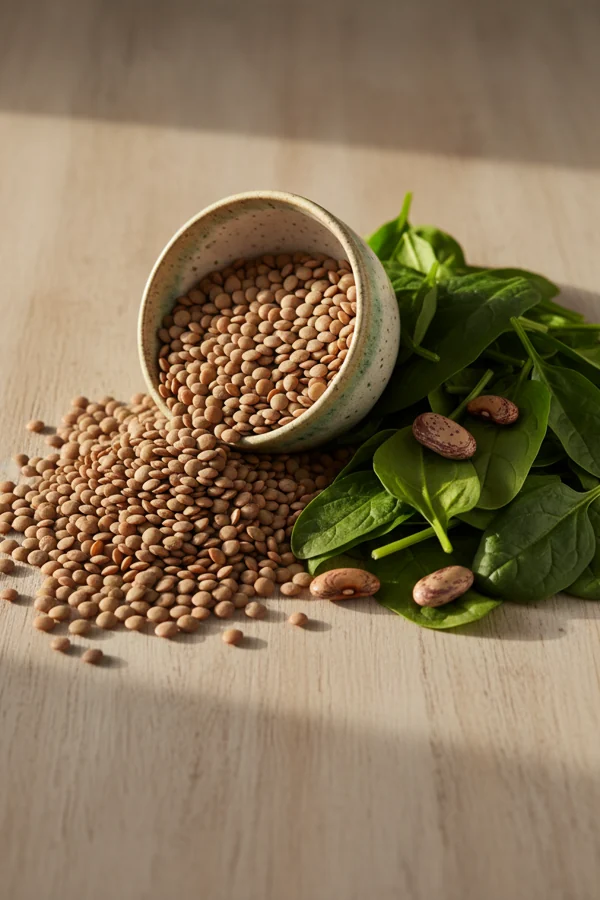
Iron from meat, poultry and fish is heme iron. Your body pulls in roughly 15–35% of it. Iron from plants — lentils, beans, spinach, tofu, oats — is non-heme iron, and absorption there runs closer to 2–20%.
That’s a huge range. And the reason it’s so wide is the interesting bit: non-heme iron is extremely sensitive to whatever else is sitting on the plate. Heme iron mostly isn’t.
The chemistry is simple enough. Plant iron shows up mainly as ferric iron, Fe3+. Your small intestine absorbs ferrous iron, Fe2+, far more easily. Something has to convert one into the other.
That’s vitamin C’s job. It’s a reducing agent — it hands over an electron, turns Fe3+ into Fe2+, and forms a soluble complex that keeps the iron available instead of letting it bind to something else and drop out of reach.
So vitamin C isn’t a vague “booster.” It does one specific chemical job, at one specific moment. Hold onto that detail, because it explains the rule further down that catches most people out.
I ate lentils several times a week for years and never once thought about what else was on the plate with them. Turns out that was the whole ballgame. If you’re building meals around iron-rich plant foods, this one conversion step is where your leverage is.
How much vitamin C? The dose-response data
Here’s the study that finally answered my question.
Hallberg and Brune published a dose-response investigation in 1986, using radio-labeled iron across 299 subjects. They added increasing amounts of ascorbic acid to meals and measured what actually got absorbed — not what should theoretically happen. (Hallberg & Brune, 1986 — PubMed)
Across a dose range of 25 mg to 1000 mg added to a meal, iron absorption climbed from 0.8% to 7.1%.
Big effect. But look at the shape of it, not just the two endpoints.
Why more stops helping
The researchers described the relationship as log/log. In plain English: every extra bit of vitamin C buys you less than the bit before it. The curve flattens out, and it flattens early.
Which is why their conclusion wasn’t “take as much as you can.” It was that about 50 mg in each main meal is enough for optimum effect.
Fifty milligrams. Not a supplement. Not a protocol. A piece of fruit.
This is the part that runs against instinct, and it’s the part I got wrong for a long time. Most nutrition advice quietly implies more is better. Here the measured data says the useful range arrives fast and then plateaus. Going from nothing to 50 mg is where nearly all of the benefit lives.
What 50 mg actually looks like on a plate
You clear that bar easily with normal food.
| Food | Serving | Vitamin C |
|---|---|---|
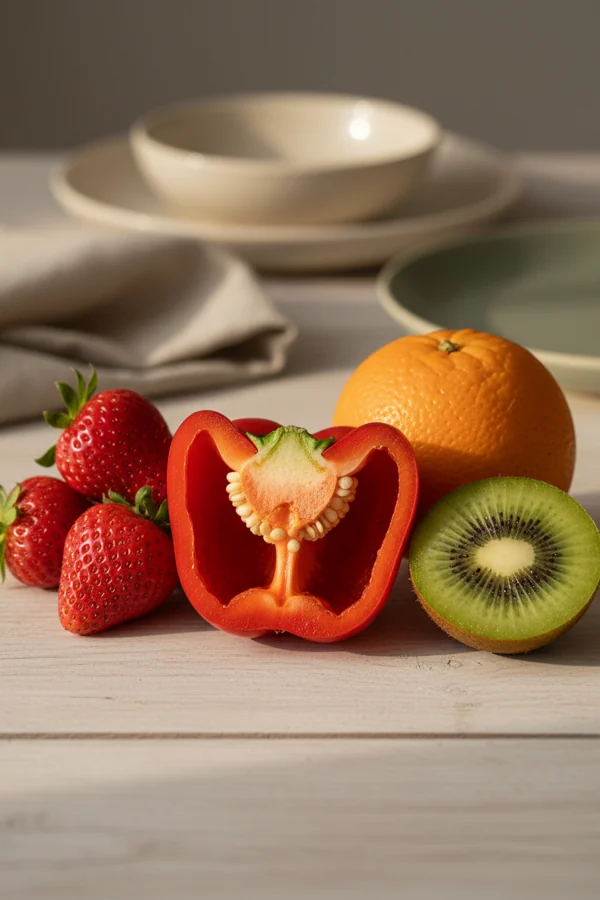
| Red bell pepper, raw | ½ cup chopped (75 g) | ~106 mg |
| Strawberries, raw | 1 cup halves (152 g) | ~89 mg |
| Broccoli, raw | 1 cup chopped (91 g) | ~83 mg |
| Orange | 1 medium (131 g) | ~70 mg |
| Kiwifruit, green | 1 medium (69 g) | ~52 mg |
Half a red bell pepper does it. One orange does it. A handful of strawberries does it.
You don’t need to measure anything or track anything. You need one visibly vitamin-C-rich item on the plate, in the same meal. That’s the whole ask.
Same meal or same day?
This is the rule nobody states plainly, and it’s the one most likely to be quietly costing you.
Remember that the conversion from Fe3+ to Fe2+ happens in your stomach, while the food is still sitting there. Vitamin C has to be present at that moment. It’s a chemical reaction with a time and a place — not a daily quota you fill in whenever.
So lentils at noon and an orange at four in the afternoon? You’ve eaten both nutrients. You haven’t paired them.
Same meal. Not same day.
What I noticed:
“For years I ate a lentil bowl at lunch and had fruit later in the afternoon, and I assumed that counted. It doesn’t. Now the fruit goes on the plate. It changed nothing about what I buy — only when I eat it.”
What’s blocking your iron — with actual numbers
Vitamin C is one half of the story. The other half is what’s working against you in that same meal.
Tannins in tea and coffee
Polyphenols bind iron and pull it out of play before you ever absorb it. The effect is dose-dependent, and it isn’t small.
| Tannin in the meal | Iron absorption reduced by |
|---|---|
| 5 mg | 20% |
| 25 mg | 67% |
| 100 mg | 88% |
Research on polyphenol-containing drinks found black tea reduced non-heme iron absorption by 79–94%. (Polyphenol beverages and iron absorption — PubMed)
Read that again. A cup of tea alongside your lentils can undo more than the vitamin C added.
Phytates in grains and legumes
Phytate is stored phosphorus in seeds, grains and beans. It binds minerals, and iron is one of them.
| Phytate in the meal | Iron absorption reduced by |
|---|---|
| 2 mg | 18% |
| 250 mg | 82% |
There’s an irony worth sitting with here. Many of the best plant iron sources — beans, lentils, whole grains — carry phytate in the very same package. The food supplying the iron is also limiting it.
Soaking, sprouting and fermenting all bring phytate down. If you already batch-cook fiber-rich foods like lentils and beans, an overnight soak costs you nothing but a bit of forward planning.
Calcium, the one everybody forgets
Calcium competes with iron for the same absorption pathway — though this one turns out to be weaker than it is usually presented. Single-meal studies show it; whole-diet studies mostly do not. I went through the evidence in real in one meal but mostly not across a whole diet.
That’s not a reason to avoid dairy. It’s a reason not to stack it onto the one meal you were counting on.
And here’s where it loops back: research on ascorbic acid found it partially offsets the inhibition from both phytates and tannins. (Ascorbic acid and dose-dependent phytate inhibition — PubMed) Vitamin C doesn’t only add. It defends.
The one-hour fix
Of everything I read putting this together, this is the single finding I actually changed a habit over.
Researchers gave twelve women a standardized porridge meal labeled with a stable iron isotope, on three separate occasions. (American Journal of Clinical Nutrition, 2017)
| Condition | Iron absorbed |
|---|---|
| Meal with water | 5.7% |
| Meal with tea, same time | 3.6% |
| Meal with tea, one hour later | 5.7% |
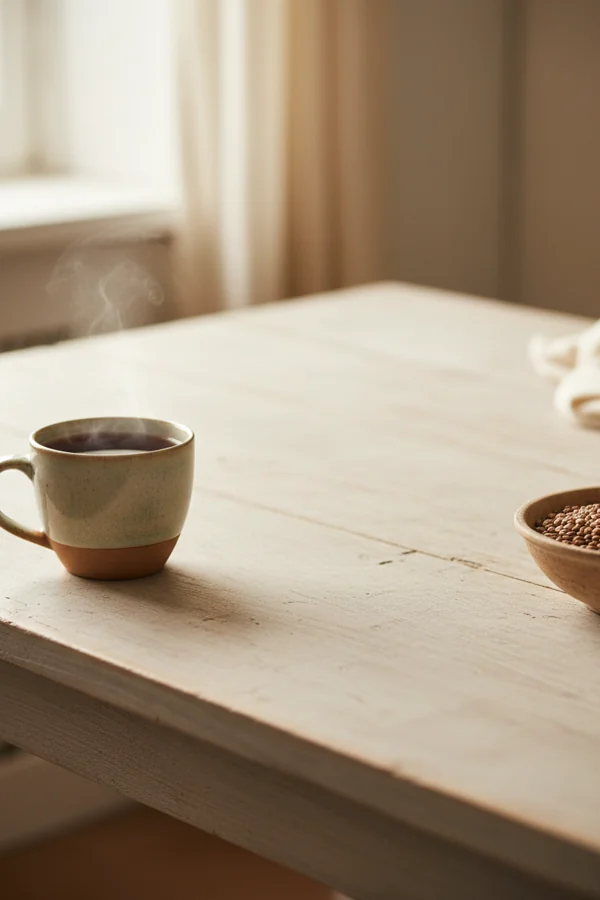
Tea taken with the meal cut absorption. Tea taken an hour afterwards landed at exactly the same level as plain water.
Measured as inhibition, the effect dropped from 37.2% down to 18.1% — roughly halved.
So you don’t have to give up tea or coffee. You have to move it. That’s the entire intervention.
Worth being straight about the limits, though: twelve participants is a small study, and it used one standardized meal. The direction lines up with the wider polyphenol research, and acting on it costs nothing — but it’s one trial, not a settled fact.
One important caveat: this is tea. Coffee does not follow the same rule. In an earlier dual-isotope study, Morck, Lynch & Cook, 1983 found a cup of coffee cut iron absorption from a meal by 39%, and — unlike tea — taking that coffee a full hour after the meal inhibited absorption just as much as drinking it alongside. What did work was the opposite direction: coffee an hour before the meal caused no measurable drop at all.
So the two drinks need opposite instructions. I unpacked the full comparison in tea and coffee follow opposite timing rules, including what happens with green tea and milk. Tea: wait an hour after. Coffee: drink it before you eat.
One important caveat: this is tea. Coffee does not follow the same rule. In an earlier dual-isotope study, Morck, Lynch & Cook, 1983 found a cup of coffee cut iron absorption from a meal by 39% — and, unlike tea, taking that coffee a full hour after the meal inhibited absorption just as much as drinking it alongside. What did work was the opposite direction: coffee an hour before the meal caused no measurable drop at all.
So the two drinks need opposite instructions. Tea: wait an hour after. Coffee: drink it before you eat.
I’ll admit this is the one that got me. I’d been drinking tea with lunch for as long as I can remember, and it never occurred to me that timing did anything at all.
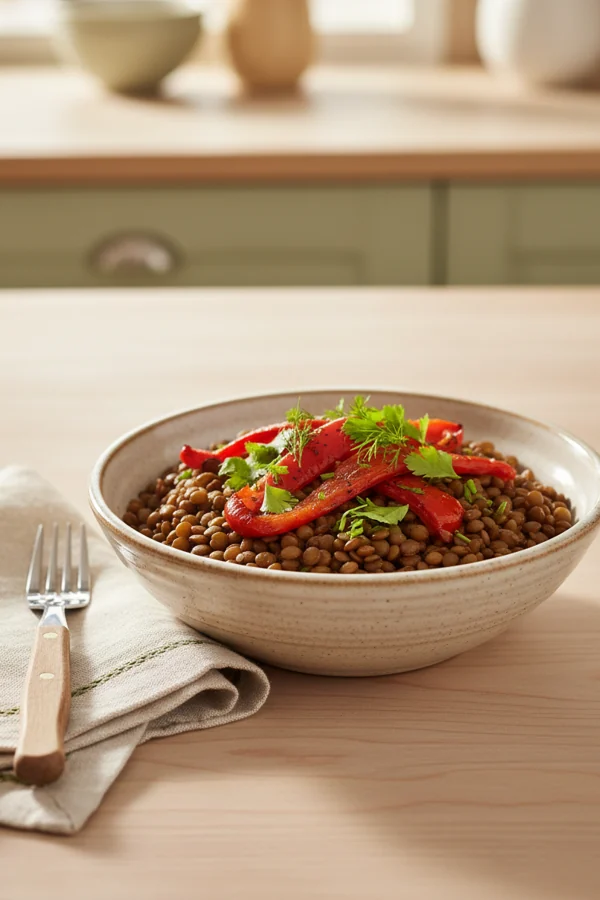
Putting it on a plate
Three combinations that satisfy both rules — vitamin C present, inhibitors moved out of the way.
- Lentils with roasted red pepper. The pepper covers the vitamin C requirement several times over, and it’s already in the same bowl.
- Oats with strawberries. An overnight soak also lowers the phytate in the oats, so you’re fixing two things at once. Related, and worth understanding: cooking and cooling changes food in ways most people never think about.
- Tofu stir-fry with broccoli. The broccoli brings the vitamin C, and it’s already going in the pan.
Then the timing rule on top: keep tea and coffee out of the meal itself. With tea, an hour afterwards is enough. With coffee it is not — move it to an hour before the meal instead.
None of this needs new shopping. It’s sequencing.
If you’re generally curious where your intake sits, low-level nutrient gaps are worth understanding — and if you use supplements at all, learn how to read a supplement label before you buy anything. It’s a genuinely useful skill.
Frequently Asked Questions
How much vitamin C do I need to absorb iron?
Around 50 mg in the same meal, based on Hallberg’s dose-response work. That’s roughly half a red bell pepper or one orange. Past that point the curve flattens and extra vitamin C adds very little.
Does vitamin C have to be eaten at the same time as iron?
Yes. The reaction happens in your stomach while the meal is there. Eating both nutrients on the same day but in separate meals doesn’t create the pairing effect.
What foods block iron absorption?
Tea and coffee polyphenols, phytates in grains and legumes, and calcium. All three are dose-dependent — black tea has been measured cutting non-heme iron absorption by 79–94%, and 250 mg of phytate by around 82%.
Does coffee or tea affect iron absorption?
Considerably, if you drink it with the meal. In the 2017 trial, tea alongside the meal dropped absorption from 5.7% to 3.6%. The same tea an hour later left it unchanged at 5.7%.
Can I take a vitamin C supplement instead of eating fruit?
The research used both synthetic ascorbic acid and vitamin-C-rich foods, and both worked. Since roughly 50 mg is the target, ordinary food clears it easily — you don’t need a supplement for this particular purpose.
The Bottom Line
Three things carry almost all of the effect. Aim for about 50 mg of vitamin C. Put it in the same meal, not the same day. Move tea to an hour after the meal, and coffee to an hour before it.
None of them cost money. None of them need tracking. This is one of the three rules behind every food pairing — the same logic covers fat-soluble vitamins and turmeric too.
I don’t count milligrams at dinner, and you don’t need to either. The one change I’ve actually kept is moving my tea to an hour after lunch — small enough that it took no willpower at all, and by the numbers, the biggest single item in this article.
Want to try it tomorrow? Note three lines: what your iron source was, what vitamin C landed on the same plate, and how far your tea or coffee was from the meal. That’s enough to spot your own pattern within a week.
You can read more about how I approach all this on the about the author page.
References & Inspiration
- Hallberg L, Brune M. Effect of ascorbic acid on iron absorption from different types of meals. 1986. — https://pubmed.ncbi.nlm.nih.gov/3700141/
- Inhibition of non-haem iron absorption in man by polyphenolic-containing beverages. — https://pubmed.ncbi.nlm.nih.gov/10999016/
- Iron absorption in man: ascorbic acid and dose-dependent inhibition by phytate. — https://pubmed.ncbi.nlm.nih.gov/2911999/
- A 1-h time interval between a meal containing iron and consumption of tea attenuates the inhibitory effects on iron absorption. American Journal of Clinical Nutrition, 2017. — https://ajcn.nutrition.org/article/S0002-9165(22)02698-3/fulltext
- Iron Absorption: Factors, Limitations, and Improvement Methods. ACS Omega, 2022. — https://pubs.acs.org/doi/10.1021/acsomega.2c01833
- USDA FoodData Central — https://fdc.nal.usda.gov/
Everything I share here is educational and reflective, not medical advice. It should not replace diagnosis, treatment, or care from a licensed healthcare professional. See the full medical disclaimer.

About Mr. Anh
We turn solid evidence into everyday habits Americans can actually do—plain English, cups/oz, grocery-aisle swaps, and routines that fit real life. Our editorial process: Experience—we road-test tips in real schedules…