Turmeric and Black Pepper: What the 2,000% Claim Rests On
The 2,000% turmeric claim rests on one 1998 study, never independently replicated. The mechanism is plausible; the size of the effect is not.
Every article about turmeric repeats the same number. Black pepper raises curcumin absorption by 2,000%. Add a pinch, unlock the benefits.
I repeated it myself for years.
Then I opened the study it comes from, and found something thinner than the number suggests.
Quick Takeaways:
– The 2,000% figure comes from one study, published in 1998
– No independent research group has replicated it in the years since
– The mechanism is plausible — piperine does slow how fast curcumin is cleared
– The study used 2 g of curcumin, roughly 13–33× the curcumin in a teaspoon of turmeric powder
– Adding pepper to your curry is a reasonable habit. It is not the transformation the number implies
This is about how absorption works, not about diagnosing anything. Nothing here is advice about treating any condition.
What the study actually did
The source is Shoba and colleagues, published in Planta Medica in 1998. (Shoba et al., 1998)
Healthy volunteers took 2 g of curcumin, with and without 20 mg of piperine — the active compound in black pepper. Blood curcumin was measured over the following hours.
At the 45-minute mark, the piperine group showed bioavailability 2,000% higher than the group without it.
In rats, the same combination raised overall curcumin bioavailability by 154%.
That’s the whole basis. One trial, small, nearly three decades ago.
Why the mechanism is still worth taking seriously
It would be easy to dismiss the whole thing, and that would be the wrong reading.
Curcumin has a real absorption problem. Your body treats it as something to get rid of — the liver and gut wall attach molecules to it that mark it for rapid clearance. Most of a curcumin dose is processed and gone before it reaches general circulation.
Piperine interferes with those clearance enzymes. That part isn’t controversial, and it’s the same category of mechanism as the other two rules in this cluster: it doesn’t change curcumin’s form or carry it anywhere, it just slows the exit. The full framework is in the three rules behind every food pairing.
So the direction is well founded. What isn’t established is the size.
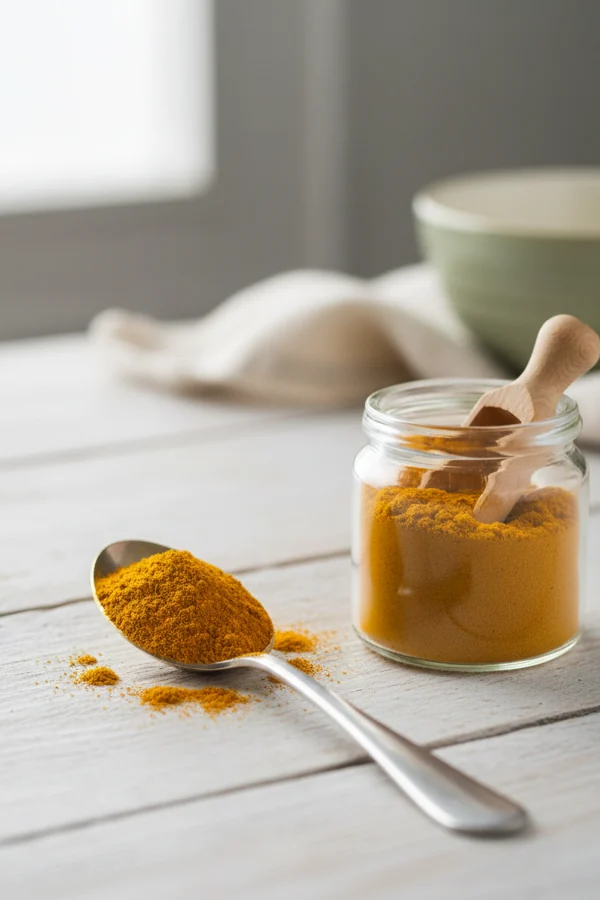
The 2,000% problem
A twenty-fold increase measured once, in a small group, in 1998, is a hypothesis. It becomes a fact when someone else measures it and gets something similar.
That hasn’t happened. No independent group has replicated the magnitude of that finding.
There’s a specific reason to be cautious with this particular number: it was measured at a single time point, 45 minutes in. Curcumin blood levels without piperine are extremely low — close to the limits of what the assays of the era could detect reliably. When your baseline is near zero, percentage increases inflate dramatically. Going from a very small number to a slightly less small number can produce a very large percentage.
That doesn’t mean the effect is imaginary. It means 2,000% is doing more work in headlines than it can support in evidence.
What newer work does and doesn’t tell us
Research on the combination hasn’t stopped — but it mostly moved on to different questions. A randomised controlled trial on curcumin with piperine and muscle recovery after exercise, for instance, tested the pairing on an outcome rather than on absorption itself.
That’s a common pattern. Later studies adopt the combination as a given — because the 1998 result made it standard practice — and then measure something else entirely. So the literature grows without the original number ever being re-tested.
Which is how a single measurement quietly becomes settled knowledge without anyone checking it twice.
What I noticed:
“I quoted that figure in articles and in conversation, always second-hand, always from someone else quoting it. It took me an embarrassingly long time to actually open the 1998 paper. Reading primary sources is slower, and it has changed several things I thought I knew.”
The part nobody does the arithmetic on
Here’s what struck me hardest, and I haven’t seen it in any of the popular articles.
The study used 2 g of curcumin. Not 2 g of turmeric — 2 g of the isolated compound.
Turmeric powder is only about 2–5% curcuminoids by weight. So reaching 2 g of curcumin means eating roughly:
| Curcuminoid content | Turmeric powder needed |
|---|---|
| 5% | ~40 g |
| 3% | ~67 g |
| 2% | ~100 g |
A teaspoon of turmeric powder is about 3 g. That’s somewhere around 60–150 mg of curcumin.
The study dose was roughly 13 to 33 times what a generous teaspoon delivers.
So when an article tells you to add black pepper to your turmeric latte to “unlock” the 2,000% benefit, the comparison being invoked involved a dose you would not get from cooking. Nobody is eating 67 g of turmeric powder.
What this means for actual cooking
None of this is a reason to stop.
Black pepper with turmeric is a sound habit. It costs nothing, the mechanism is real, traditional cuisines pair them anyway, and pepper improves the dish.
It is not a switch that unlocks anything. Treat it as a small, plausible improvement to a modest culinary dose — not as the difference between working and not working.
Fat helps too, and gets mentioned less. Curcumin is fat-soluble, so cooking turmeric in oil or coconut milk engages a different mechanism entirely — the one I covered in why a fat-free salad wastes them. A curry with oil and pepper stacks two mechanisms without anyone planning it.
If you’re cooking with turmeric regularly, these anti-inflammatory drinks and Mediterranean anti-inflammatory recipes already put it alongside fat and pepper in the normal course of things.
How to read the next big absorption number
This article is really about a habit of reading, so let me make it explicit. When you meet a striking percentage in nutrition writing, three questions do most of the work:
| Question | Why it matters |
|---|---|
| How many studies? | One trial is a hypothesis. Replication makes it a finding |
| What was the baseline? | Percentage gains from near-zero baselines inflate enormously |
| What was the dose? | Study doses are frequently far above anything you would eat |
Apply those three to the 2,000% claim and it doesn’t collapse — it just shrinks to something honest. That’s usually what happens.
If you buy turmeric supplements, it’s worth knowing how to read a supplement label, since curcuminoid content and piperine additions vary enormously between products.
Frequently Asked Questions
Does black pepper really increase turmeric absorption?
The mechanism is real — piperine slows the enzymes that clear curcumin. The often-quoted 2,000% figure comes from a single 1998 study that no independent group has replicated, so treat the direction as sound and the magnitude as unsettled.
How much black pepper do I need with turmeric?
The 1998 study used 20 mg of piperine, which is roughly a quarter teaspoon of ground black pepper. In cooking, a normal grind alongside turmeric is the practical version.
Is turmeric useless without black pepper?
No. Pepper plausibly helps, but turmeric was used in cooking for centuries without anyone calculating piperine doses. Fat matters too, since curcumin is fat-soluble.
Why is the 2,000% number questionable?
It was measured at one time point in one small 1998 trial, against a baseline so low that small absolute changes produce huge percentages. It has not been independently replicated.
Does cooking turmeric in oil help?
It should, on the same principle that governs any fat-soluble compound. That’s a different mechanism from piperine — one carries the compound, the other slows its removal.
The Bottom Line
Put pepper in the curry. Cook the turmeric in oil. Both are sensible, both are free, and both have plausible mechanisms behind them.
Just don’t expect a teaspoon of turmeric plus a grind of pepper to reproduce a trial that used a dose you’d never eat, measured once, in 1998, and never checked since.
The habit is good. The number is doing too much work.
You can read more about how I work through this on the about the author page.
References
- Shoba G, Joy D, Joseph T, Majeed M, Rajendran R, Srinivas PS. Influence of piperine on the pharmacokinetics of curcumin in animals and human volunteers. Planta Med 1998. — https://pubmed.ncbi.nlm.nih.gov/9619120/
- Curcumin and Piperine Supplementation and Recovery Following Exercise Induced Muscle Damage: A Randomized Controlled Trial. — https://pmc.ncbi.nlm.nih.gov/articles/PMC5358025/
Everything I share here is educational and reflective, not medical advice. It should not replace diagnosis, treatment, or care from a licensed healthcare professional. See the full medical disclaimer.

About Mr. Anh
We turn solid evidence into everyday habits Americans can actually do—plain English, cups/oz, grocery-aisle swaps, and routines that fit real life. Our editorial process: Experience—we road-test tips in real schedules…