Anti-Inflammatory Meal Prep: The 90-Minute Sunday Protocol
Anti-inflammatory eating doesn't fail because people don't know what to eat. It fails because the right food isn't ready on the hardest days. This guide gives you a single 90-minute Sunday protocol that stocks your refrigerator with five days of anti-inflammatory components — organized by minute, with specific technique decisions that preserve each food's active compounds all week.
- Why Anti-Inflammatory Meal Prep Requires Different Technique
- The 5 Compound-Preservation Rules for Anti-Inflammatory Meal Prep
- The 90-Minute Sunday Anti-Inflammatory Prep Session
- 3 Ways to Customize Your Prep Session by Symptom
- The Weekly Assembly Blueprint
- Anti-Inflammatory Meal Prep FAQs
- The Bottom Line
You’ve read the articles. You know salmon helps, that turmeric matters, that broccoli’s supposed to be your best friend right now. The problem isn’t information — it’s that none of that shows up in your fridge on a Tuesday night when you’re exhausted, your joints are stiff, and you’re one bad decision away from ordering pizza.
Here’s the part nobody says out loud: anti-inflammatory eating doesn’t fail because people don’t know what to eat. It fails because the right food isn’t ready on the hardest days.
When I shifted from “I know what to eat” to “it’s already prepped,” everything changed. Not because I found some miracle food, but because the barrier was gone. Sunday at 3pm, I put in 90 minutes. The rest of the week takes care of itself.
And here’s the piece most guides completely miss: you can spend those 90 minutes prepping all the right anti-inflammatory foods using completely standard cooking techniques — and systematically destroy the compounds that make those foods worth eating. The broccoli loses its sulforaphane. The garlic loses its allicin. The turmeric absorbs at 2% instead of 40%. You’ve done the work and gotten a fraction of the result.
This guide shows you how to run the session so your Sunday prep actually delivers all week.
Quick takeaways:
⏱️ 90-minute timed session — organized sequentially so nothing overlaps wrong
- 🧪 5 Compound-Preservation Rules — the specific technique decisions most guides skip entirely
- 🗓️ Assembly blueprint — 5 dinners, 5 lunches, 5 breakfasts from one Sunday session
- 🎯 3 symptom variations — joint pain, fatigue + brain fog, gut health
- 📋 Printable timer + shopping list at the end
Why Anti-Inflammatory Meal Prep Requires Different Technique
Standard meal prep is optimized for efficiency — how to cook the most food in the least time. Anti-inflammatory meal prep needs something slightly different: compound preservation. And those two goals frequently conflict.
The foods with the strongest anti-inflammatory effect — broccoli, garlic, turmeric, fatty fish, berries — all contain specific compounds that are sensitive to heat level, water, cooking duration, and what you combine them with. Get it right, and you have sulforaphane, allicin, curcumin, EPA, DHA, and anthocyanins working for you all week. Get it wrong with standard technique, and you’ve got the fiber and the calories without most of the anti-inflammatory function.
When I first started this protocol, I was roasting broccoli at 425°F like every meal prep influencer on the internet does. Looked great. Tasted great. But I wasn’t getting the sulforaphane. A 2018 study published in the Journal of Agricultural and Food Chemistry (NCBI) confirmed that high-heat cooking of cruciferous vegetables significantly degrades myrosinase — the enzyme without which sulforaphane can’t form. The fix was just dropping the oven temperature 50 degrees. That’s the level of adjustment we’re talking about here: small, specific, non-dramatic.
For the mechanism-by-mechanism breakdown of which compounds fight which inflammatory pathways, the anti-inflammatory foods guide gives you the full picture. This article is about the prep session itself.
The 5 Compound-Preservation Rules for Anti-Inflammatory Meal Prep
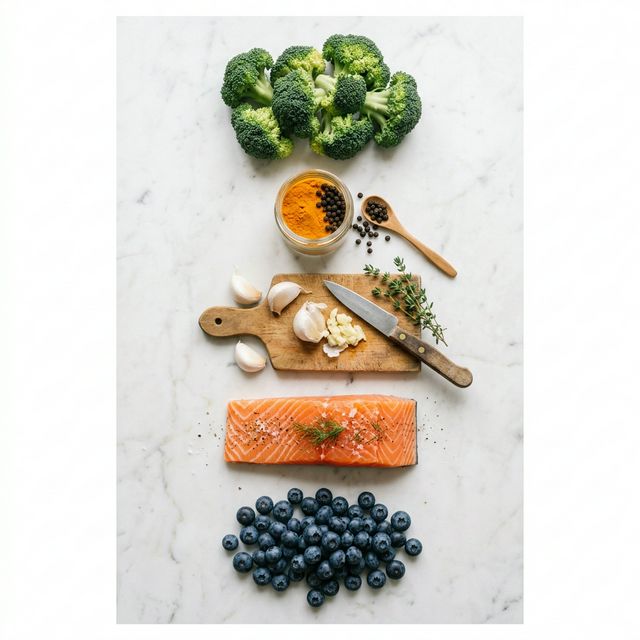
Rule 1 — The Sulforaphane Rule (Cruciferous Vegetables)
Foods: Broccoli, cauliflower, Brussels sprouts, kale, cabbage
Sulforaphane is a potent NF-κB inhibitor — one of the most researched anti-inflammatory compounds in plant foods, with strong clinical data showing reduction in IL-6, TNF-α, and CRP. The catch: sulforaphane doesn’t exist in broccoli as a ready-made compound. It forms through a reaction between glucoraphanin and an enzyme called myrosinase when you cut or chew cruciferous vegetables. High heat destroys myrosinase before that reaction completes.
The rule: Roast cruciferous vegetables at 375°F maximum — never the 425°F that maximizes browning. Steam for 3–4 minutes only; never boil (boiling loses up to 77% of glucosinolate content within 5 minutes). A 375°F roast takes 22–25 minutes and produces beautifully caramelized vegetables with meaningful sulforaphane intact.
One-line change: Drop your oven temperature from 425°F to 375°F. Add 5 minutes to the timer. That’s it.
Rule 2 — The Curcumin Rule (Turmeric)
Foods: Turmeric powder, fresh turmeric root
Curcumin simultaneously inhibits both COX-2 and NF-κB inflammatory signaling — two of the major molecular targets in chronic inflammation management. The problem is well-documented: curcumin has notoriously poor standalone bioavailability. Your body absorbs very little of it on its own.
The fix is simple but non-negotiable. Piperine — the active compound in black pepper — increases curcumin bioavailability by approximately 20-fold (2,000%) according to the landmark Shoba et al. study in Planta Medica (PubMed). Adding fat (EVOO, tahini, coconut milk) provides the lipid carrier curcumin needs to cross the gut lining.
The rule: Turmeric always with black pepper AND a fat source. Build it into sauces and dressings — never add it raw to a high-heat roasting pan where heat degrades curcumin before the combination with pepper can occur.
I make the turmeric-black pepper tahini sauce in this protocol every single week. It takes 3 minutes, covers most of the week’s meals, and delivers activated curcumin with every single serving automatically.
Rule 3 — The Allicin Rule (Garlic)
Foods: Fresh garlic cloves — not jarred, not pre-minced
Allicin reduces pro-inflammatory cytokines IL-6 and TNF-α and supports gut microbiome balance that affects systemic inflammation downstream. But allicin doesn’t exist in a whole garlic clove — it’s produced when the enzyme alliinase (activated by physical damage like crushing or mincing) converts alliin into allicin.
Here’s the problem: alliinase is heat-sensitive. Expose freshly cut garlic to heat immediately and you deactivate the enzyme before meaningful allicin forms. Lawson and Hughes in the Journal of Agricultural and Food Chemistry (PubMed) documented that alliinase requires time at room temperature after cell disruption to complete allicin synthesis. After 10 minutes, the allicin has formed and is heat-stable — it survives cooking.
The rule: Crush or mince all garlic you’ll use this week, then let it rest at room temperature for 10 full minutes before any heat exposure.
This is also why pre-minced jarred garlic doesn’t deliver the same benefit — whatever allicin formed has already oxidized away during storage.
Practical application: The very first step of every prep session, before the oven goes on, before water boils — crush all the garlic you need for the week. Set it aside on the cutting board. By the 10–15 minute mark, it’s fully activated and ready to use.
Rule 4 — The Omega-3 Rule (Fatty Fish and Seeds)
Foods: Wild salmon, sardines, mackerel, chia seeds, ground flaxseed, walnuts
EPA and DHA — the marine omega-3s — convert to resolvins and protectins: specialized pro-resolving mediators that actively signal inflammation resolution (not just inhibition). They’re fragile. Omega-3 fatty acids oxidize when exposed to high heat, extended cooking time, air, and light. Oxidized omega-3s are actually pro-inflammatory.
Broiling salmon at high heat until it’s dry, then storing it in a thin plastic container at the front of the refrigerator where door-opening creates temperature fluctuation — that systematically degrades the EPA and DHA you were trying to consume.
The rule: Bake fatty fish at 300–350°F until just barely opaque in the center. Store omega-3-rich foods in airtight glass containers at the back of the middle refrigerator shelf. Ground flaxseed goes rancid fast — grind weekly from whole seeds, not monthly.
Rule 5 — The Anthocyanin Rule (Berries and Purple Foods)
Foods: Blueberries, blackberries, red cabbage, purple sweet potato, pomegranate seeds
Anthocyanins inhibit inflammatory enzyme activity (COX-1 and COX-2) and act as potent antioxidants against the oxidative stress that drives chronic inflammation. They’re heat-sensitive. Adding blueberries to warm oatmeal, cooking them into a sauce, or any heat exposure degrades significant anthocyanin concentration.
The rule: Raw only. Wash, portion into glass containers during prep, refrigerate. Add them cold at serving time — never during cooking. This one’s non-negotiable.
Sound like a lot of rules? After two sessions, they become automatic. The first time through, print this section and keep it on the counter.
The 90-Minute Sunday Anti-Inflammatory Prep Session
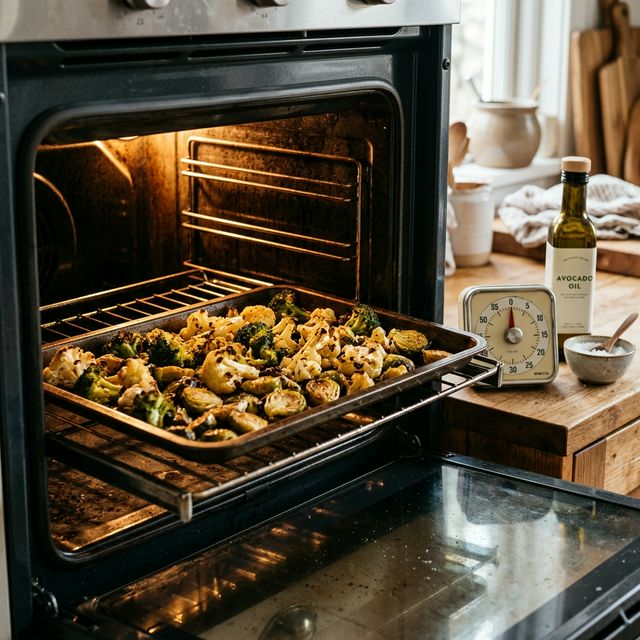
This protocol is sequential — longer-cooking items start first, shorter prep fills the gaps. By minute 90, everything finishes simultaneously. Serves 2 people for 5 weekday dinners, 5 lunches from components, and 5 breakfasts.
Equipment you’ll need: 2 pots, 1 large sheet pan, 1 baking dish, blender or immersion blender, 8–10 glass containers with lids, kitchen timer.
⭐ Before the timer starts — The Allicin Activation Step
Crush or mince 8–10 garlic cloves (all you’ll use this week). Pile on cutting board. Set a 10-minute phone timer. Now start the protocol below while allicin activates.
Minutes 0–15 — Start Your Grains (They Take the Longest)
Grains have the longest cook time, so they always go first.
Start cooking now:
- 2 cups farro OR 1.5 cups brown rice (medium-low heat, 25–30 min)
- 1.5 cups red lentils in a second pot (medium heat, 15–18 min)
Technique: Cook both in low-sodium vegetable or chicken broth instead of plain water — more flavor, more trace minerals. Add directly to the lentil pot: 1 tsp turmeric + ½ tsp black pepper + 1 tbsp EVOO. Every lentil serving now has activated curcumin built in, automatically.
While grains heat up: Chop all cruciferous vegetables. Broccoli florets, cauliflower pieces, quartered Brussels sprouts. Toss with avocado oil (not EVOO for roasting — its polyphenols degrade above 375°F; avocado oil handles the heat cleanly), sea salt, black pepper. Spread on sheet pan in a single layer.
Minutes 15–40 — Roast Vegetables + Bake Salmon
Oven set to 375°F:
- Sheet pan, upper rack: cruciferous vegetables — 22–25 minutes. Set timer, leave them alone.
- Baking dish, lower rack: wild salmon fillets — 325°F if your oven has two zones (ideal for omega-3 preservation). Bake 25–28 minutes until just barely opaque in the center.
If your oven only runs one temperature at a time: roast crusifers at 375°F first (25 min), then reduce to 325°F for salmon (20 min). Adds about 20 minutes to total session.
While the oven works: Prep sweet potatoes if including. Dice, toss with avocado oil and cinnamon. Sweet potatoes don’t have the sulforaphane concern — they can roast at 400°F after the crucifer tray comes out.
Minutes 40–60 — Proteins Finish + Eggs
At minute 40:
- Check salmon — pull when center just turns from translucent to barely opaque; residual heat finishes it on the counter
- Start 6 hard-boiled eggs: cold water start, bring to boil, then 9 minutes for firm yolk
- Sweet potatoes: swap onto sheet pan at 400°F now, 20 minutes
While everything finishes: lay out all your sauce ingredients. The next 15 minutes are for the three sauces that make this whole system work.
Minutes 60–75 — Build the 3 Anti-Inflammatory Sauces
Three sauces, three minutes each. These cover the entire week.
Sauce 1 — Turmeric-Black Pepper Tahini (grain bowls, salmon, roasted vegetables)
- 4 tbsp raw tahini + juice of 1.5 lemons + 1 tsp organic turmeric + ½ tsp freshly cracked black pepper + 1 activated garlic clove + 3–4 tbsp water to thin
- Whisk or blend. Glass jar. Lasts 6–7 days refrigerated.
I’ve been making this sauce weekly for over a year. The key is freshly cracked pepper — not pre-ground. Fresh cracking releases more piperine, which is what makes the curcumin absorption math actually work. For the turmeric itself, I order organic through Thrive Market — their organic turmeric and raw tahini run about 35% below grocery pricing, and I go through both on essentially every prep session.
Sauce 2 — Ginger-Miso Dressing (lentil bowls, salads, gut health variation)
- 2 tbsp white miso paste + 1 tbsp fresh grated ginger + 1 tbsp rice wine vinegar + 1 tbsp EVOO + 1 tsp raw honey + 2 tbsp warm water to thin
- Whisk into warm (not hot) water — miso’s live cultures are heat-sensitive above 115°F. Glass jar. Lasts 5–6 days.
Sauce 3 — EVOO-Herb Drizzle (finishing sauce for everything)
- 4 tbsp high-quality EVOO + 1 tsp dried Greek oregano + juice of 1 lemon + 1 activated garlic clove, minced + pinch sea salt + cracked black pepper
- Shake in a jar. No blending. Lasts 1 week.
This sauce is always served cold or at room temperature — never heated. This preserves the polyphenol content of the EVOO that the PREDIMED trial (NEJM) identified as one of the most important mechanisms behind the Mediterranean diet’s cardiovascular protective effect.
Minutes 75–90 — Overnight Components + Fridge Map
Chia Pudding (4 servings):
- 6 tbsp chia seeds + 2 cups full-fat coconut milk + 1 tsp grated fresh ginger + 1 tbsp raw honey
- Stir, divide into 4 glass jars, refrigerate. Do not add berries now — add raw at serving per Rule 5.
Overnight Oats (3 servings):
- 1.5 cups rolled oats + 2 cups unsweetened almond milk + 1 tbsp freshly ground flaxseed + 1 tsp cinnamon + 1 tbsp maple syrup
- Divide into 3 glass jars, refrigerate. Berries at serving only.
The Anti-Inflammatory Fridge Map:
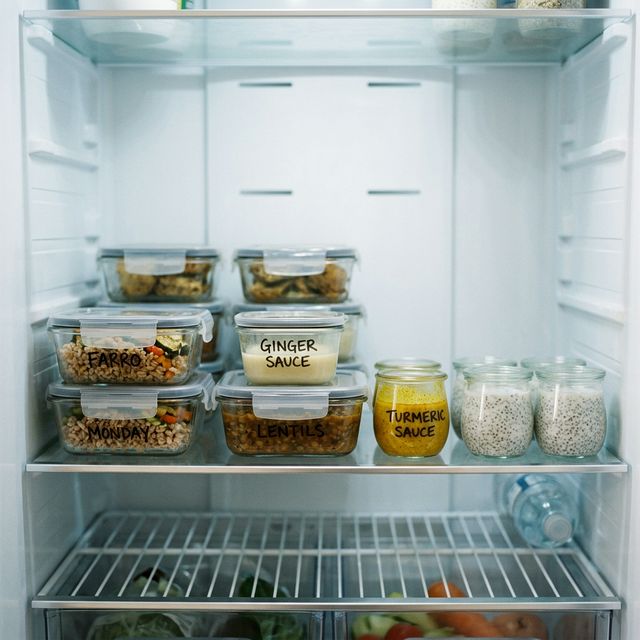
| Shelf Position | What Goes Here | Why |
|---|---|---|
| Top shelf | 3 sauce jars (labeled 1, 2, 3) | Eye-level = most-reached; you’ll grab these daily |
| Middle shelf — back | Salmon container + chia puddings | Omega-3 items need consistent cold — back has the most stable temp |
| Middle shelf — front | Eggs, overnight oats jars | Eaten within 2–3 days; front access is fine |
| Bottom shelf | Farro + lentils containers | 5–6 day shelf life; stable anywhere |
| Crisper drawer | Unwashed berries, raw spinach, fresh herbs, ginger | Raw items stay fresh with crisper humidity |
For glass containers specifically — I use borosilicate glass with airtight locking lids. BPA-free glass matters for omega-3-rich items: plastic off-gases compounds that accelerate EPA/DHA oxidation. It’s a small detail that makes a real difference by Wednesday.
Session complete. Timer stops at ~90 minutes.
3 Ways to Customize Your Prep Session by Symptom
Once the base session feels natural, these targeted variations shift your week’s emphasis without changing the timing or structure.
Joint Pain Focus
Joint pain and arthritis are primarily driven by the prostaglandin and leukotriene inflammatory pathways — most directly addressed by omega-3s and curcumin.
Adjustments:
- Protein this week: Prioritize wild salmon over chicken. EPA and DHA directly compete with arachidonic acid for inflammatory enzyme access — the most relevant mechanism for joint pain.
- Sauce emphasis: Double the turmeric-black pepper tahini batch. Add 1 tsp fresh grated ginger to Sauce 2 as well — gingerols have been shown in multiple randomized trials to reduce joint pain comparably to low-dose NSAIDs over time.
- Breakfast add: 2 tbsp tart cherry concentrate stirred into overnight oats. Anthocyanins in tart cherries specifically target synovial joint inflammation.
For the habit-level picture — the behaviors that actively worsen joint inflammation alongside diet — the anti-inflammatory tips guide covers the RED habits worth stopping this week.
Fatigue and Brain Fog Focus
Inflammatory fatigue (common in CFS, long COVID, and autoimmune flares) is often compounded by deficiencies in magnesium, B12, iron, and choline — nutrients that mitochondria and neurotransmitter synthesis both depend on.
Adjustments:
- Grain emphasis: Farro over brown rice — significantly more magnesium per serving and a lower glycemic load that prevents the post-meal energy crash that compounds fatigue.
- Protein shift: Eggs as the co-primary protein alongside salmon. Eggs are the highest dietary source of choline — critical for acetylcholine synthesis and liver detoxification of inflammatory metabolic byproducts.
- Oats add: 1 tbsp miso stirred into overnight oats after serving — miso’s probiotic content supports the gut-brain axis signaling that mediates inflammatory fatigue.
Gut Health and Microbiome Focus
Gut inflammation — leaky gut, dysbiosis, IBS flares — responds specifically to prebiotic fiber, fermented foods, L-glutamine, and polyphenol diversity.
Adjustments:
- Grain emphasis: Red lentils as the primary base. Among the highest prebiotic fiber sources — they directly feed Lactobacillus and Bifidobacterium populations and produce short-chain fatty acids that maintain gut barrier integrity.
- Cooking liquid: Bone broth instead of vegetable broth for the lentils. L-glutamine in bone broth supports intestinal epithelial cell repair.
- Add to fridge map: One jar of raw refrigerated kimchi or sauerkraut (not heat-processed — live cultures only) to serve alongside any bowl.
- Sauce 2 emphasis: Make the ginger-miso dressing your primary sauce this week. Miso + gingerols + acetic acid from rice vinegar is a strong gut-health combination.
For the broader Mediterranean approach that overlaps significantly with this gut-health variation, the mediterranean meal prep guide covers the Component Prep Method using a compatible base structure.
The Weekly Assembly Blueprint
After Sunday, weekday eating is pure assembly — no real cooking required.
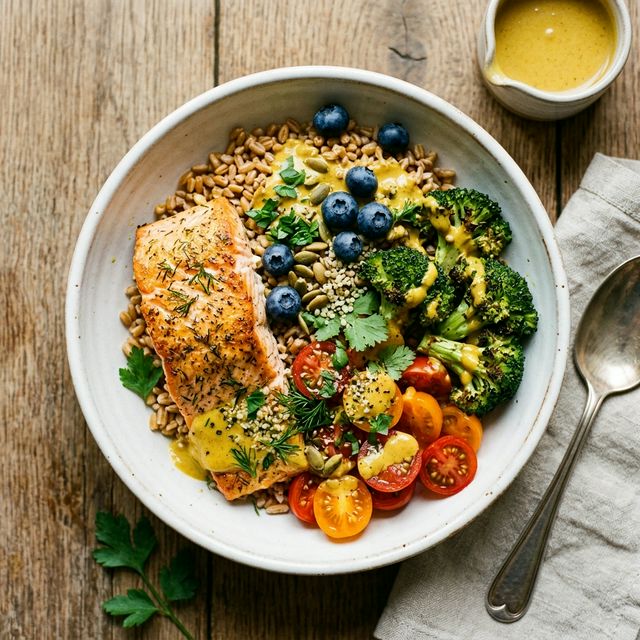
Dinner: 4–5 minutes
| Day | Grain Base | Protein | Sauce | Additions |
|---|---|---|---|---|
| Monday | Farro | Baked salmon (use first — best omega-3 when fresh) | Turmeric tahini | Roasted broccoli + cherry tomatoes |
| Tuesday | Red lentils | Soft-boiled eggs (2) | Ginger miso | Roasted cauliflower + spinach |
| Wednesday | Farro | Remaining salmon OR sardines (pantry) | EVOO herb | Red cabbage + avocado + walnuts |
| Thursday | Red lentils | Chickpeas (heat 3 min in skillet) | Turmeric tahini | Brussels sprouts + pumpkin seeds |
| Friday | Brown rice | 3-egg frittata + any remaining vegetables | EVOO herb | Whatever’s left in the crisper |
Lunch: 5 minutes (cold, no reheating)
½ cup grain → large handful raw spinach (wilts slightly under cold grain, no cooking needed) → 2 tbsp any sauce → 1 tbsp hemp or chia seeds → small handful raw blueberries (cold, straight from crisper — Rule 5) → drizzle EVOO. Done.
Breakfast: 2 minutes
Rotating: chia pudding (days 1–2) → overnight oats (days 3–5). Both already made. Add toppings:
- Chia pudding: Raw blueberries + 1 tbsp almond butter + drizzle of honey
- Overnight oats: Raw berries + extra cinnamon + ground flaxseed if desired
Anti-Inflammatory Meal Prep FAQs
What foods should I meal prep for anti-inflammatory diet?
The five highest-priority items for a Sunday anti-inflammatory prep session: (1) Wild salmon or sardines — primary EPA/DHA omega-3 source; (2) Cruciferous vegetables roasted at 375°F — sulforaphane preservation; (3) Farro or red lentils cooked in broth with turmeric and black pepper — curcumin delivery with every serving; (4) Fresh garlic crushed and rested 10 minutes before heat — allicin activation; (5) Pre-made turmeric-black pepper tahini sauce — so every meal this week delivers curcumin in its most bioavailable form automatically.
What is the fastest anti-inflammatory meal to make?
A cold grain bowl from prepped components takes 4–5 minutes. Scoop cold farro or lentils, add cold roasted vegetables, 2 tbsp turmeric tahini, scatter raw blueberries, drizzle EVOO. No reheating — cold bowls retain more phytonutrients than microwaved versions and are faster to assemble. Fridge to table: under 5 minutes.
How do I start anti-inflammatory meal prep?
Start small: one 60-minute first session using one grain, one cruciferous vegetable, one protein, and one sauce. Crush garlic (rest 10 min), start farro, roast broccoli at 375°F, bake salmon at 325°F, make turmeric-tahini. That single session gives you all the components for five anti-inflammatory grain bowls. Add complexity in weeks 2–3 as the timing becomes intuitive.
Can meal prep reduce inflammation?
Yes — specifically because it ensures consistent daily access to anti-inflammatory compounds on the days when cooking from scratch isn’t realistic. The PREDIMED trial (NEJM) is the clearest large-scale evidence that consistent Mediterranean-style eating reduces cardiovascular inflammatory markers over sustained periods — consistency being the operative word. Meal prep is a consistency tool. The technique rules here add a second layer: not just access to the right foods, but preservation of their active compounds.
What should I batch cook to reduce inflammation?
In priority order: (1) Turmeric-black pepper lentils or farro — curcumin with every serving; (2) Sheet-pan cruciferous vegetables at 375°F — sulforaphane preserved; (3) Gently baked salmon at 300–325°F — omega-3 intact; (4) Turmeric-tahini sauce — the week’s anchor sauce; (5) Chia pudding — anti-inflammatory breakfasts for 4 days, already done. These five cover the major anti-inflammatory pathways simultaneously.
How long do anti-inflammatory meal preps last in the fridge?
Cooked farro and lentils: 5–6 days. Roasted cruciferous vegetables: 4–5 days. Baked salmon: 2–3 days maximum — use on Monday and Tuesday. Hard-boiled eggs (unpeeled): 5–7 days. Sauces and dressings: 5–7 days. Chia pudding and overnight oats: 4–5 days. Critical note: omega-3-rich proteins go on days 1–2 always. Shift to eggs and legumes for days 3–5.
What are the 5 anti-inflammatory foods I should eat every day?
Based on the strongest daily-dose evidence: (1) Extra virgin olive oil, 2–4 tablespoons — oleocanthal mechanism comparable to low-dose ibuprofen per PREDIMED data; (2) Crushed fresh garlic — 1 clove minimum, rested 10 minutes; (3) Leafy greens — spinach, kale, or arugula — daily flavonoid and folate for inflammatory gene expression regulation; (4) A fatty fish or omega-3 equivalent — wild salmon, sardines, or 2 tbsp ground flaxseed; (5) Turmeric with black pepper and fat — even 1 tsp in a dressing counts. This list is the core shopping tier for the mediterranean grocery list as well.
Is meal prepping good for inflammation?
It’s one of the most practical lifestyle interventions available — not because of any single food, but because it removes the decision-making barrier on the highest-inflammation days, when willpower and energy are at their lowest. People managing arthritis, fibromyalgia, autoimmune flares, or post-viral fatigue consistently report that pre-cooked food in the fridge makes the anti-inflammatory diet sustainable in a way daily cooking simply doesn’t. The technique rules here add a second layer: the prep doesn’t just get you the food — it preserves what’s inside it.
The Bottom Line
Anti-inflammatory eating fails at the fridge, not at the article. You already know what to eat. This protocol closes the gap — in 90 minutes on Sunday that funds the entire week.
The 5 Compound Rules are the detail most guides skip. They’re not complicated. Drop the oven temperature. Rest the garlic. Pair turmeric with pepper. Bake salmon gently. Add berries cold. Five small decisions, once per session, compounding all week.
Ready for the full 4-week structure? The anti-inflammatory meal plan gives you daily menus, weekly body checkpoints, and a grocery list for each week — with this 90-minute Sunday session as the weekly prep foundation across all four weeks.
⚕️ Health Disclaimer: The information in this article is for educational purposes only and is not intended as medical advice. Always consult a qualified healthcare provider before making significant dietary changes, especially if you have a diagnosed health condition, are pregnant, take prescription medications, or have food allergies or intolerances. Reducing inflammation through diet is a complementary strategy, not a replacement for medical treatment. Individual responses to dietary interventions vary significantly. Nothing in this article is intended to diagnose, treat, cure, or prevent any disease.

About Jane Smith
We turn solid evidence into everyday habits Americans can actually do—plain English, cups/oz, grocery-aisle swaps, and routines that fit real life. Our editorial process: Experience—we road-test tips in real schedules…