When to Take Digestive Enzymes: Stop Turning Your Stomach into an Enzyme Graveyard
When to Take Digestive Enzymes: Stop Turning Your Stomach into an “Enzyme Graveyard” You just dropped $40 on the most...
- The Western Mistake: The "Gastric Emptying" Trap
- The Eastern Danger: Extinguishing Your "Spleen Fire"
- The Ultimate "First Bite + Warm Sip" Protocol
- Do You Need to Take Enzymes With Every Meal?
- Warning: When to Consult a Doctor Before Taking Enzymes
- The Takeaway: Timing Is Everything
- Frequently Asked Questions (FAQ)
When to Take Digestive Enzymes: Stop Turning Your Stomach into an “Enzyme Graveyard”
Here’s the hard truth: the problem isn’t the pill. The problem is the exact minute you swallow it.
Through years of researching this topic and applying what I’ve learned on myself, my family, and close friends, I’ve noticed that most people who buy digestive enzymes make one of two fatal timing mistakes — and both turn the stomach into what I call an “Enzyme Graveyard”: a place where expensive protein molecules get incinerated or flushed away before they ever get a chance to do their job.
As someone trained in Traditional Oriental Medicine (a dedicated researcher, not a clinician) with a deep interest in Western health science, today I’m going to share with you the exact golden window of minutes to take your enzymes, and one simple “temperature hack” that has changed the gut comfort of myself and many of the people I’ve shared it with — starting with tonight’s dinner.
The Western Mistake: The “Gastric Emptying” Trap
Let’s talk physiology first. Your stomach is not a passive bag waiting for food to drop in. It is a precision organ that behaves on a tight clock.
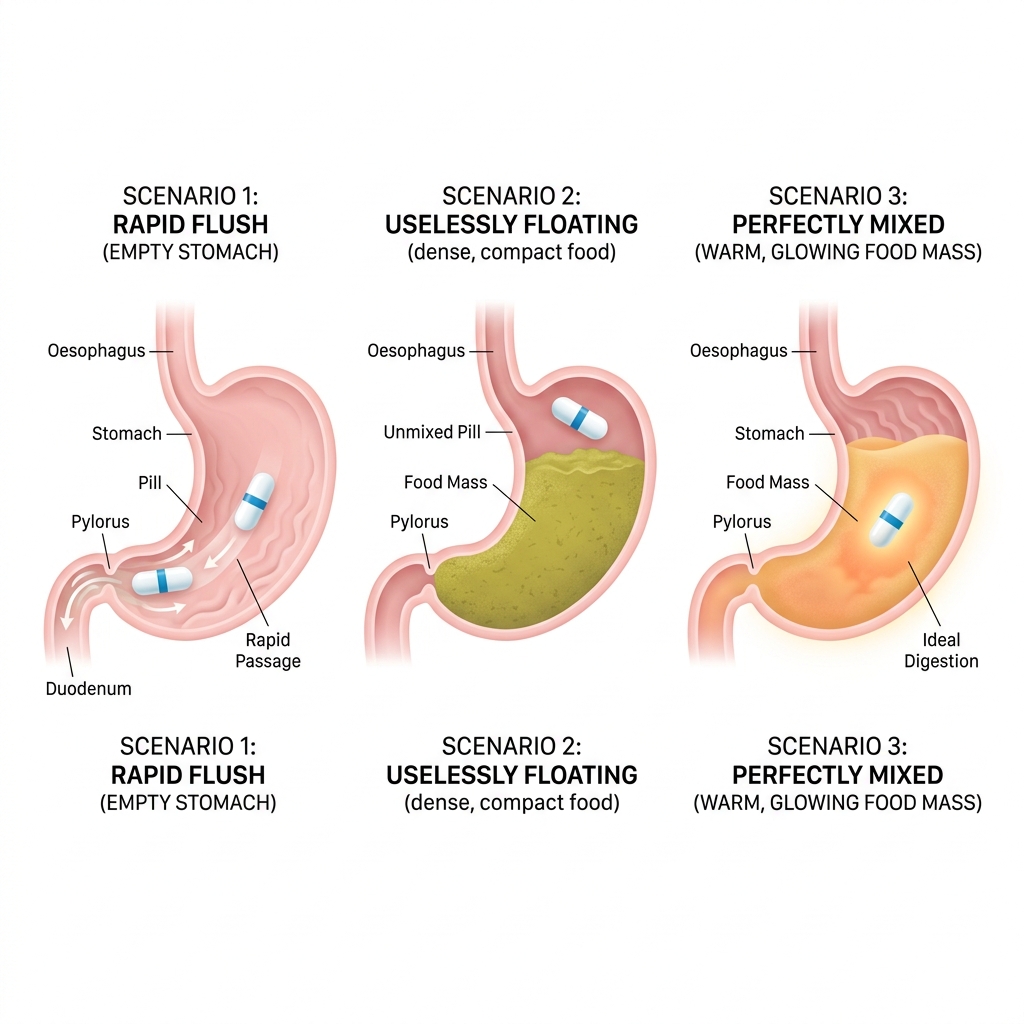
Mistake #1: Taking Enzymes 30–60 Minutes Early (The Flush-Through Trap)
So many friends and family members have told me: “I take them an hour before my meal to let them ‘get ready.'” This is a disaster wearing the costume of discipline.
Gastric physiology research is unambiguous: liquids start emptying from the stomach almost instantly — a glass of plain water has a T-1/2 (time for 50% to empty) of under 22 minutes [1]. Gelatin capsules take 10–30 minutes to dissolve, and indigestible tablets taken on an empty stomach with 250ml water fully exit the stomach in 30–50 minutes [2].
The math: if you take your enzyme with a glass of water at 6:00 PM and don’t sit down to eat until 7:00 PM, every single molecule of enzyme has already flushed through into your small intestine. By the time your steak finally arrives in your stomach, there are zero scissors left to cut it.
Worse still: if your supplement contains animal-derived enzymes (like pancreatin or trypsin from porcine pancreas), these enzymes only work in the alkaline environment of the small intestine (pH 7.0–9.0). Sitting in a raw stomach acid bath with no food to buffer them, they become denatured and irreversibly destroyed [3].
Mistake #2: Taking Enzymes After You Finish Eating (The Floating Trap)
The opposite mistake: you eat a full meal, watch 20 minutes of TV, then remember the supplement. By now, the dense food mass is packed tightly at the bottom of your stomach. The enzyme capsule just floats on top, physically unable to mix into the food it’s supposed to digest.
The clinical PERT guidelines (Pancreatic Enzyme Replacement Therapy) recommend patients split their dose: half with the first bite, the other half during the meal. Enzymes degrade within 10 minutes of entering the stomach, which makes timing absolutely critical [4].
The Critical Exception: Systemic Enzymes
There’s one category of enzyme that MUST be taken the opposite way — on a completely empty stomach. These are the anti-inflammatory systemic enzymes like Bromelain (extracted from pineapple) and Serrapeptase (a bacterial enzyme).
- Purpose: Not to digest food, but to be absorbed intact into the bloodstream and travel to inflamed tissues (joints, sinuses, scar tissue).
- Timing: At least 30 minutes before a meal OR 2 hours after a meal [5].
- Requirement: Must be enteric-coated to survive stomach acid and dissolve in the intestine.
If you take serrapeptase with your steak dinner, it will be commandeered to digest the steak — and your goal of reducing knee inflammation goes out the window.
The Eastern Danger: Extinguishing Your “Spleen Fire”
Here is the perspective that 99% of internet articles about digestive enzymes completely miss — and it’s the silent mistake destroying gut health in millions of homes every single day.
The Concept of Spleen Qi
In Traditional Chinese Medicine (TCM), digestion isn’t a cold chemical reaction. It is an act of cooking.
Picture your stomach as a clay pot. And your Spleen Qi is the fire burning beneath it. Food drops into the pot, the fire heats it, and the food is “cooked” into pure essence that nourishes every cell in your body.
The Spleen loves warmth and dryness. The Spleen hates cold and dampness. This is one of the most foundational principles in TCM, documented in classical Chinese medical texts dating back over 2,000 years.
The Ice Water Shock and the Fermentation Disaster
Here is the single biggest mistake I observe at family dinners and among friends: they swallow their enzyme capsule with a tall glass of ice-cold water right before sitting down to eat.
The consequence is a two-front disaster — and this time, Western science actually agrees with Eastern wisdom. From the Western view, ice water at 4°C hitting the stomach lining causes localized smooth-muscle contraction, slowing gastric motility, prolonging the time food sits stagnant in the stomach. From the Eastern view, the cold qi from the ice instantly extinguishes the Spleen Fire. The “pot” is no longer being heated.
When the stomach is paralyzed by cold, food doesn’t get properly digested. It just sits there. And guess what happens to protein and starch sitting warm and dark in your gut for hours? Anaerobic fermentation.
This is exactly why so many friends I’ve shared this with eventually complain: “The more enzymes I take, the worse my sulfur-smelling gas gets!” — Ironically, the expensive supplement combined with the cold water is producing more bloating and gas than no supplement at all.

The Ultimate “First Bite + Warm Sip” Protocol
So how do you protect the enzyme from acid, prevent it from flushing through, AND avoid extinguishing the Spleen Fire? Here is the protocol I’ve personally used on myself and shared with family and close friends — simple, free, and effective from the very first meal.
Step 1: The First Bite Buffer
Do not swallow the pill before sitting down. Sit down first, set the food in front of you, then take your first real bite of food — ideally something substantial (a forkful of meat, a piece of bread, a chunk of avocado). Chew thoroughly (at least 20 chews), then swallow. This action triggers both the “cephalic phase” (nervous-system signal) and the “gastric phase” (mechanical and acid response): saliva flows, hydrochloric acid is released, the stomach muscles begin to churn.
Now your stomach has a physical buffer in place: a coating of food that will surround and protect the enzyme capsule from direct acid assault.
Step 2: The Warm Sip (The TCM Hack)
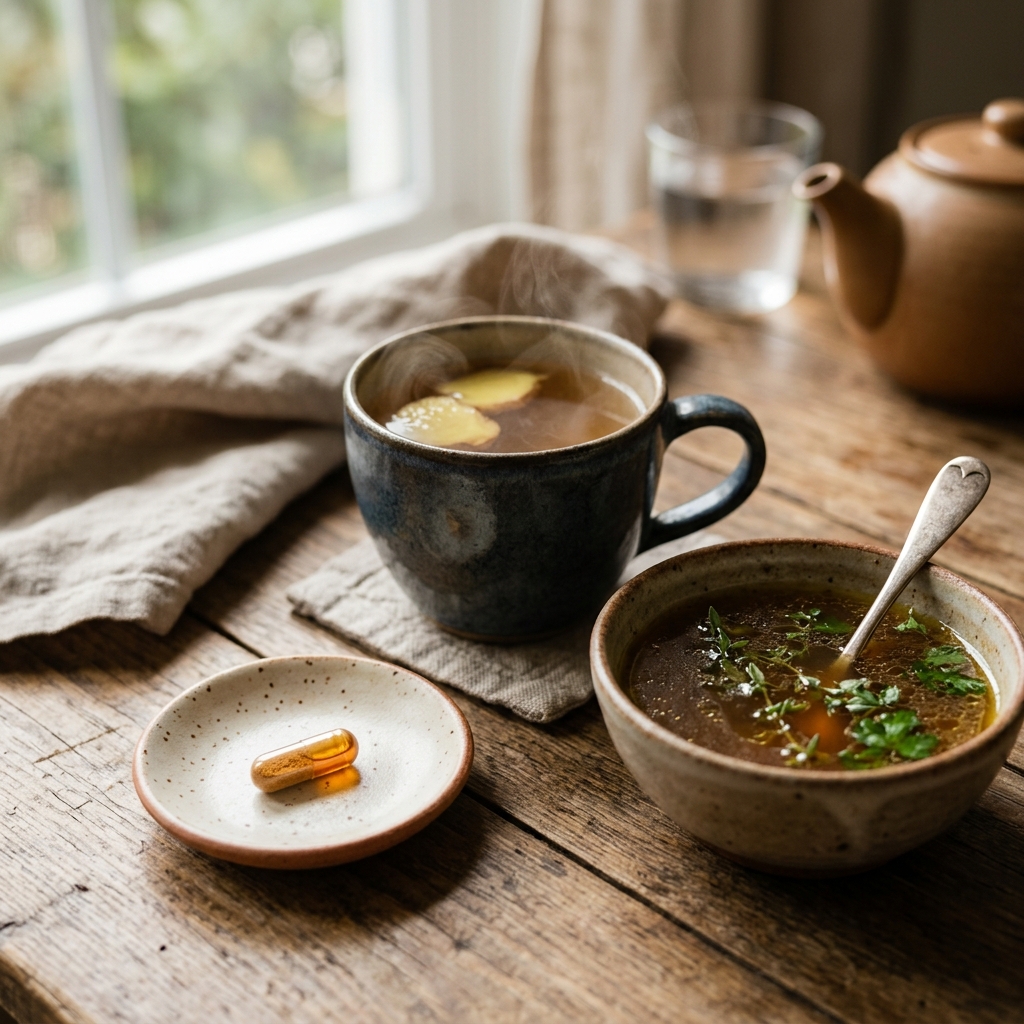
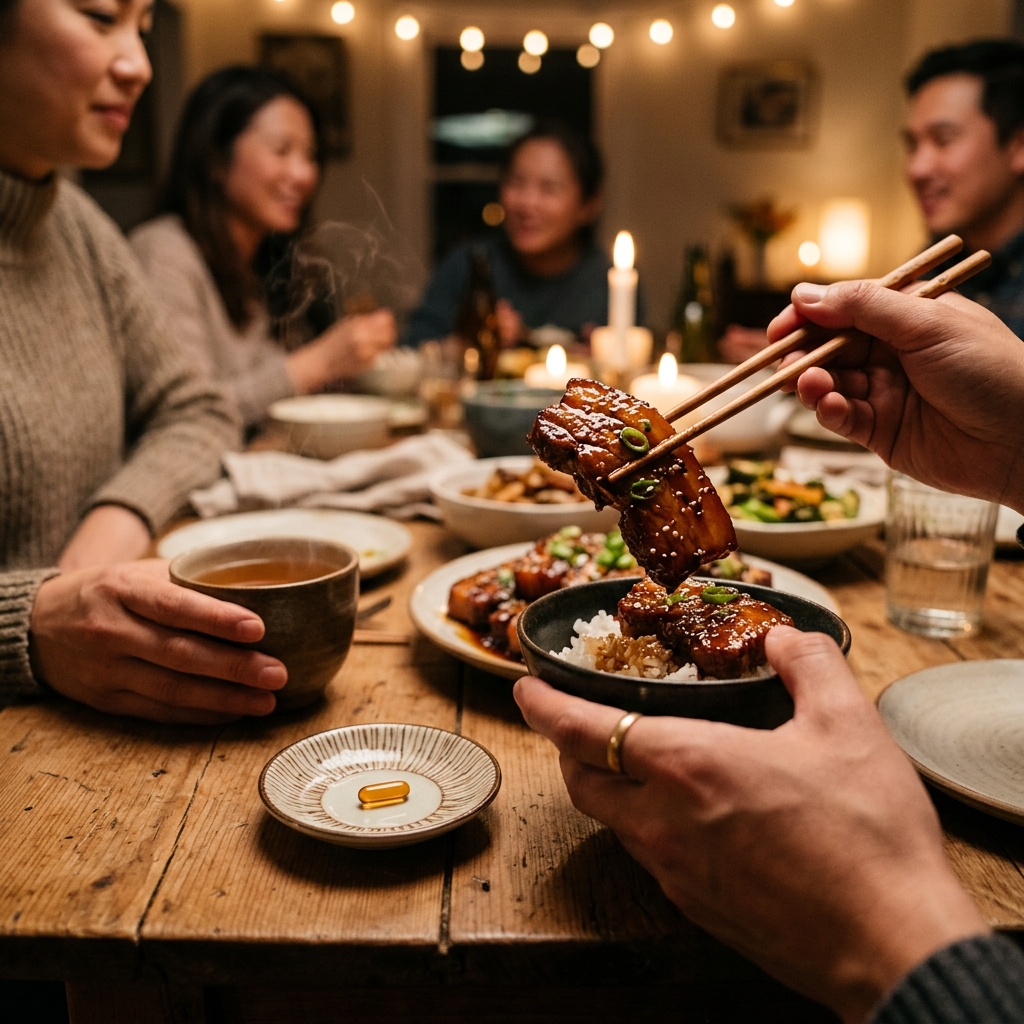
Immediately after swallowing that first bite, take your enzyme capsule with just 2–3 sips of warm liquid (around 105–120°F / 40–50°C — pleasantly warm, not scalding). Even better, use:
- Warm bone broth — rich in collagen and glutamine, soothes the gut lining.
- Light ginger tea — ginger contains the natural protease zingibain and tonifies Spleen Qi in TCM.
- Warm chamomile tea — relaxes smooth muscle, reduces bloating.
Why this works so powerfully: Warmth instantly kindles the Spleen Fire, the stomach’s smooth muscle relaxes and engages, the gelatin capsule dissolves faster and more evenly in a warm environment, and the enzyme disperses uniformly through the food mass instead of clumping.
Step 3: Finish the Meal Normally
Eat the rest of your meal as usual. By now, your enzyme is perfectly nestled in the center of the food mass, in a warm, active environment, mixed thoroughly by the stomach’s natural churning. This is the optimal operating condition.
Bonus tip for large meals (>20 minutes): For long meals — buffets, multi-course dinners, hot pot — split the dose into two: half at the first bite, half halfway through. This is exactly what PERT clinical guidelines recommend for patients managing pancreatic enzyme replacement.
Do You Need to Take Enzymes With Every Meal?
Short answer: No.
Digestive enzymes are a supportive crutch, not a permanent cane. The end goal is to use them to lighten the load on your exhausted pancreas while you rebuild your gut lining and restore your natural Spleen Qi.
When You SHOULD Take Enzymes
- Heavy, protein-dense meals: steak, seafood feasts, holiday banquets.
- Greasy meals: fried foods, fatty cuts of meat, anything deep-fried.
- Personal trigger foods: dairy (if lactose-intolerant), beans, cabbage, onions.
- Eating out — when you can’t control oil quality, freshness, or seasoning.
- When sick, recovering from surgery, or post-antibiotics: your pancreas is overworked.
When You DON’T Need Them
- Light snacks: a single apple, a handful of nuts — don’t waste a capsule.
- Very small, easy-to-digest meals: plain rice porridge, light broth soup, steamed vegetables.
- When you’re well-rested, calm, and chewing properly. Sometimes the issue isn’t enzyme deficiency — it’s eating in a rush.
One sign you’re over-relying on enzymes: you start feeling like you “can’t eat” without a pill. This is a signal to take a 1–2 week break and address root causes — manage stress at the table, chew slowly, eat at regular hours, and rebuild Spleen Qi with warm foods.
Warning: When to Consult a Doctor Before Taking Enzymes
Digestive enzymes are generally safe, but there are scenarios where you must seek medical advice first:
- On blood thinners (Warfarin, high-dose Aspirin): Bromelain and serrapeptase have mild anticoagulant effects and may increase bleeding risk.
- Currently taking antibiotics: Separate doses by at least 2 hours — enzymes can degrade some antibiotic compounds.
- Acute or chronic pancreatitis: Requires a specific PERT protocol from a gastroenterologist.
- Active stomach ulcers with bleeding: High-dose protease may irritate raw ulcer tissue.
- Pregnancy and breastfeeding: Safety data is limited; consult your OB-GYN.
- Allergies to pineapple, papaya, or Aspergillus mold: Cross-reaction possible with bromelain, papain, or fungal-source enzymes.
Absolutely avoid: taking enzymes with strong tea or coffee (tannins and caffeine inhibit enzyme activity), and taking enzymes with water hotter than 140°F (60°C) — high temperatures denature the enzymes (this is the same reason you can’t cook a pineapple and still get bromelain from it).
The Takeaway: Timing Is Everything
If you remember only three things from this article, make them these: (1) Timing is everything — never too early, never too late, “The First Bite” is the golden window. (2) Stop swallowing supplements with ice water — this is the silent saboteur happening in millions of households every day. (3) Know your three enzyme categories: general digestive enzymes (with the first bite), PERT for pancreatic insufficiency (split-dose per doctor), and Systemic Enzymes like Bromelain/Serrapeptase (empty stomach, far from meals).
In medicine — just like in a Vietnamese kitchen — great ingredients alone aren’t enough; it’s the fire and the timing that make the dish. Your body deserves both.
Tonight at dinner, try the “First Bite + Warm Sip” protocol — sit down, chew that first bite thoroughly, then take your enzyme with 2–3 sips of warm ginger tea. Come back in seven days and tell me how much lighter your stomach feels in the comments below!
Frequently Asked Questions (FAQ)
Should I take digestive enzymes before or with my meal?
The optimal timing is with the first bite or within the first few minutes of the meal. You can take them 5–10 minutes before if you’re certain you’ll start eating immediately. Strictly avoid taking them 30+ minutes before — the enzyme will flush into your small intestine before food even arrives.
If I forgot and I’m already halfway through my meal, is it too late?
No, but effectiveness drops by roughly 30–50%. Take it immediately with a sip of warm water — the enzyme can still help break down the latter half of your meal and food still in the stomach. Next time, place the bottle on the dinner table alongside your fork.
What’s the right water temperature?
105–120°F (40–50°C) — warm enough to feel comfortable against your cheek, but not hot enough to burn your hand. Avoid water above 140°F because it destroys enzymes. Avoid water below 75°F because it suppresses Spleen Fire.
I take Bromelain for joint pain. Should I take it with food?
No — this is a special case. Bromelain used for systemic anti-inflammatory purposes must be taken on a completely empty stomach — at least 30 minutes before a meal or 2 hours after — so the enzyme is absorbed intact into the bloodstream. If taken with food, it will be redirected toward digesting dietary protein instead.
Will long-term enzyme use make my pancreas lazy?
For standard-dose plant- or fungal-source enzymes (Aspergillus): no evidence of dependency or pancreatic atrophy. However, with high-dose animal-source enzymes (like Pancrelipase used in clinical PERT), there can be mild feedback inhibition. If you’re using enzymes long-term without a clinical condition, taking a 1–2 week break every few months is a smart practice.
I’ve had my gallbladder removed. Should I take a different kind of enzyme?
Yes, significantly different. You should prioritize formulas with high-dose Lipase plus added Ox Bile or Bile Acids. Without a gallbladder to release bile on demand, you need to supply your own “detergent” to emulsify fats before lipase can break them down — otherwise you’ll continue to suffer fat malabsorption and floating stools.

About Mr. Anh
We turn solid evidence into everyday habits Americans can actually do—plain English, cups/oz, grocery-aisle swaps, and routines that fit real life. Our editorial process: Experience—we road-test tips in real schedules…