Why Am I So Bloated? The 3 Root Causes Your Doctor Isn’t Telling You
It’s an incredibly frustrating experience. You wake up with a relatively flat stomach, feeling energized and ready to take on...
It’s an incredibly frustrating experience. You wake up with a relatively flat stomach, feeling energized and ready to take on the day. You intentionally choose a “healthy” lunch—perhaps a massive kale salad with grilled chicken, chickpeas, and a raw green juice. You’re doing everything right by modern nutritional standards.
Yet, within 30 minutes, your stomach balloons outward. You feel heavy, sluggish, and uncomfortably distended. You find yourself secretly unbuttoning your pants under your desk, wondering, “Why am I so bloated when I eat so clean?”
For years, the standard medical advice for bloating has been frustratingly generic: Eat slower. Drink more water. Avoid salt. Stop chewing gum. But if you are someone who has tried all of these surface-level tips and still looks six months pregnant after eating an apple, you already know those tips don’t work.
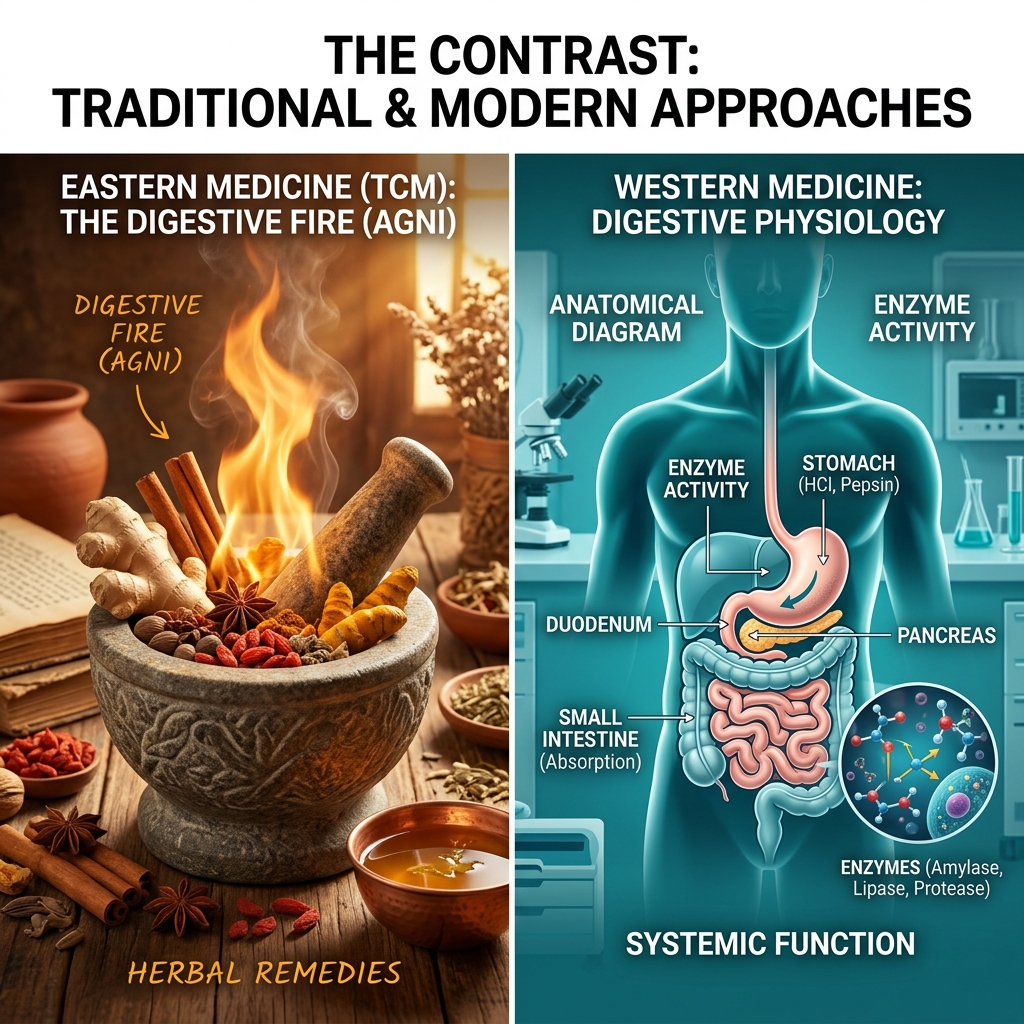
In Traditional Oriental Medicine, which has studied digestion for over 3,000 years, we view the digestive system not just as a tube of acid, but as a “Furnace” (The Spleen and Stomach Qi). In modern functional medicine, we call this the Gut Factory. When your furnace loses its fire, or your factory breaks down, food doesn’t digest—it rots.
The truth is, not all bloating is the same. To banish the bloat, you must first identify which of the three types of bloating you are suffering from. Today, we are going to bridge the gap between ancient Eastern wisdom and modern Western science to uncover the three root causes of your bloating—and exactly how to fix them.
Type 1: “Why am I so bloated and gassy after eating?” (The Food Paradox)
If your stomach is relatively flat in the morning but swells up tightly immediately after meals—accompanied by frequent burping or flatulence—you are experiencing Type 1: Acute Digestive Bloating.
The Clean Eating Paradox
This is the most common and often the most misunderstood form of bloating. Many people switch to a plant-based diet, load up on raw salads, beans, and high-fiber cruciferous vegetables (like broccoli and cauliflower) in an attempt to get healthier. But instead of feeling vibrant, their digestion completely crashes.
In Oriental Medicine, this is a classic case of “Spleen Qi Deficiency” caused by “Cold and Damp” foods. The Spleen (the digestive furnace) requires heat and energy to “cook” and transform food into usable energy. Raw vegetables and cold salads are energetically “Cold.” If your digestive fire is already weak from stress or aging, dumping a bowl of raw, cold vegetables into it completely extinguishes the fire. The food sits there, cold and stagnant.
The Missing “Scissors” (Digestive Enzymes)
From a modern Western perspective, we explain this through the “Factory Metaphor.” Your food is like a long pearl necklace. Your body cannot absorb the whole necklace; it needs individual pearls.
To cut the necklace, your pancreas produces Digestive Enzymes (the biological “scissors”). However, modern diets, chronic stress (which shifts the body into ‘Fight or Flight’ mode), and aging severely deplete your body’s natural enzyme production.
If you eat a massive bowl of raw kale, but you lack the specific enzyme (cellulase) to break down plant walls, or the enzyme (alpha-galactosidase) to break down complex bean sugars, the food travels down into your large intestine completely intact.
The Bacterial Feast
Once that large, undigested piece of food hits your lower colon, the trillions of probiotics living there throw a feast. They ferment the undigested rotting food. The byproduct of this bacterial fermentation is massive amounts of hydrogen and methane gas.
This gas becomes trapped in the winding tunnels of your intestines, expanding outward and causing that painful, tight, drum-like swelling in your abdomen. You aren’t fat; your intestines are literally inflated with bacterial gas.
Quick Takeaways for Type 1:
– You lack the “fire” (enzymes) to break down raw/complex foods.
– Healthy foods rot in the gut and are fermented by bacteria.
– The Fix: Cook your vegetables to pre-digest them (adding “fire”), and supplement with a broad-spectrum Digestive Enzyme before heavy meals to act as your missing “scissors.”
Type 2: “Why am I so bloated on my period?” (The Water Trap)
If your bloating follows a strict monthly calendar, appearing 3 to 7 days before your menstrual cycle and vanishing a few days after it starts, you are dealing with Type 2: Hormonal Bloating.
Women often feel guilty during this time, assuming they ate too much chocolate or salty food. However, it is crucial to understand that period bloating is not gas.
Gas vs. Water Retention
While Type 1 bloating is caused by air bubbles in the intestines, Type 2 bloating is caused by Water Retention (Edema) at the cellular level. Your cells are acting like tiny sponges, soaking up and holding onto water.
In Eastern medicine, this pre-menstrual phase is deeply connected to the Liver. The Liver governs the smooth flow of Qi (energy) and blood. When stress or hormonal shifts occur, it causes “Liver Qi Stagnation.” Energy gets blocked in the lower abdomen, causing fluids (Dampness) to accumulate rather than flush out.
The Estrogen and Progesterone Rollercoaster
Western endocrinology backs this up perfectly. In the days leading up to your period, your estrogen and progesterone levels wildly fluctuate.
- Estrogen surges can trigger the kidneys to retain more sodium. Where sodium goes, water follows. This causes widespread cellular swelling, making your rings feel tight and your stomach feel heavy and puffy.
- Progesterone drops right before bleeding begins. However, while progesterone was high (during the luteal phase), it acted as a muscle relaxant.
The Paralyzed “Janitor” (MMC)
That muscle-relaxing effect of progesterone has a devastating side effect on digestion. It slows down the smooth muscle contractions of your GI tract[1].
Your gut has a built-in “Janitor” called the Migrating Motor Complex (MMC). Every 90 minutes, it sends a sweeping wave to push waste out. Progesterone effectively paralyzes the Janitor. Digestion grinds to a halt, leading to pre-menstrual constipation. The physical backup of stool in the colon physically pushes the abdominal wall outward, compounding the water retention.
Quick Takeaways for Type 2:
– The bloating is water and stool backup, not bacterial gas.
– Hormones tell the body to hoard sodium and paralyze the gut’s “Janitor.”
– The Fix: Counterintuitively, you must drink more water to flush the sodium out. Supplement with Magnesium Glycinate to relax the bowel muscles and stimulate a bowel movement, relieving the physical pressure.

Type 3: “Why am I so bloated all the time?” (The Chronic Red Flags)
This is the most severe and exhausting form of bloating. If you wake up bloated, go to sleep bloated, and look distended even if you drink nothing but water, you are dealing with Type 3: Chronic Gut Dysfunction.
This is no longer just a temporary reaction to a heavy meal or a monthly cycle. This means the structure of your “Gut Factory” is compromised. In Oriental Medicine, this is a deep state of “Spleen and Stomach Yang Deficiency” combined with “Damp-Heat.” The furnace is completely broken, and toxic dampness has settled deep into the tissues.
In Functional Medicine, we look for three major red flags:
1. Low Stomach Acid (Hypochlorhydria)
Most people believe heartburn and acid reflux are caused by too much acid. In reality, it is usually caused by too little acid. Stomach acid (HCl) is the spark plug of digestion. It sterilizes your food and signals the pancreas to release enzymes.
If chronic stress, aging, or years of taking antacids (like Omeprazole) have destroyed your stomach acid, food sits in your warm stomach and putrefies. This rotting food creates upward gas pressure (causing reflux) and eventually dumps undigested into the small intestine.
2. SIBO (Small Intestinal Bacterial Overgrowth)
Remember the “Factory Workers” (Probiotics) that live in your large intestine? They belong down there. The small intestine, where nutrient absorption happens, is supposed to be relatively sterile.
However, if your stomach acid is low, or your MMC “Janitor” is broken (from chronic snacking or stress), the bacteria from the large intestine can crawl backward up into the small intestine. This is SIBO[2]. Now, the moment you eat a piece of fruit or a carbohydrate, these misplaced bacteria ferment the sugars immediately in the upper gut, causing instant, severe, and painful bloating right below the ribcage.
3. Leaky Gut Syndrome & Chronic Inflammation
When undigested food particles and bacterial toxins constantly bombard the delicate lining of your intestines, the lining becomes inflamed and microscopic holes open up. This is Leaky Gut.
Toxins leak into the bloodstream, putting your immune system into overdrive. The constant, low-grade inflammation causes the tissues of the abdominal wall to swell. You aren’t just filled with gas; your actual intestinal tissues are inflamed, red, and swollen, causing a permanent distended look.
Quick Takeaways for Type 3:
– The bloating is a structural issue: Low Acid, Misplaced Bacteria (SIBO), or Tissue Inflammation (Leaky Gut).
– The Fix: Stop snacking to let the MMC Janitor work. You must heal the gut lining with collagen/bone broth (a deeply nourishing ‘Yang’ food in Eastern medicine) and address the bacterial overgrowth with a functional medicine practitioner.
The “Deflate” Protocol: How to Banish Bloating for Good
- Supply the Scissors (Fix Type 1): If you are eating healthy foods but feeling awful, your pancreas is tired. Before your largest meals, take a high-quality, plant-based Digestive Enzyme supplement. It will break down the fiber and proteins before the bacteria can ferment them into gas.
- Warm the Furnace (Eastern Wisdom): Stop drinking ice water with your meals. Cold extinguishes the digestive fire. Drink room temperature water or warm ginger tea. Cook your vegetables instead of eating raw, massive salads, especially if you have a weak gut.
- Activate the Janitor (Intermittent Fasting): The MMC only sweeps the gut when you are fasting. If you snack every 2 hours, the janitor never works, and bacteria overgrow. Leave at least 3 to 4 hours of zero caloric intake between meals.
- Flush the Water (Fix Type 2): During your period, increase hydration and potassium-rich foods to push the retained sodium out of your cells.
When Is Bloating a Medical Emergency?
While functional bloating is common and highly treatable, sudden or severe changes in your abdomen should never be ignored. Please consult a gastroenterologist immediately if your bloating is accompanied by:
- Unexplained, rapid weight loss.
- Severe, sharp, unremitting abdominal pain.
- Black, tarry stools or visible blood in the toilet.
- An absolute inability to pass gas or have a bowel movement for several days.
Medical References
- [1] “Gastrointestinal transit: the effect of the menstrual cycle.” National Center for Biotechnology Information (NCBI). Available from: https://www.ncbi.nlm.nih.gov/
- [2] “Small Intestinal Bacterial Overgrowth (SIBO) and hypochlorhydria.” National Institutes of Health (NIH) Clinical Studies. Available from: https://www.ncbi.nlm.nih.gov/

About Mr. Anh
We turn solid evidence into everyday habits Americans can actually do—plain English, cups/oz, grocery-aisle swaps, and routines that fit real life. Our editorial process: Experience—we road-test tips in real schedules…