Digestive Enzymes vs Probiotics: Stop Treating Them Like Rivals — Here’s the Order That Actually Works
Digestive Enzymes vs Probiotics: Stop Treating Them Like Rivals — Here’s the Order That Actually Works Every single month, thousands...
- TL;DR — The Difference in One Sentence
- What Each One Actually Does — The Western Science View
- Order Matters: Why Most People Get It Backwards
- The Eastern View: "Light the Furnace First, Plant the Field Second"
- Decision Tree — Which One Do YOU Actually Need?
- Can You Take Them at the Same Time? (Timing Protocol)
- What About Synbiotics?
- Food-First Always Wins — Get Both From Your Plate
- When NOT to Take Any Supplement
- Summary & Key Takeaways
- Frequently Asked Questions (FAQ)
Digestive Enzymes vs Probiotics: Stop Treating Them Like Rivals — Here’s the Order That Actually Works
They Google “digestive enzymes vs probiotics, which is better?” and fall into a maze of articles that all conclude with the same wishy-washy line: “Each has its own benefits — it’s best to take both.”
That answer isn’t wrong. But it’s missing one critical piece: the order.
The real question isn’t “which is better?” The real question is: in what order are you taking them?
Through years of researching this topic and applying these principles on myself, my family, and close friends, I’ve come to one clear conclusion: 90% of gut supplement users are wasting their money — not because the products are bad, but because they’re throwing seeds onto dry concrete. As someone trained in Traditional Oriental Medicine (a dedicated researcher, not a clinician) with a deep love for Western health science, today I’ll share with you the simple two-step order that transformed my own digestion and that of many friends I’ve shared it with.
TL;DR — The Difference in One Sentence
- Digestive Enzymes act on WHAT YOU JUST ATE — chopping food into absorbable nutrients. Immediate effect, within minutes.
- Probiotics act on WHO LIVES INSIDE YOUR GUT — replenishing and balancing the colonic microbiome. Gradual effect, over days to weeks.
- They don’t compete and they don’t kill each other — they operate in different locations, on different timescales. And the order you take them matters more than which one you pick.
What Each One Actually Does — The Western Science View
Before talking about “order,” let’s understand each character in the story.
Digestive Enzymes — “The Scissors”
Digestive enzymes are non-living proteins (not bacteria). Their sole job is to cut complex nutrient chains into microscopic, absorbable molecules [1]. Picture a long pearl necklace — your body can’t swallow the whole string; it can only absorb one pearl at a time.
- Where they work: Stomach and small intestine — the entire “operation” happens within 60–90 minutes after eating.
- The Big Three: Amylase (starch), Protease (protein), Lipase (fat).
- Speed: Immediate. The moment you take your first bite, salivary amylase is already at work.
- Supplement sources: Plant-based (papain from papaya, bromelain from pineapple), fungal (Aspergillus — acid stable), animal-based (pancreatin — requires enteric coating).
For a deeper look at enzyme structure and types, see our What Are Digestive Enzymes — Complete Guide.
Probiotics — “The Workers”
Probiotics are living bacteria. They do not break down the steak in your stomach. This is the single most common misconception — and it’s why millions of probiotic bottles get bought for the wrong reason.
The actual job of probiotics is to:
- Ferment dietary fiber into SCFAs (short-chain fatty acids) — the fuel for your intestinal lining cells.
- Compete for space with harmful bacteria to maintain microbial balance.
- Modulate immunity — 70% of your body’s immune cells reside in the gut.
- Produce certain vitamins in the B and K2 groups [2].
Common strains: Lactobacillus, Bifidobacterium, Saccharomyces boulardii. Unit of measurement: CFU (Colony Forming Units — count of living cells). Speed of effect: slow — 2 to 8 weeks for noticeable shifts.
Primary location: The colon (large intestine). Not the stomach. Not the small intestine. This single detail is what explains the “disaster” coming up next.
Order Matters: Why Most People Get It Backwards
This is the heart of the article.
The Fermentation Disaster
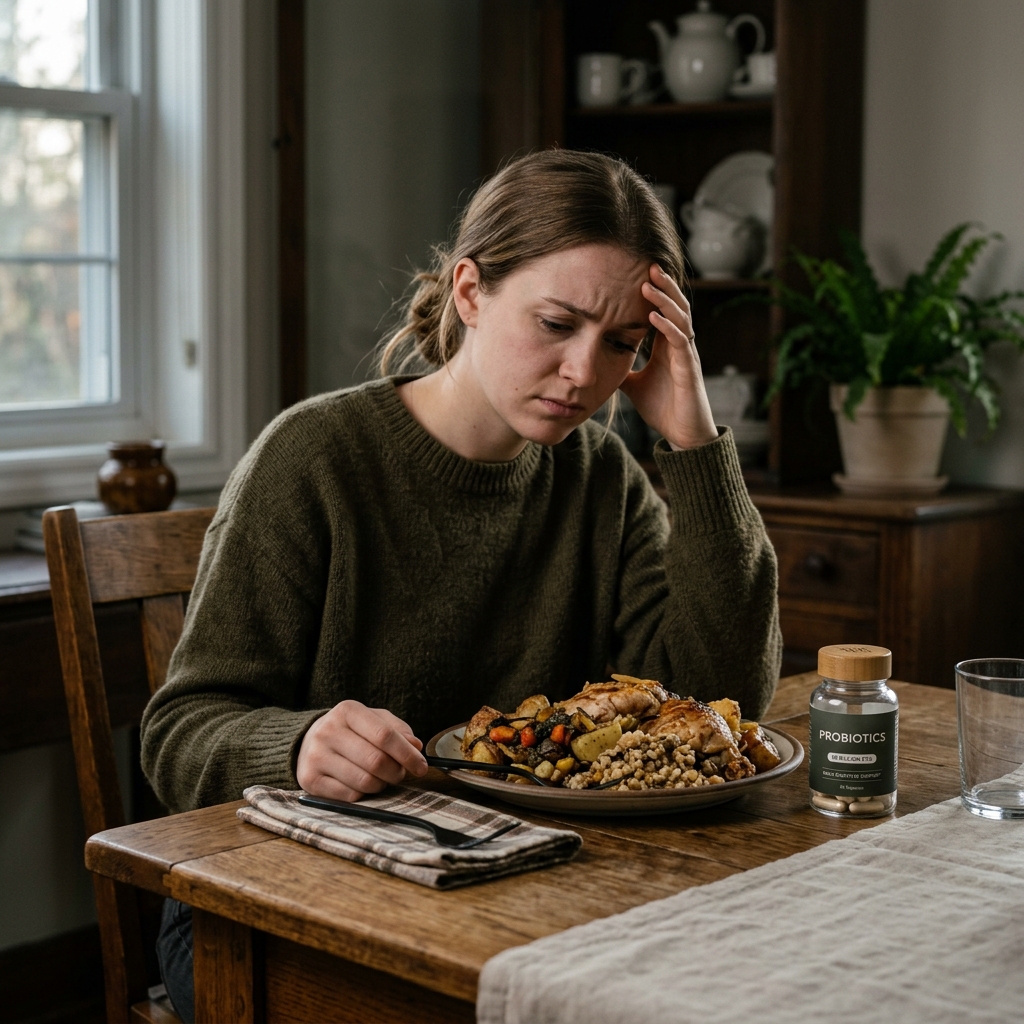
Picture this scenario — I suspect many readers will recognize themselves:
- You eat a heavy, oily stir-fry with rice and a side of fried vegetables.
- Your pancreas is stressed (deadline at work, sleep-deprived) → it releases insufficient enzymes.
- The unbroken-down food mass — protein not yet cleaved into amino acids, fat not yet emulsified — slides from your small intestine straight into the colon, still in chunks.
- Meanwhile, an hour earlier, you took a “top-tier” 50-billion-CFU probiotic capsule.
- The fresh probiotics arrive in the colon and discover… an enormous raw-food feast.
- They “eat their fill.” Anaerobic fermentation explodes.
- Result: methane and hydrogen sulfide gas — distended belly, sulfur-smelling flatulence, heavy bloating that lingers for hours.
The irony: the more probiotics you take, the worse it gets. This isn’t the probiotic’s fault. It’s the fault of skipping the enzyme step upstream.
The Golden Rule — Enzymes FIRST, Probiotics SECOND
After years of personal experimentation and conversations with friends who tried this, I’ve distilled a simple protocol:
- Phase 1 (Weeks 1–4): If you’re currently bloated + struggling with digestion → only take enzymes with every heavy meal. Goal: “clean up” the gut, ensure food is being broken down completely.
- Phase 2 (From Week 5): Once digestion stabilizes (lighter belly, formed stools, reduced gas) → only then introduce probiotics to rebuild the ecosystem.
- Reverse this order = wasted money + worsened symptoms.
I’ve shared this protocol with roughly a dozen friends who’d been “addicted” to probiotics for years without seeing results. Most of them reported back after four weeks: their bellies felt noticeably lighter, the gas reduced dramatically — just from changing the order.
The Eastern View: “Light the Furnace First, Plant the Field Second”
This is the perspective I love most, and it’s the angle nearly every Western article misses.
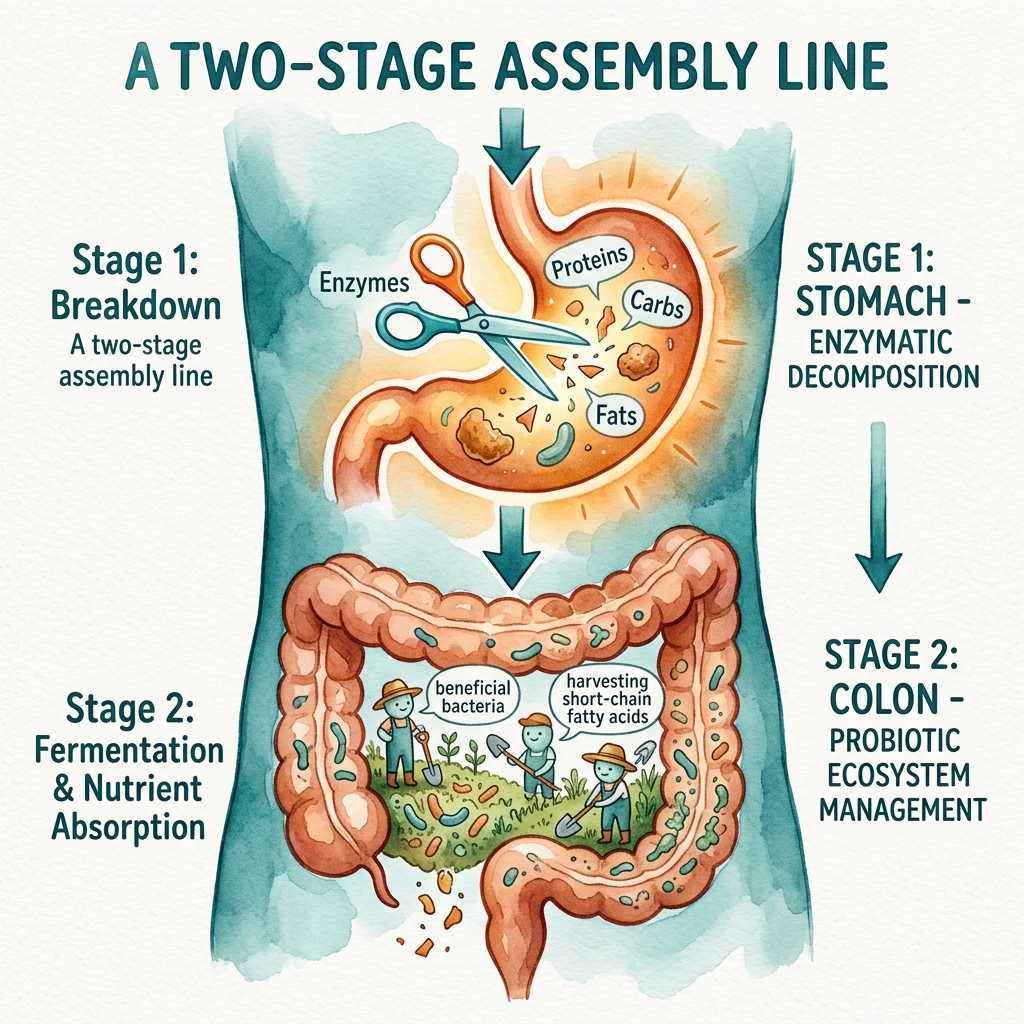
In Traditional Chinese Medicine (TCM), digestion isn’t a cold chemical reaction. It’s a two-stage process:
Stage 1 — Cooking (Stomach + Small Intestine)
The Spleen is the furnace, the stomach is the pot. Spleen Qi is the heat of the furnace, “cooking” food. Enzymes correspond to this heat — they “cook” food at the molecular level, transforming raw substrate into pure essence.
Stage 2 — Planting (The Colon)
The colon in TCM resembles a field — where the microbial ecosystem flourishes. Probiotics correspond to the farmers — tending the soil, planting seedlings, maintaining the ecosystem.
No Vietnamese farmer plants rice in soil still littered with uncleared rocks, with weeds unculled and water not yet drained. They clear the field first, then plant. The Spleen Fire must burn first, food must be “cooked,” before the colon is ready to receive probiotics.
Practical lesson: A warm meal + chewing 20 times per bite + a small dish of raw fermented vegetables on the side = you’ve simultaneously lit your Spleen Fire and delivered natural probiotics. The body rebalances itself. No 50-billion-CFU probiotic capsule required.

Decision Tree — Which One Do YOU Actually Need?
Quick reference table:
| Situation / Symptom | Enzyme Priority | Probiotic Priority | Both | See Doctor First |
|---|---|---|---|---|
| Bloating IMMEDIATELY after eating (within 30 min) | ✅ | |||
| Bloating LATE (2–4 hours after eating) | ✅ | |||
| Floating, greasy stools | ✅ (Lipase) | |||
| After long antibiotic course | ✅ | |||
| All-day bloating, irregular bowel movements | ✅ | |||
| Post-surgery / recovering from illness | ✅ | |||
| Suspected SIBO (bloating + burping within 1 hour) | ⚠️ Cautiously | ❌ May worsen | ✅ | |
| IBS-D (chronic diarrhea) | ⚠️ Strain-dependent | ⚠️ Strain-dependent | ✅ | |
| Healthy, eats vegetables daily | ❌ Not needed | ❌ Not needed |
The SIBO/IBS Warning — The Most Important Section in This Article
This is the angle 99% of other articles avoid, but I think you deserve to know:
If you suspect you have SIBO (Small Intestinal Bacterial Overgrowth), do NOT self-prescribe probiotics. In SIBO, bacteria have already overgrown the small intestine — a place that should be nearly sterile. Adding probiotics to this situation = pouring gasoline on a fire [3].
Red flags for SIBO:
- Bloating + burping within 1 hour of eating (especially after carbs or sugar).
- Undigested food visible in stool, feeling of “raw food passing through.”
- Severe post-meal fatigue.
- Low vitamin B12 despite adequate diet.
→ See a gastroenterologist for a hydrogen breath test before buying any supplement on your own. During this phase, enzymes may actually be safer than probiotics because they reduce the “leftover food” available for bacterial overgrowth.
For a full breakdown of bloating types and their root causes, see Why Am I So Bloated?
Can You Take Them at the Same Time? (Timing Protocol)
Short answer: Yes, safely [4]. But there are three options — from simplest to most optimized.
Option A — Take Them Together (Simplest)
- Both enzyme and probiotic with the “First Bite” of your meal.
- Best for: beginners who don’t want to track multiple time-points.
- Limitation: some acid-sensitive probiotic strains will partially die off in the stomach.
Option B — Stagger the Timing (Optimized)
- Morning (empty stomach): An enteric-coated probiotic capsule — most cells survive the stomach and reach the colon intact.
- With lunch and dinner: An enzyme capsule with the “First Bite + 2–3 sips of warm liquid” protocol.
Option C — Synbiotic (Pre-Combined)
Products combining Probiotic + Prebiotic (the fiber that feeds the bacteria). Convenient, but you still take enzymes separately if you have digestive issues.
For detailed timing and the “First Bite + Warm Sip” protocol, see When to Take Digestive Enzymes.
What About Synbiotics?
- Definition: Synbiotic = Probiotic (live bacteria) + Prebiotic (the fiber that feeds them).
- Scientific evidence: A 2025 meta-analysis of 5,207 participants across 90 randomized controlled trials found synbiotics outperformed prebiotics alone for reducing inflammatory biomarkers [5].
- When to use: Post-antibiotics, post-food-poisoning, or while recovering from damaged intestinal lining [6].
- Cannot replace enzymes — because neither probiotics nor prebiotics can cut protein or fat in your meal.
Food-First Always Wins — Get Both From Your Plate
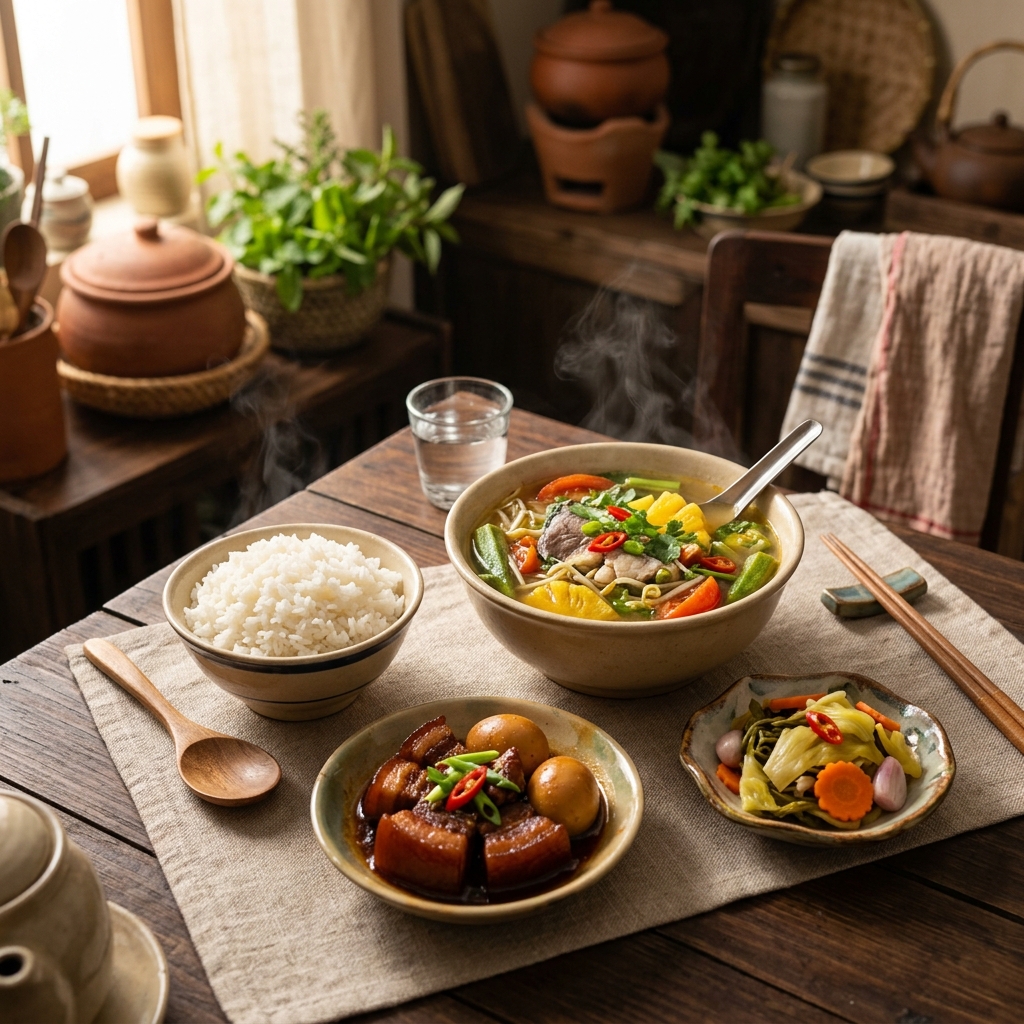
Before reaching for a pill, look at your plate:
Natural enzyme sources: Fresh pineapple (Bromelain), green papaya (Papain), fresh ginger (Zingibain), raw honey, avocado (natural lipase), kiwi (Actinidin). Read more: Pineapple digestive enzymes — Bromelain and Foods high in natural digestive enzymes.
Natural probiotic sources: Raw, unpasteurized sauerkraut, kimchi, Vietnamese pickled vegetables, kefir, miso, natto, unsweetened kombucha.
Natural prebiotic sources (feeding the probiotics): Garlic, onions, leeks, asparagus, green bananas, oats.
A balanced Vietnamese meal — white rice + sour pineapple soup + braised meat + a side of pickled vegetables + a small dish of kimchi — already delivers all three categories naturally. Our ancestors figured this out long before the supplement industry existed.
When NOT to Take Any Supplement
- You’re healthy, regular, no bloating → none needed.
- Eating enough vegetables, fermented foods, sleeping well, low stress → your body self-regulates.
- You have a diagnosed medical condition requiring treatment → see your doctor, don’t replace medication with supplements.
My personal rule, one I share with family and friends: supplements are a temporary crutch, not a permanent cane. The ultimate goal is always to return to whole foods + a balanced lifestyle. Don’t spend the rest of your life dependent on a pill bottle.
Summary & Key Takeaways
If you remember only three things from this article: (1) This isn’t a contest — it’s a two-stage assembly line. Enzymes chop food (stomach + small intestine), Probiotics tend the microbiome (colon). (2) Order matters. Enzymes first (light the furnace), Probiotics second (plant the field). Reverse the order = fermentation disaster. (3) Suspect SIBO/IBS → see a doctor BEFORE taking probiotics. In these conditions, probiotics can make things worse.
CTA — Action for This Week: Have you been bloated despite six months of religious probiotic use? Try a two-week probiotic break, replaced with enzymes at every heavy meal (+ warm meals, chewing 20 times per bite). After 14 days, journal how your stomach feels — and come back to share your results in the comments below!
Frequently Asked Questions (FAQ)
What’s the difference between digestive enzymes and probiotics?
Enzymes are non-living proteins that cut food in the stomach and small intestine, with immediate effect. Probiotics are living bacteria that tend the colonic ecosystem, with effects unfolding over 2–8 weeks. Different in nature, location, and timescale.
Can I take them at the same time?
Completely safe. The simplest approach: take both with the “First Bite” of your meal. The optimized approach: probiotic in the morning on an empty stomach, enzymes with lunch and dinner.
Which is better for bloating?
Bloating immediately after eating (<30 min) → prioritize enzymes. Late bloating + irregular bowels → prioritize probiotics. Both work if your symptoms are mixed. If SIBO is suspected → see a doctor first.
Do digestive enzymes “kill” probiotics?
No. Enzymes break down food (carbs, protein, fat), not living bacterial cells. Probiotics survive and function normally when taken alongside enzymes.
Should I take enzymes or probiotics first?
If you’re unsure where to start → begin with enzymes for 2–4 weeks. Once digestion stabilizes (lighter belly, formed stools) → then add probiotics.
What happens if I take probiotics without enzymes?
If your digestion is already strong → you’re fine, probiotics still help. If your digestion is weak → undigested food meeting fresh probiotics = excessive fermentation, worse bloating (the “fermentation disaster” scenario I described).
Do I need both?
Not everyone does. If you’re healthy + eating vegetables + fermented foods regularly → you may not need either. Only supplement when symptoms warrant it or when recovering from illness. The ultimate goal is independence from any supplement bottle.

About Mr. Anh
We turn solid evidence into everyday habits Americans can actually do—plain English, cups/oz, grocery-aisle swaps, and routines that fit real life. Our editorial process: Experience—we road-test tips in real schedules…