Mediterranean Meal Prep: 90-Min Sunday System (20+ Meals)
Mediterranean eating failed you before — not because of willpower, but because of system. This 90-minute Sunday Component Prep Method gives you 5 prepared elements and 20+ different meals all week in under 5 minutes each. No food fatigue, no sad reheated bowls.
You’ve done Mediterranean eating before. It worked — for about nine days.
You felt lighter, slept better, had actual energy in the afternoon. Then Wednesday hit. You’d planned to bake salmon but the fillet had been in the fridge since Sunday. Nothing was prepped. Takeout made more sense. By Friday, the “Mediterranean lifestyle” was a nice memory.
Here’s what actually went wrong — and it wasn’t willpower: you were trying to cook every night. That’s not how this diet actually works. The Greek islanders and southern Italian families who inspired the research weren’t making fresh dinners from scratch seven nights a week. They were assembling meals from components they’d already prepared: a pot of white beans, a tray of roasted peppers, good olive oil always on the counter. The cooking was already done.
This guide teaches you the Mediterranean Component Prep Method — a 90-minute Sunday system that gives you 5 prepared elements and 20+ different meal combinations for the entire week. Every bowl tastes different. Nothing reheats into sadness. And every single one comes together in under 5 minutes.
By the end of this guide, you’ll have a complete Sunday routine, a mix-and-match meal matrix you can print out, and the three sauces that make every Mediterranean meal taste genuinely fresh — even on Friday.
Quick Takeaways:
- Mediterranean prep is built on components, not complete meals — this is the cultural difference most people miss
- 5 components prepped Sunday → 20+ different meals all week, each in under 5 minutes
- The 3-sauce system is what prevents food fatigue by Wednesday
- This system is the natural continuation after a structured anti-inflammatory meal plan
- Total Sunday time: ~90 minutes (75 active, 45 hands-off oven time)
Mediterranean Component Prep: 5 building blocks prepped once, 20+ meals assembled all week
Why Mediterranean Meal Prep Works Differently from Standard Prep
Open almost any meal prep guide and the approach is identical: cook seven complete meals on Sunday, divide into labeled containers, reheat Monday through Sunday. It works for about four days. Then the container that was exciting on Monday becomes something you stare at with mild dread by Thursday.
Mediterranean prep is structurally different. The difference is cultural, and it matters.
The Mediterranean Prep Philosophy: Components, Not Complete Meals
Greek home cooks and southern Italian families don’t pre-portion seven dinners. They prepare ingredients: a pot of simmered lentils or chickpeas, a tray of roasted vegetables, a jar of something acidic (capers, olives, pickled peppers), good bread, and quality olive oil always within reach. From these, meals are assembled at serving time — not reheated from a sealed container.
I started cooking this way after spending two weeks eating at a family-run agriturismi in Sicily — and for the first time, the whole Mediterranean lifestyle actually clicked. There was always food around. Nothing was “ready to eat” exactly, but everything came together in minutes. That’s the system.
The research backs this up. A 2020 study published in Preventive Medicine Reports found that Mediterranean diet adherence was significantly higher among participants who ate flexibly — varying ingredients within consistent food patterns — compared to those rigidly following pre-set daily menus. In other words: variety within a system beats repetitive perfection. Every time.
Why Mediterranean Prep Doesn’t Get Boring by Wednesday
Sound familiar? Here’s what actually prevents the Wednesday wall:
Fresh herbs go on at serving, not in the container. Cooked herbs lose their aromatics and color. Mediterranean food’s signature brightness — the fresh parsley, dill, and basil — is always added just before eating. Never reheated inside a container.
Acid is added fresh every time. A squeeze of lemon, a splash of red wine vinegar, a few capers dropped over the top. This is what separates vibrant Mediterranean cooking from sad reheated grain bowls. The same base component tastes completely different with lemon tahini versus roasted garlic olive oil.
A rotating sauce trio changes everything. The same farro-and-salmon bowl with three different sauces is three entirely different meals. We’ll cover all three — they’re the single most important piece of this system.
Already following an anti-inflammatory meal plan? Mediterranean prep is the natural Week 5 and beyond — the stage where eating this way stops feeling intentional and starts feeling automatic.
The 5-Component Mediterranean Prep System
This is the core of everything. Every meal you’ll eat this week comes from these five components. Prep each one on Sunday, and the rest of the week is five minutes of assembly.
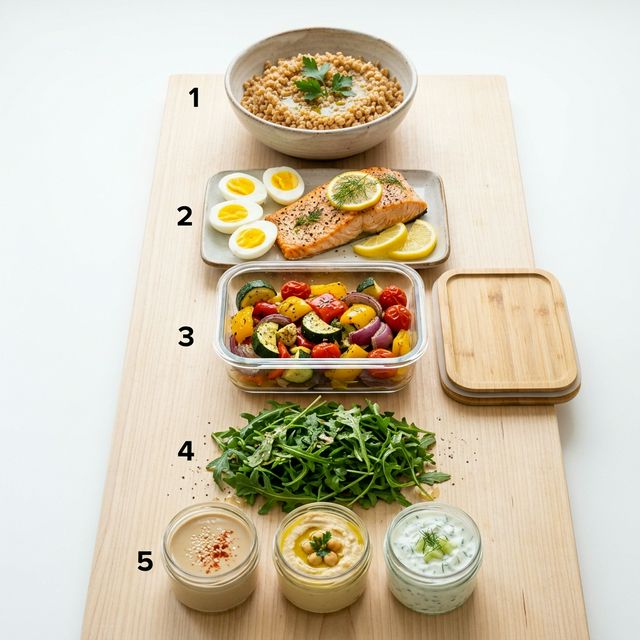
Component 1: The Grain Base (20 minutes, mostly hands-off)
One pot. One grain. The foundation of 80% of your meals.
Your three options:
- Farro — The most nutritionally aligned with traditional Mediterranean eating. Chewy, nutty, high in fiber, holds its texture beautifully after 4–5 days refrigerated. Takes 25–30 minutes to cook. Worth the extra time.
- Quinoa — Fastest (15 minutes), highest in protein of the three, naturally gluten-free. Slightly more neutral flavor — great if you want the grain to be background, not feature.
- Brown rice — Most versatile, cheapest, most familiar. The quiet backdrop that makes everything else shine.
How to cook in bulk: 1.5 cups dry grain + 3 cups water (farro needs 2.5 cups). Bring to a boil, reduce to a simmer, cover, walk away. Season only with a pinch of salt while cooking — you’ll season each assembled bowl at serving time.
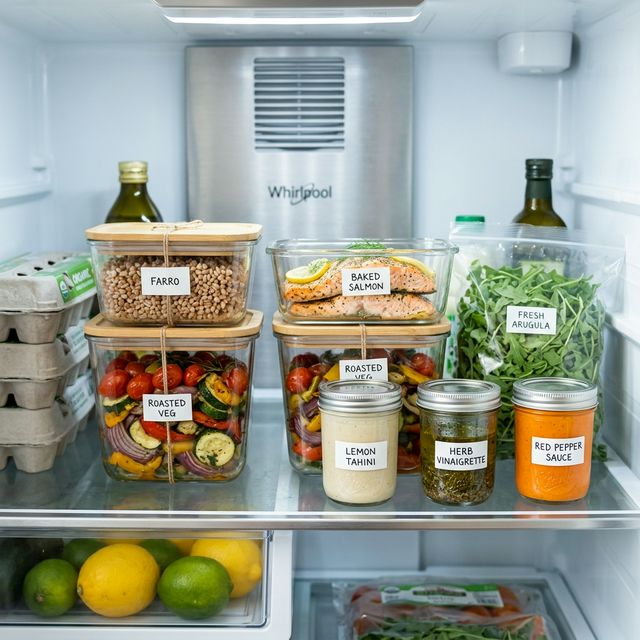
Storage: 5 days refrigerated, 3 months frozen. Store in a wide, shallow glass container for easiest scooping. I label mine with masking tape and a marker — it sounds fussy but takes 10 seconds and prevents the “what is this?” moment Thursday night.
Component 2: The Proteins (30 minutes total, all happening while the oven’s already on)
Mediterranean eating is protein-smart, not protein-heavy. You want 2–3 sources that work in different contexts — some hot, some cold, some in-between.
Baked salmon (2–3 fillets, 6–8 oz each): Line a baking sheet with parchment. Drizzle fillets with extra virgin olive oil, squeeze half a lemon over them, season with dried oregano and black pepper. Bake at 400°F for 12–14 minutes. This is your highest-value protein — wild salmon is one of the richest dietary sources of EPA and DHA omega-3 fatty acids, the specific types that directly inhibit COX-2 enzyme pathways linked to inflammatory signaling. A 2018 review published in Nutrients found that regular fatty fish consumption reduced serum CRP — a primary inflammatory marker — by 20–30% in adults with elevated baseline levels.
Hard-boiled eggs × 6: Drop them into already-boiling water, cook exactly 10 minutes, immediately transfer to ice water. Unpeeled, they keep 7 full days. Peel as needed. These are your fastest protein — slice and drop over any bowl, eat alongside as a snack, or crumble into a salad.
No-cook pantry proteins: Rinsed chickpeas and white beans from the can. Drain, rinse, done. One can of chickpeas delivers 21g protein per cup. These are your emergency proteins — when the salmon’s gone and the eggs are all eaten, you’re never without something substantial.
The quality gap here is real, especially with canned fish and olive oil. Wild-caught canned salmon, organic chickpeas, and a genuine Greek or Italian EVOO taste noticeably different from conventional versions. I restock these through Thrive Market, which stocks all three at 25–50% below grocery prices — EVOO, wild-caught salmon, and organic legumes as standard. The membership costs around $5/month and typically pays for itself in a single pantry run.
Component 3: The Roasted Vegetables (25 minutes oven time, fully passive)
Two sheet pans. Two flavor profiles. Infinite combinations.
Sheet Pan 1 — The Mediterranean Mix:
Zucchini (half-moons), cherry tomatoes (whole), red onion (quartered), red and yellow bell peppers (strips), 4–5 garlic cloves (smashed, skin on). Toss everything with 3 tablespoons EVOO, a good pinch of salt, and dried oregano. Roast at 375°F for 25–28 minutes, giving it one stir at the half-way mark.
Sheet Pan 2 — The Hearty Base:
Cubed sweet potato, cauliflower florets, drained-and-dried chickpeas (they go crispy — it’s a revelation). Toss with EVOO, ground cumin, za’atar if you have it, salt. Roast at 400°F for 30 minutes.
One technique note that matters for meal prep: Lower-temperature roasting (375°F instead of the usual 425°F) gives you slightly less char, but the vegetables hold their structure for 4–5 days of refrigerated storage without turning to mush. High-heat roasting creates better immediate texture but your Tuesday leftovers will be noticeably worse.
What NOT to prep in advance: avocado (browns in hours), cucumber (releases water and gets slimy), dressed leafy greens (wilts by morning). These are always added at serving. This is non-negotiable.
Component 4: The Leafy Green Base (10 minutes, the most important prep technique)
The green base is your instant freshness element. It’s what makes an assembled bowl feel like it was just made — even if everything else was prepped five days ago.
Best options:
- Arugula — Peppery and bold. Holds structure remarkably well. Pairs with lemon and EVOO like they were made for each other.
- Baby spinach — Neutral, soft, the most forgiving. Works raw or briefly wilted.
- Chopped romaine — Crunchy and hydrating. Best for heavier Mediterranean-style dressings.
The prep technique that makes greens last: After washing, spin until completely dry in a salad spinner. Then lay them on a clean kitchen towel and gently press — you want them genuinely dry, not just spun. Place in a container lined with a single dry paper towel. Close the lid. They’ll last 5 full days without wilting because moisture is the only thing that kills them, and you’ve removed it.
The difference between properly dried and just-spun greens is striking. My greens used to last 2 days. With this method: 5 days, no problem.
Component 5: The Sauce Trio (10 minutes, all three at once)
This is the system’s real secret. Three sauces, three completely different flavor profiles, same set of components. Make all three on Sunday. They all last 7 days refrigerated in mason jars. From the same grain-and-salmon bowl, you get:
- Sauce 1: bright, tangy, citrus-forward
- Sauce 2: creamy, mild, protein-boosted
- Sauce 3: deep, savory, intensely Mediterranean
Sauce 1 — Lemon-Herb Tahini (the universal Mediterranean bowl sauce):
3 tablespoons tahini + juice of 1 large lemon + 1 small garlic clove (finely minced or grated) + 3–4 tablespoons cold water (add slowly, whisking constantly, until pourable consistency) + pinch of salt. If you have fresh parsley, a tablespoon chopped goes in. Whisk 90 seconds. Done. This sauce makes any combination taste cohesive, bright, and genuinely good.
Sauce 2 — Hummus Dressing (creamy, high-protein, 90 seconds flat):
3 tablespoons store-bought hummus + juice of half a lemon + 3 tablespoons water, whisked to pourable. Black pepper. Done. Left thick, it doubles as a dip. Thinned, it coats a grain bowl beautifully. Works especially well over chickpea and white bean bases.
Sauce 3 — Roasted Garlic EVOO (simplest, most powerful):
Take the garlic cloves that soft-roasted in their skins on your sheet pan. Squeeze them out — they’ll be golden and jammy. Whisk with 4 tablespoons of your best olive oil and a pinch of flaky salt. Drizzle cold over anything. This is what makes a basic plate of roasted vegetables taste like something you’d pay restaurant prices for.
One important note on EVOO and heat: Olive oil’s polyphenols — the compounds responsible for much of its anti-inflammatory benefit — degrade above 375–400°F. A 2020 study in the Journal of Agricultural and Food Chemistry found that cold-addition of EVOO preserved over 90% of polyphenol content, while high-heat cooking reduced it by up to 40%. The practical takeaway: roast with EVOO at moderate temperatures, but always finish with a fresh drizzle at serving. Your roasted garlic EVOO sauce, added cold, delivers full polyphenol benefit every time.
For the full breakdown of which anti-inflammatory foods overlap with this system and why each one works at the cellular level, we’ve covered that in depth in our dedicated guide.
The Mediterranean Mix-and-Match Meal Matrix
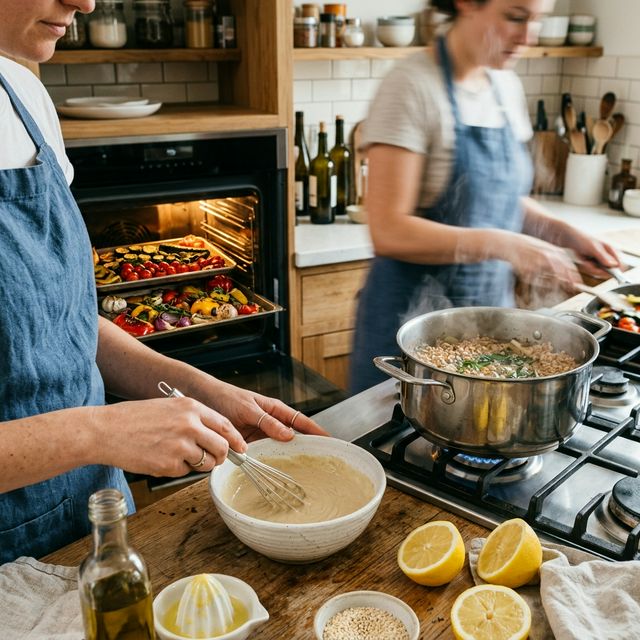
Here’s where the system becomes obvious. From your five prepped components, here are combinations you can assemble this week — each one genuinely different, each one under 5 minutes.
| Grain | Protein | Roasted Veg | Green | Sauce | → Meal |
|---|---|---|---|---|---|
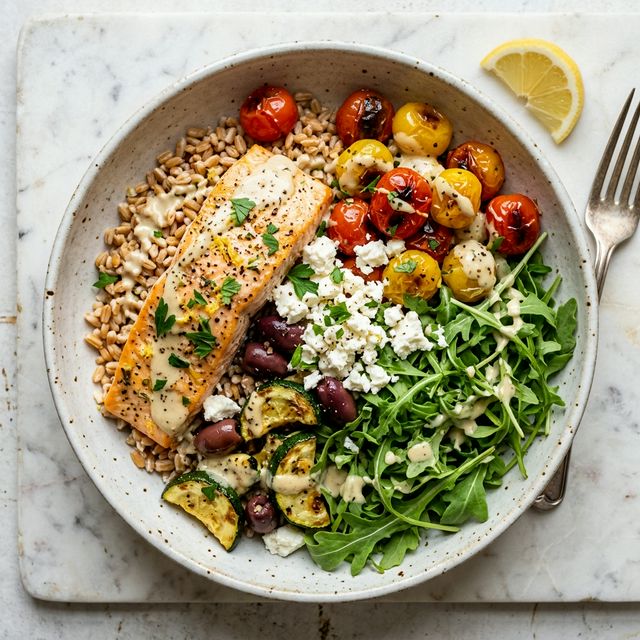
| Farro | Baked salmon | Zucchini + tomato | Arugula | Lemon-herb tahini | Mediterranean Grain Bowl |
| Quinoa | Chickpeas | Sweet potato + cauliflower | Spinach | Hummus dressing | Greek Power Bowl |
| Brown rice | 2 halved eggs | Mediterranean mix | Romaine | Roasted garlic EVOO | Warm Mediterranean Salad |
| Farro | White beans | Cauliflower + cumin | Arugula | Lemon-herb tahini | White Bean Farro Bowl |
| Quinoa | Canned salmon | Cherry tomatoes + peppers | Baby spinach | Garlic EVOO + lemon | Quick Salmon Grain Bowl |
| — | Chickpeas + 1 egg | Both veg trays | — | Thick hummus | Mezze Lunch Plate |
| Brown rice | Salmon + chickpeas | Mediterranean mix | Arugula | Tahini + garlic EVOO drizzle | The Full Med Bowl |
You won’t eat the same meal twice until at least Thursday.
Assembly sequence: Grain base first (room temperature is fine — Mediterranean food isn’t meant to be scalding). Then roasted veg. Then protein. Greens on top or alongside. Sauce drizzled just before eating. Fresh lemon squeeze. Done.
Why this variety matters beyond taste: Diet adherence research consistently shows that monotony — not difficulty — is the primary reason people abandon healthy eating patterns. The landmark PREDIMED trial, which followed over 7,000 participants for 5 years, found that the Mediterranean diet participants with the highest adherence rates were those who reported most variety within the dietary pattern. Variety isn’t a luxury here. It’s the mechanism that makes the health outcomes possible.
The 90-Minute Sunday Prep Timeline
Most guides tell you what to make. This one tells you what to do in what order so your oven, stove, and hands are never idle at the same time.
| Time | What You’re Doing | Active? |
|---|---|---|
| 0:00 | Preheat oven to 375°F. Put grain pot of water on stove, bring to boil. | 5 min active |
| 0:05 | Chop all vegetables for both sheet pans. Toss with EVOO and seasoning. | 15 min active |
| 0:20 | Both sheet pans into oven. Lower grain to a simmer, cover. Start hard-boiling eggs. | 5 min active |
| 0:25 | Make all 3 sauces while the oven does its work. | 15 min active |
| 0:40 | Check Sheet Pan 1, give a stir. Prep salmon — oil, lemon, seasoning, ready to go in. | 5 min active |
| 0:45 | Sheet Pan 1 out. Salmon goes in at 400°F. Drain eggs, into ice water. | 3 min active |
| 0:57 | Salmon done. Pull. Drain grain, fluff with fork. | 5 min active |
| 1:05 | Wash and fully dry greens (the paper towel technique from above). | 10 min active |
| 1:15 | Portion everything into glass containers. | 15 min active |
| 1:30 | Done. Clean up. Week handled. | — |
Total active time: approximately 78 minutes. The oven and stove handle the rest. You’ll never be standing still — there’s always something to chop, whisk, or prep while things cook.
The Full Shopping List (5-Component System, 2 People for 5 Days)
Produce:
Zucchini (2 medium), cherry tomatoes (1 pint), red onion (2), bell peppers (3, mixed colors), garlic (1 head), sweet potato (2 medium), cauliflower (1 small-medium head), arugula or baby spinach (2 bags, 5 oz each), lemons (4–5), fresh flat-leaf parsley, fresh dill
Proteins:
Wild salmon fillets (2–3, 6–8 oz each), eggs (1 dozen), canned wild salmon (2 cans), canned chickpeas (2 cans, 15 oz), white beans (1 can, 15 oz)
Pantry:
Farro or quinoa (1 lb), tahini (light-colored, pourable — quality matters here), extra virgin olive oil (genuinely good — this is the foundational ingredient), kalamata olives, capers, sun-dried tomatoes in oil, red wine vinegar, dried oregano, ground cumin, za’atar (worth finding — it makes everything taste more Mediterranean)
Refrigerated:
Store-bought hummus (clean ingredient list), Greek yogurt, feta cheese
Almost everything on this list is available through Thrive Market at 25–50% less than standard grocery prices — especially the pantry staples where quality matters most: EVOO, tahini, and canned wild salmon. I run this system weekly and it’s where I do my pantry restocking.
Mediterranean Meal Prep for Specific Goals
Mediterranean Meal Prep for Weight Loss
Here’s what most people get wrong about Mediterranean eating and weight: it’s not a calorie-restriction approach. It’s a food-substitution approach. And that makes all the difference.
When you replace processed, calorically dense foods with fibrous whole grains, legumes, and vegetables — while keeping healthy fat from olive oil and protein from fish — you naturally eat fewer calories while feeling more satisfied. The food’s lower caloric density does the math for you. No counting required.
A 2020 meta-analysis published in Obesity Reviews found that Mediterranean diet adherents lost an average of 4.1 kg more than control groups over 12 months — without caloric counting as a mandatory component.
The Component Prep system specifically supports this because when you’re hungry at 3pm and something fast sounds good, you have an assembled Mediterranean bowl available in 3 minutes. That systematically removes the “there’s nothing ready, I’ll just get something” moment that derails most eating plans.
Practical adjustment for weight loss goals: Scale the grain base to ½ cup cooked (rather than a full cup) and increase the leafy green base proportionally. You’ll eat a larger volume of food on a smaller caloric footprint.
Mediterranean Meal Prep for Anti-Inflammatory Benefits
Every component in this system is doing something measurable.
Wild salmon delivers EPA and DHA omega-3 fatty acids that directly inhibit COX-2-mediated inflammatory signaling. EVOO contains oleocanthal, a compound with mechanism of action similar to low-dose ibuprofen. Farro and chickpeas provide soluble fiber that feeds Lactobacillus and Bifidobacterium species — the gut bacteria most associated with reduced systemic inflammation. Dark leafy greens provide lutein and zeaxanthin, which reduce oxidative stress at the cellular level.
Most people notice improved morning energy and reduced joint stiffness around Day 10–14 of consistent eating. Blood marker changes — specifically serum CRP and IL-6 — typically become measurable at the 4–8 week mark.
If you’re coming from the structured approach of a four-week anti-inflammatory meal plan, this system is designed to be your Week 5 and beyond — the autonomous phase where you no longer need the plan, just the system.
The gut connection to inflammation goes deeper than most people realize. Our gut healthy foods guide covers how fermented foods (including the Greek yogurt and feta in this system) specifically support the gut-inflammation axis.
Mediterranean Meal Prep on a Budget
The full system costs approximately $65–80/week for two people at standard US grocery prices. Here’s how to bring it to $45–55 without meaningfully compromising the nutritional profile:
| Full Version | Budget Version | Weekly Saving |
|---|---|---|
| Fresh wild salmon fillets | Canned wild salmon (×2) | $8–12 |
| Organic chickpeas (canned) | Dried chickpeas, soaked overnight | $3–4 |
| Farro | Brown rice | $2–3 |
| Fresh arugula bags | Frozen spinach (thawed, squeezed dry) | $3 |
| Sun-dried tomatoes in oil | Canned diced tomatoes | $2 |
Budget system total: approximately $45–55/week for two people.
A Thrive Market membership (approximately $5/month, billed annually) typically saves members $267/year on exactly the categories this system needs most: organic EVOO, canned wild fish, tahini, and legumes. If you’re running this system consistently, the math works in your favor by month two.
Frequently Asked Questions
How do you meal prep for the Mediterranean diet?
The most effective approach is Component Prep — not full-meal prep. Cook one grain base (farro, quinoa, or brown rice), two or three protein sources (baked salmon, hard-boiled eggs, rinsed chickpeas), two sheet pans of roasted vegetables, and three sauces each Sunday. From these five components you can assemble 15–20 genuinely different Mediterranean meals throughout the week in under 5 minutes each. This avoids the food fatigue that kills most meal prep routines by Wednesday, because no two meals actually taste the same.
What foods can I meal prep on the Mediterranean diet?
Best Mediterranean foods to prep ahead: cooked grains (farro, quinoa, or brown rice), baked salmon fillets, hard-boiled eggs, roasted zucchini, peppers, tomatoes, sweet potato, cauliflower, rinsed canned chickpeas and white beans, tahini-based sauces. Always add these fresh at serving: chopped herbs (parsley, dill, basil), avocado, cucumber, undressed leafy greens, fresh lemon juice. The fresh-at-serving elements are what keep every meal tasting like it was just made.
How long does Mediterranean meal prep last in the fridge?
Cooked grains: 5 days. Baked salmon: 3–4 days. Hard-boiled eggs (unpeeled): 7 days. Roasted vegetables: 4–5 days. Rinsed canned chickpeas or white beans: 3–4 days in a sealed container. Tahini and hummus sauces: 7 days. Roasted garlic EVOO: 5 days. Glass containers consistently outperform plastic here — they don’t absorb food odors, maintain lower internal temperature, and preserve flavor noticeably better.
What are good Mediterranean diet lunches to prep?
The four best prep-ahead Mediterranean lunches from this system: (1) Farro bowl with chickpeas, roasted peppers, arugula, and lemon-herb tahini — 3 minutes to assemble. (2) Big arugula plate with baked salmon, kalamata olives, capers, crumbled feta, and lemon EVOO drizzle. (3) White bean and roasted cauliflower bowl with za’atar, fresh parsley, and hummus dressing. (4) Quinoa bowl with canned salmon, cherry tomatoes, fresh herbs, and hummus dressing. For morning meals that pair with this system, our anti-inflammatory breakfast guide has specific Mediterranean-compatible options.
Is Mediterranean meal prep good for weight loss?
Yes — and without tracking calories. The mechanism is food substitution, not restriction: replacing calorically dense processed food with fiber-rich grains, legumes, and vegetables naturally reduces caloric intake while increasing satiety. A 2020 meta-analysis in Obesity Reviews found that Mediterranean adherents lost 4.1 kg more than controls over 12 months without explicit calorie restriction. The Component Prep system specifically eliminates the “nothing is ready, I’ll just get fast food” moments that undermine consistent eating — which is where most weight loss progress is actually lost.
Can I freeze Mediterranean meal prep?
Yes — grains, cooked legumes, roasted vegetables, and portioned baked salmon all freeze well for up to 3 months. Freeze in individual portions for fastest weeknight use. Thaw grain and vegetable components overnight in the fridge, or reheat directly from frozen with a splash of water. Don’t freeze: dressed fresh salads, fresh herbs, tahini sauces (texture suffers), or avocado. Freezing is a good backup strategy — prep a double batch of your grain and roasted veg every few Sundays and build a 2-week buffer.
What is the best grain for Mediterranean meal prep?
Farro is the most aligned with traditional Mediterranean eating — it’s an ancient whole grain native to Italy and Greece, high in fiber (7g per serving), and holds its texture extraordinarily well after refrigeration. Quinoa is fastest at 15 minutes, contains the most protein of the three, and is gluten-free. Brown rice is the most affordable and has the most neutral flavor profile — ideal for when you want the other components to lead. All three work within this system; choose based on how much time you have Sunday and which flavor profile you prefer. For anti-inflammatory benefit specifically, farro’s fiber content supports the gut microbiome most directly.
The Bottom Line
Mediterranean eating has never been about cooking every night. It’s always been about having the right components ready — so that the healthy choice is genuinely the fastest choice when you’re hungry.
The 5-Component System takes one Sunday. It gives you 20+ different meals, zero decision fatigue Monday through Friday, and the full anti-inflammatory, heart-protective, metabolism-supporting benefits of genuine Mediterranean nutrition. Not for a week. Every week.
The first time it’ll feel like a lot. The second time, it’ll click. By the third Sunday, it’s reflexive — you’re roasting vegetables and whisking tahini without thinking about it. That’s the point where the health outcomes start accumulating: not from one impressive prep session, but from consistent months of meals that were genuinely easier than ordering out.
Start this Sunday. Grain base, proteins, two sheet pans, dried greens, three sauces. Ninety minutes. By Monday lunch you’ll understand everything the research has been saying for 40 years.
Want to take this further? Download the free Anti-Inflammatory Foods Checklist — a printable reference that maps each ingredient in this system to its specific anti-inflammatory mechanism. Useful to have open while shopping.
If you’re building this system as part of reducing chronic inflammation, the 4-Week Anti-Inflammatory Meal Plan is the structured starting point — with week-by-week body checkpoints and complete grocery lists that transition naturally into this prep system.

About Jane Smith
We turn solid evidence into everyday habits Americans can actually do—plain English, cups/oz, grocery-aisle swaps, and routines that fit real life. Our editorial process: Experience—we road-test tips in real schedules…