The Worst Foods for Skin, Ranked by What the Research Actually Measured
Every list has the same foods in the same order. The one study that measured both dose and effect ranks them almost backwards. Here is the real order.
- The List Everyone Copies
- The Ranking the Research Actually Produced
- Fried Food Is Number One — For the Wrong Reason
- White Rice: The One Nobody Wants to Talk About
- Sugar and Chocolate: Smaller Than You Think
- What the Strongest Evidence Actually Points To
- The Foods That Showed a Protective Effect
- Three Claims on These Lists That Are Simply Wrong
- How to Use This Without Overhauling Your Diet
- When Diet Is Not the Answer
- Frequently Asked Questions
- The Bottom Line
Open ten articles about the worst foods for your skin and you will find almost the same list. Dairy. Sugar. Chocolate. Fried food. Usually in roughly that order.
Here is a question none of those articles answer: where did the order come from?
Not from research. I went looking. The one study that measured both how much people ate and how much worse their acne was ranks these foods almost backwards from the list everybody copies.
This article is not another list. It is the same list, put in the order the numbers actually support — and three things change once you do that.
Quick takeaways:
- Fried food came out on top — but not for the reason you have been told
- White rice was close behind, and eating less of it barely helped
- Dairy was not statistically significant in this study — with an important caveat
- Unsweetened tea showed a protective effect stronger than most of the harmful ones
- Food can make skin worse in one to two weeks, but takes eight to make it better. That asymmetry explains a lot
The List Everyone Copies
I read through the pages currently ranking on the first page for this topic. A few things stood out.
One is a dermatology clinic page of roughly 380 words. It names twelve foods. It gives no mechanism for any of them, cites no studies, and offers no amounts. It is on the first page of Google.
Another is around 700 words and does give reasons — three of which are factually wrong, which I will come back to.
The longest is about 2,000 words and is the best of them. It still cites nothing.
What none of them provide is the thing the format implies: a ranking. They present five, ten or twelve foods as though the order were meaningful, when the order is simply inherited from the article before it.
If you want the wider picture of what food does and does not do for skin, the clear skin diet guide covers the whole evidence base. This article is specifically about the avoid-list, and about how badly it has been ordered.
The Ranking the Research Actually Produced
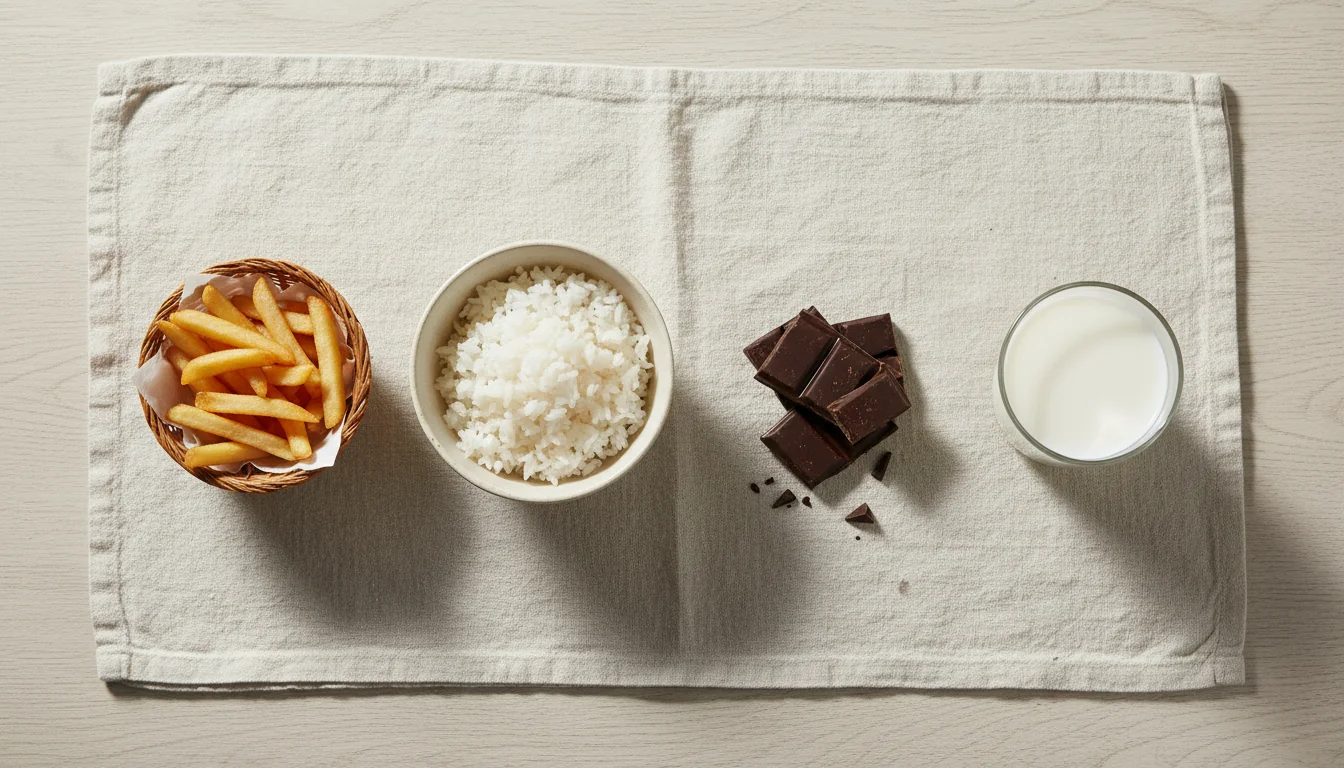
In 2020, researchers surveyed 2,476 people aged 18 to 44 about what they ate and how severe their acne was. Unlike almost every source in this space, they measured frequency and portion, not just “do you eat this”.
Here is what came out, as adjusted odds ratios:
| Food | Amount | Odds ratio | p |
|---|---|---|---|
| Fried / oily food | 3+ times a week | 1.84 | 0.029 |
| White rice | 2+ portions a day | 1.80 | 0.002 |
| White rice | under 2 portions a day | 1.78 | 0.004 |
| Chocolate | over 100 g a week | 1.29 | 0.009 |
| Milk | — | not significant | — |
Compare that to the running order of every list you have read.
What these numbers are, and what they are not
I want to be careful here, because being careless about this is the thing I am criticising.
This is a cross-sectional survey with self-reported diet and self-assessed acne. That is weaker evidence than a controlled trial. People recall their eating habits imperfectly, and people with acne may recall them differently from people without it.
An odds ratio is an association. An odds ratio of 1.84 means the odds of more severe acne were about 84% higher in the frequent-fried-food group. It does not mean fried food caused it.
What this data is genuinely good for is relative ranking — comparing foods measured the same way, in the same population, at the same time. That is exactly what the popular lists claim to do and never actually do.
Why dairy is missing from the top
This is the part that needs the caveat, not the headline.
Milk showed an association in the simple analysis, but the relationship did not hold once other dietary factors were accounted for.
Before you read that as “dairy is fine”: this was a Thai population, and median dairy intake was around four glasses a week.
That number matters enormously, because the largest analysis of dairy and acne — 78,529 people — found the association only becomes clear at about one glass a day. At two to six glasses a week, it was not statistically significant there either.
So these two studies are not contradicting each other. They are agreeing. This population was mostly eating below the amount where the dairy signal appears. That is a finding about dose, not about safety. I go through the dairy numbers properly in does dairy cause acne.
What it does tell you is narrower and still useful: in a population eating modest amounts of dairy, other foods mattered more.
Fried Food Is Number One — For the Wrong Reason
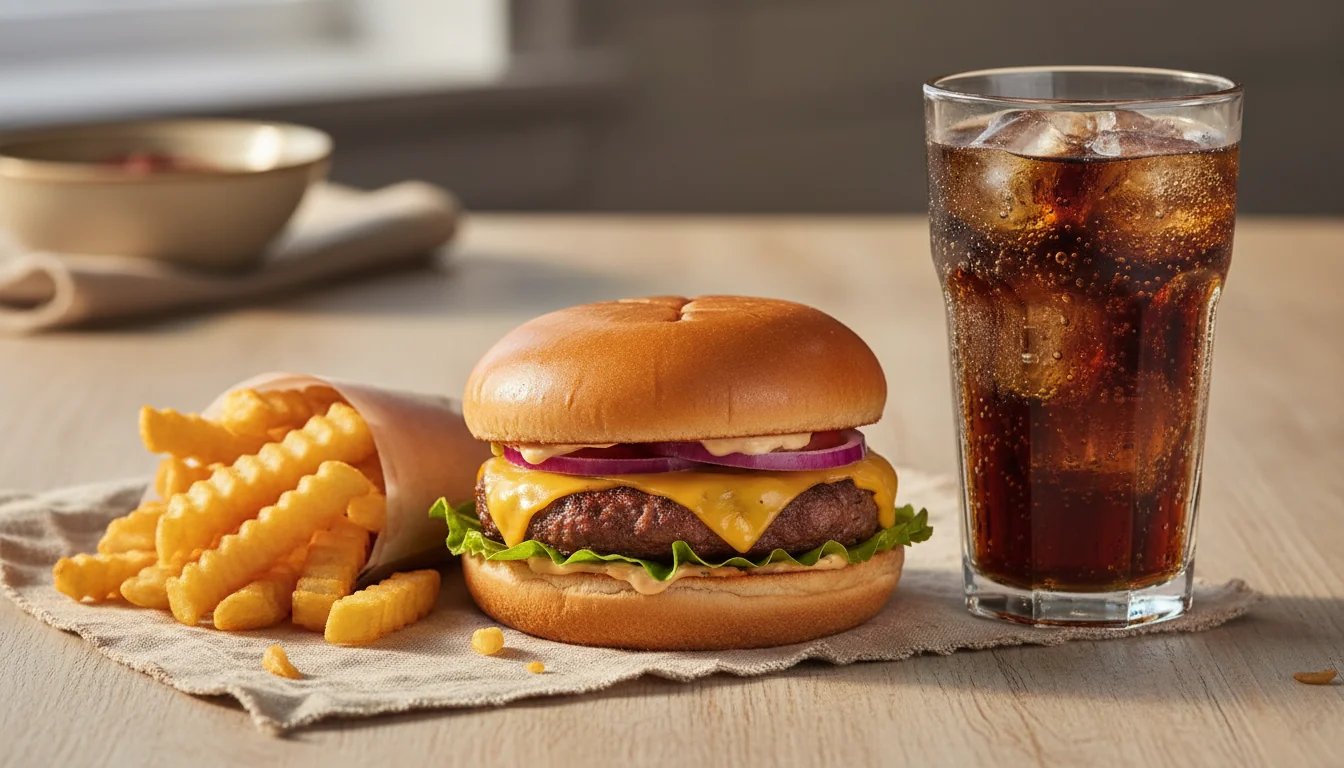
Fried food topped the table at 1.84, higher than anything else measured.
The lists get this one right. Their explanation for it is wrong, and the wrongness is worth understanding because it changes what you do about it.
What the popular explanation gets wrong
The first-page article I mentioned says fried foods are “loaded with preservatives that can clog pores.”
Another says fatty foods “contain pro-inflammatory cytokines.”
Both are wrong in the same direction — they imagine food acting on your skin physically or directly.
Food does not clog pores from the inside. A blocked follicle is a build-up of your own sebum and skin cells. Nothing you swallow travels to a pore and plugs it. Oil on your hands touching your face is a real thing; oil in your stomach is not the same event.
Cytokines are signalling molecules your immune system produces. Food does not contain them and does not deliver them. Food can influence how many your body makes, which is a completely different claim with a completely different implication.
What the AAD actually says
The American Academy of Dermatology addresses this directly. People avoid greasy fries and burgers for their skin — and, in their words, probably not for the reason you think.
The issue is not the grease. It is what the meal does to your blood sugar.
The likely mechanism
A typical fried meal is not just fat. It is fat wrapped around refined carbohydrate, usually eaten quickly, often with a sweetened drink.
That combination raises blood glucose and insulin, and insulin drives IGF-1 — which increases sebum production and the keratin build-up that blocks a follicle. This is the same pathway that puts high-glycemic eating at the top of the evidence pile for acne generally.
The type of fat may add something on top. Repeatedly heated oils and a high intake of omega-6 relative to omega-3 shift the body’s inflammatory balance, which I cover in seed oils and inflammation.
Why this matters practically: if you believe grease clogs pores, you switch to baked crisps and feel you have solved it. If you understand it is a blood-sugar event, you look at the whole meal — the batter, the bun, the drink — which is where the effect actually lives.
White Rice: The One Nobody Wants to Talk About
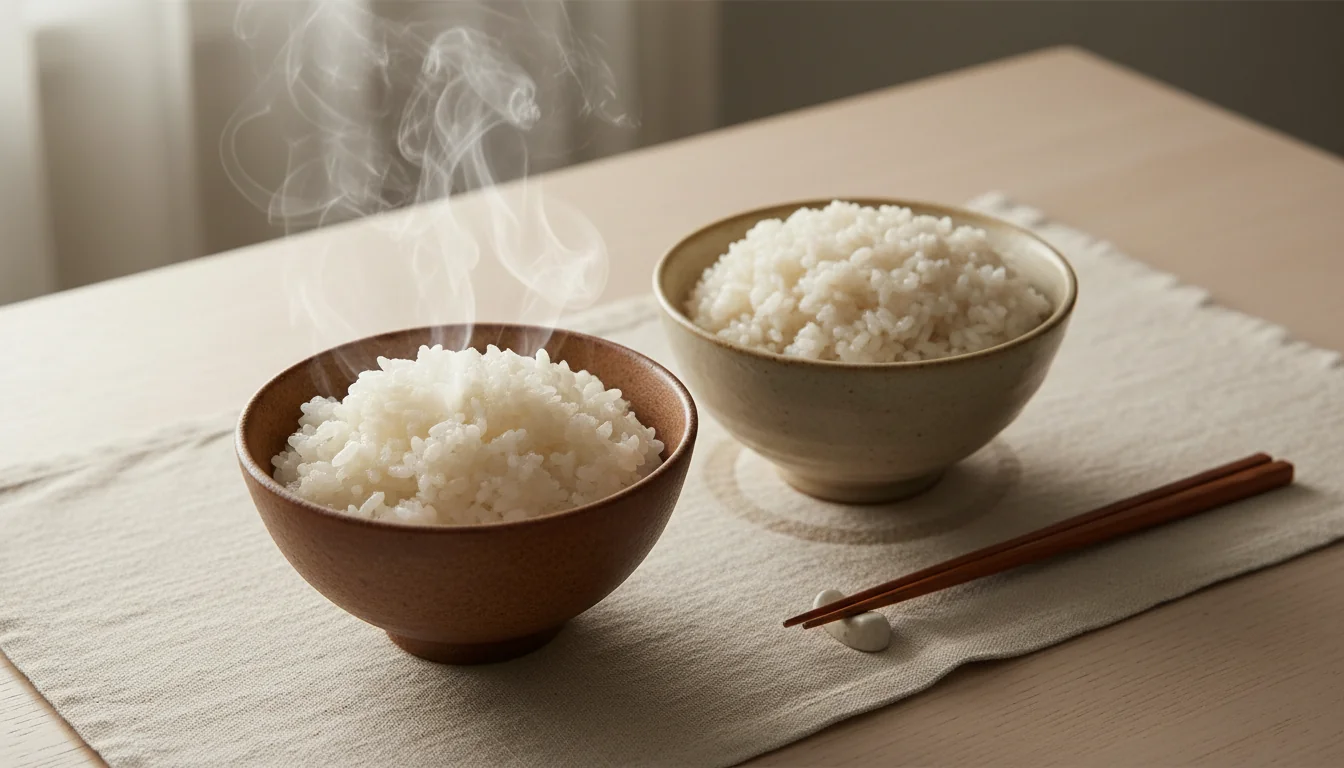
White rice scored 1.78 to 1.80 — statistically stronger than chocolate, and close to fried food.
It appears on almost none of the popular lists.
The numbers explain why it belongs there. White rice has a glycemic index of about 89 and a glycemic load of 83. Brown rice comes in at a GI of 50 and a glycemic load of 16. That is not a small difference — the glycemic load is roughly five times higher.
Why eating less rice barely helps
Look at the two rice rows again:
| Amount | Odds ratio |
|---|---|
| Under 2 portions a day | 1.78 |
| 2 or more portions a day | 1.80 |
Almost flat.
Compare that to dairy, where the association climbs steadily with intake — 1.24 at a few glasses a week, 1.41 at one glass a day, 1.43 at two or more.
Rice does not behave that way here. Cutting from two portions to one moved the number by 0.02.
The practical translation is uncomfortable but clear: eating less rice is not the lever. How you eat it is.
“Just eat brown rice” is not advice
Every article that mentions rice says this, and for a large part of the world it is useless.
Rice is not a snack you can swap out. It is the base of the meal, three times a day, for a few billion people. I grew up eating it and I still do. Telling someone to replace it is telling them to eat a different cuisine.
Fortunately, the glycemic response to rice is more changeable than most people realise.
Three things that change rice without changing the amount
1. Cool it. When cooked rice is chilled, part of its starch recrystallises into resistant starch — which your small intestine does not digest as readily, lowering the glucose response of the same portion. Reheating does not undo all of it. Day-old rice, properly refrigerated and reheated thoroughly, is not the same food as fresh rice, glycemically speaking. I go through the mechanism in resistant starch and specifically in resistant starch and blood sugar. The same trick works on bread — freezing bread does something similar.
2. Do not eat it alone. Protein, fat and fibre alongside the rice slow gastric emptying and blunt the glucose peak. This is the same principle that appears to make whole milk slightly gentler than skim.
3. Change the order. Eating vegetables and protein before the rice in the same meal produces a lower glucose response than eating them in the reverse order — same food, same amount, different sequence.
None of these require you to give up rice. All of them address the actual mechanism, which reducing the portion apparently does not.
Sugar and Chocolate: Smaller Than You Think
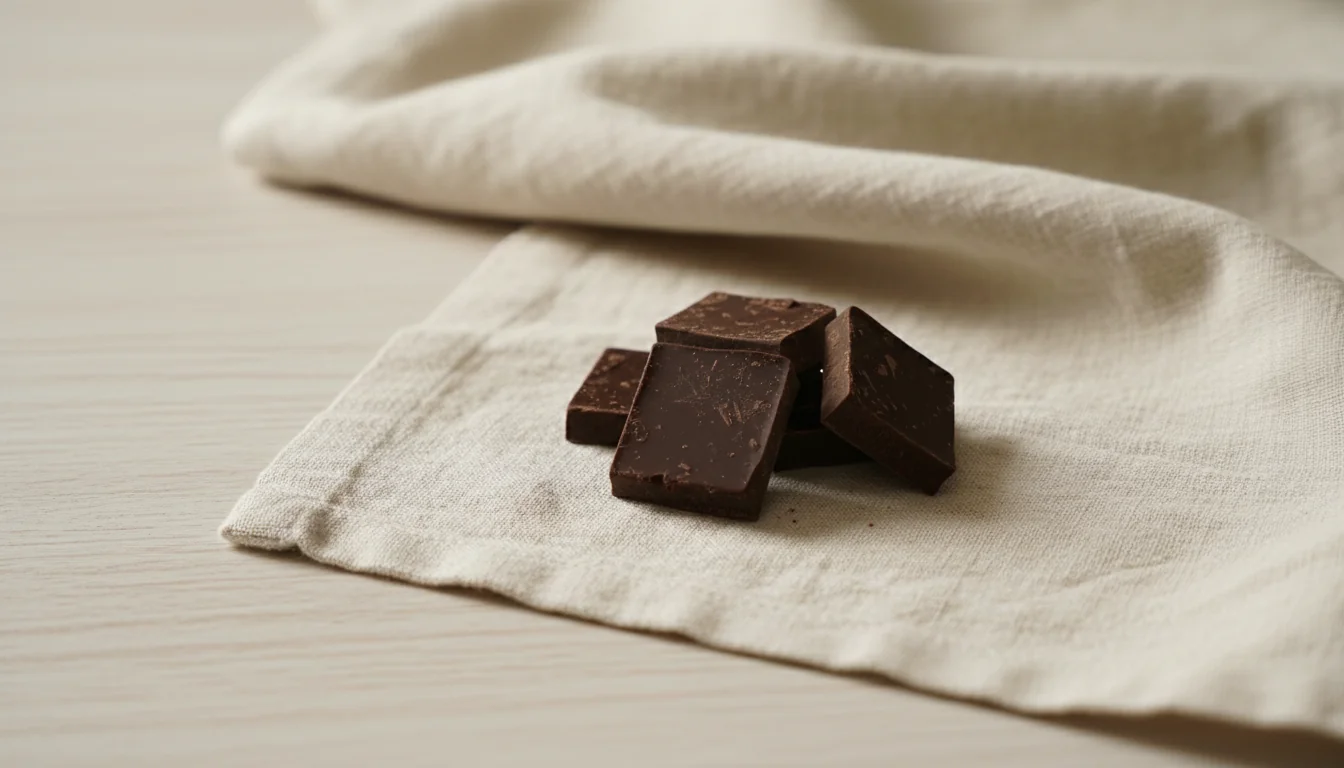
Chocolate came in at 1.29 — real, statistically significant, and the smallest effect of anything on the list.
It is usually near the top of the popular lists. It probably belongs near the bottom.
What the chocolate trials found
There are small controlled trials here, which is unusual for this field and worth knowing about.
In one, 25 g of 99% dark chocolate daily increased lesion counts after two weeks. In another, 100% cocoa powder increased lesions after one week.
Note what those trials used: nearly pure cocoa, not a chocolate bar. Which complicates the standard advice that dark chocolate is the “safe” version — in these trials, the dark stuff was the exposure.
The asymmetry nobody explains
Something in those timelines contradicts the advice I give everywhere else on this site, and I would rather resolve it than leave it sitting there.
Elsewhere I tell you dietary changes need eight weeks before you can judge them. These trials found an effect in one to two.
Both are right, because the two directions are not symmetrical.
Getting worse can be fast. Existing inflamed lesions can flare, and follicles already forming can be pushed along. You are adding to a process already running.
Getting better is slow. Improvement requires the follicles currently in progress to finish their cycle, and skin renews on roughly a 28-day schedule. Nothing you eat today empties the pipeline.
This is why “I ate badly yesterday and broke out today” can genuinely be true, while “I cut sugar for two weeks and nothing happened” tells you almost nothing.
Sugar in food versus sugar added
Worth separating, because the lists rarely do. The evidence concerns added sugar and refined carbohydrate — the glycemic load of the meal. Whole fruit, which arrives with fibre and water, behaves differently, and I break down which fruits carry what in the sugar content of fruits guide.
What the Strongest Evidence Actually Points To
Step back from the individual foods for a moment, because there is a number that outweighs all of them.
The AAD cites a study in which 87% of patients following a low-glycemic diet reported less acne.
Eighty-seven percent. Compare that to a 29% increase in odds from chocolate.
That comparison is the real argument of this article. A single change to the pattern of what you eat appears to do more than ten individual prohibitions.
And it explains why the ranking came out as it did. Fried food, white rice, white bread, sugary drinks — these look like separate items on a list of twelve. They are the same item. They are all high-glycemic-load meals, working through the same insulin and IGF-1 pathway.
The list format hides that. It presents one mechanism as twelve rules, which is both harder to follow and less effective.
A Traditional Perspective: “A list of forbidden foods is a fence with twelve gates, and a person only has to walk through one of them to feel they have failed. Change how the meal is built and there is no fence to climb. The old cooking already knew this — vegetables first, something fatty with the starch, never the rice alone.”
— Mr. Anh, Founder of Essential Wellness AZ
The Foods That Showed a Protective Effect
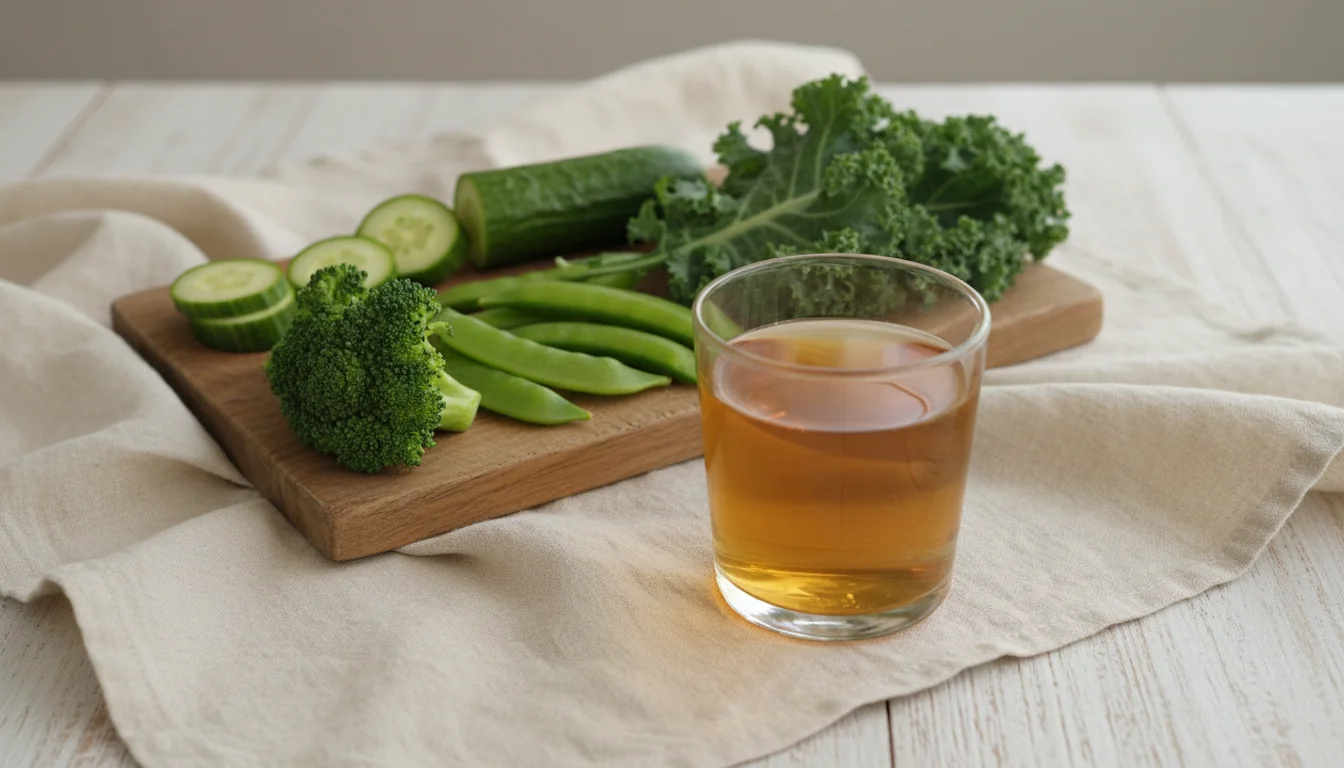
Almost half of the questions people ask Google around this topic are not about what to avoid. They are about what to eat instead.
The same study measured that too, and the results are more interesting than the avoid-list:
| Food | Amount | Odds ratio |
|---|---|---|
| Unsweetened, milk-free tea | 3+ glasses a week | 0.61 |
| Vegetables | 3+ portions a week | 0.74 |
Why the tea number is worth noticing
An odds ratio of 0.61 means about 39% lower odds of more severe acne.
Put that next to the harmful side of the same table: chocolate at 1.29, fried food at 1.84. The tea effect is larger than the chocolate effect and comparable in size to most of the rest — and it involves adding something rather than removing it.
I have not seen a single popular article on worst foods for skin mention this.
Two conditions matter, and they are in the measurement itself: unsweetened, and without milk. A sweetened milk tea is a different drink, and the sugar puts it on the other side of the table entirely.
Adding beats removing
There is a practical reason to lead with this rather than bury it.
Nobody sustains a twelve-item prohibition list. Almost anyone can drink three cups of unsweetened tea a week and put vegetables on the plate more often. The protective numbers here are not smaller than the harmful ones, and the behaviour is far easier to keep.
Three Claims on These Lists That Are Simply Wrong
I want to be specific about this, because it bears on whether the ranking in those articles is trustworthy at all.
- “Fried food clogs your pores.” It does not. Pores are blocked by sebum and skin cells produced in the follicle. What you swallow does not arrive there as grease
- “Fatty foods contain pro-inflammatory cytokines.” They do not. Cytokines are produced by your own immune cells. Food can influence how many your body makes; it does not contain them
- “Chicken contains added hormones.” It does not, at least in the US, where hormones have been prohibited in poultry production since the 1950s. This one has legs — “does chicken cause acne” is a common enough search that Google suggests it. It is built on a claim that has been illegal for seventy years
If the reasoning on the first page is wrong three times over, the ordering of the list on the same page is not something to take on trust either.
How to Use This Without Overhauling Your Diet
- Start at the top of the table, not the top of the list. Fried food and white rice, before dairy. That is the opposite of the usual advice, and it follows the numbers
- Change how you eat it before you change what you eat. Especially with rice. Cool it, pair it, order the plate. This is where the leverage is
- Add before you remove. Unsweetened tea and vegetables have measured protective effects and require no willpower budget
- One change at a time, eight weeks. Two changes at once produce an unreadable result
- Ignore the ten-item list. Nobody sustains it, and the items are not equal anyway. Two changes you keep beat ten you abandon in a fortnight
When Diet Is Not the Answer
Food is one input among several, and for many people it is not the dominant one. The AAD is direct about it: keeping skin clear takes more than a change of diet.
See a dermatologist rather than adjusting your food again if you have:
- Cystic or nodular acne — deep, painful lesions
- Acne that is scarring. Scarring is permanent, and time spent on a food experiment is time you do not get back
- Acne that is affecting your mood or your life
- No improvement after several months of consistent change
- Sudden severe acne alongside other changes worth investigating
Diet is worth working on. It is not worth working on instead of treatment.
Frequently Asked Questions
What are the worst foods for your skin?
Ranked by the study that measured both amount and effect: fried and oily food came first, white rice second, chocolate third. Dairy did not reach significance in that population, though it was consumed in modest amounts there. That ordering is close to the reverse of the standard list.
What food causes the most acne?
By effect size, fried and oily food eaten three or more times a week — about 84% higher odds of more severe acne. But the mechanism is probably the glycemic load of the meal rather than the fat, which means the batter, the bun and the drink count as much as the frying.
Does white rice cause acne?
White rice was associated with roughly 80% higher odds in this study, likely because of its very high glycemic load — around 83, against 16 for brown rice. Notably, eating less of it barely changed the number. Cooling cooked rice, pairing it with protein and fat, and eating vegetables first all lower the glucose response without reducing the portion.
Does sugar cause acne?
Sugar and refined carbohydrate raise blood glucose and insulin, which drives IGF-1 and sebum production. The strongest single figure in this whole area is that 87% of patients on a low-glycemic diet reported less acne. Chocolate specifically showed a smaller effect than most lists imply.
What foods trigger oily skin?
The high-glycemic pattern is the one with a mechanism behind it: insulin and IGF-1 stimulate sebum production. That means refined carbohydrate and sugary drinks more than fat itself — dietary fat does not become skin oil in any direct way.
What can I drink for clearer skin?
Unsweetened, milk-free tea was associated with about 39% lower odds of more severe acne at three or more glasses a week. The two conditions are part of the finding: no sugar, no milk. Water instead of sweetened drinks helps for the same underlying reason.
How long does it take for a food to affect your skin?
It is asymmetrical. Trials have found chocolate increasing lesions within one to two weeks, because you are adding to inflammation already in progress. Improvement takes longer — eight to twelve weeks — because follicles already forming have to finish their cycle and skin renews on roughly a 28-day schedule.
The Bottom Line
The worst-foods list is not wrong about the foods. It is wrong about the order, wrong about several of the reasons, and wrong about the format.
Put in the order the numbers support:
- Fried food first — but because of the meal’s glycemic load, not the grease
- White rice second, and eating less of it is not the fix; how you cook and pair it is
- Chocolate third, and smaller than its reputation
- Dairy lower than you expect in a population eating modest amounts — dose is the whole story there
- Unsweetened tea and vegetables on the other side of the ledger, with effects worth more than most of the prohibitions
And underneath all of it, one mechanism doing most of the work. Twelve rules is a harder way to describe one pattern.
If you want that pattern laid out properly — what to eat rather than what to skip, and how long each change takes to show — start with the clear skin diet guide.
Disclaimer: I’m trained in traditional medicine in Vietnam, but I’m not currently practicing medicine or providing personal diagnosis or treatment advice through this website. I write from personal experience, ongoing research, and my own food-first wellness experiments. My work explores digestion, daily energy, traditional self-care, movement, breathwork, meditation, and simple habits that support everyday well-being. Everything I share here is educational and reflective, not medical advice. It should not replace diagnosis, treatment, or care from a licensed healthcare professional.

About Mr. Anh
We turn solid evidence into everyday habits Americans can actually do—plain English, cups/oz, grocery-aisle swaps, and routines that fit real life. Our editorial process: Experience—we road-test tips in real schedules…