Healthy Skin Diet: Best Foods for Clear Skin
A note before we begin: I trained in traditional Vietnamese medicine but I don’t practice clinically or treat patients. Everything...
- How Long Before You See Anything
- What Is the Healthy Skin Diet?
- An Eastern Lens: The Lung Governs the Skin
- The Dairy Question: What the Evidence Actually Shows
- Your Gut and Your Skin Are Connected
- Foods to Avoid in a Healthy Skin Diet
- Foods to Eat in a Healthy Skin Diet
- Why Whole Foods Beat Supplements
- Simple Ways to Start a Healthy Skin Diet
- When to See a Dermatologist
- Frequently Asked Questions About the Healthy Skin Diet
- Start Your Healthy Skin Diet Today
A note before we begin: I trained in traditional Vietnamese medicine but I don’t practice clinically or treat patients. Everything below is a researcher’s notes — what I’ve read in the modern literature, what I’ve watched work for myself and my family, and how those two pictures fit together. If you have a skin condition that isn’t resolving, please see a dermatologist. This is education, not medical advice.
Healthy, glowing skin often starts with what’s on your plate. A healthy skin diet focuses on nutrient-rich foods that support skin repair, reduce inflammation, and provide antioxidants that protect against damage. While skincare products can help externally, diet plays a powerful internal role in how your skin looks and feels.
By choosing the right foods and limiting those that trigger inflammation or excess oil production, you can support clearer, smoother skin naturally. Below, we explore the science behind the healthy skin diet, the foods to avoid, and the best foods to eat for a radiant complexion.
You cut out dairy for two weeks. Nothing changed. So you concluded that food has nothing to do with your skin, and you went back to how you were eating before.
Two weeks was never going to be enough. And there is a reasonable chance you cut out the wrong thing.
This is the part most articles skip: not just what to eat, but how long before any of it shows up on your face — and which foods the evidence actually points at, rather than the ones everyone repeats.
Quick takeaways:
- Dietary changes take one to three months to show on your skin, not days
- Cow’s milk has the most consistent evidence against it. Yogurt and cheese are contested — two large reviews disagree, and most articles only tell you one side
- Low-glycemic eating has the strongest evidence of anything in this article
- Your gut and your skin are connected; an unbalanced microbiome shows on your face
- Food supports your skin. It does not replace dermatological treatment
How Long Before You See Anything
This is the question that decides whether anything else here matters, so let’s deal with it first.
A spot you can see today did not start today. It started as a microcomedone — a plug forming deep at the base of the follicle — weeks ago. Food has to be broken down, absorbed, act on your system, contribute to that plug forming, and then that plug has to travel up to the surface before you ever see it.
Add to that: your skin renews itself roughly every 28 days. So even a perfect change takes a full renewal cycle before the surface reflects it.
Practitioners who work with acne and diet put the realistic window at at least one month, and typically one to three months.
| When | What is actually happening | What not to conclude |
|---|---|---|
| Weeks 1–2 | Nothing has reached the surface yet | Far too early to judge |
| Weeks 3–4 | Spots that formed before you changed anything are surfacing now | It can look worse here. This is not failure |
| Month 2 | First trustworthy signal | You can start reading the result |
| Month 3 | The real picture | Judge it here |
The week three to four window is where most people quit. They see the same breakouts — or more — and read it as proof the change did not work. What they are actually seeing is the backlog.
The practical rule: give any dietary change a full eight to twelve weeks before you decide. If you have tried elimination diets before and “nothing happened”, ask yourself how long you actually gave it. Most people answer in weeks.
That timeline is not the same for everyone, and the 28-day figure most articles quote is a twenty-year-old’s. How long it actually takes, by age works through the arithmetic.
What Is the Healthy Skin Diet?
Before diving into specific foods, it’s helpful to understand what a healthy skin diet actually means and how nutrition affects your skin.
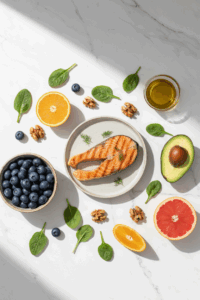
How the Healthy Skin Diet Affects Skin Health
A healthy skin diet supports the body’s natural ability to repair and protect skin cells. Skin is the body’s largest organ, and it constantly renews itself. Nutrients such as vitamins A, C, E, and omega-3 fatty acids help maintain skin elasticity and reduce inflammation.
For example, vitamin C supports collagen production. According to the NIH Office of Dietary Supplements, adults typically need about 75–90 mg of vitamin C daily, which can easily come from foods like blueberries, citrus fruits, or spinach. Omega-3 fats, found in fish such as salmon, help reduce inflammatory responses that can trigger redness or acne. The same anti-inflammatory pattern also shows up in a food-first daily plan for gut health, since the gut–skin axis often moves together — when one improves, the other tends to follow.
In contrast, diets high in refined sugar or fried foods can spike blood sugar levels. These spikes may increase insulin levels, which can stimulate oil production in the skin. Over time, this may lead to clogged pores and breakouts. That’s why focusing on whole, minimally processed foods is a core part of a healthy skin diet.
Key Nutrients in a Healthy Skin Diet
Several nutrients consistently appear in research about skin health. A well-balanced healthy skin diet should include antioxidants, healthy fats, and essential vitamins.
Antioxidants help neutralize free radicals that damage skin cells. Foods like blueberries contain high levels of antioxidants—about 9,000 antioxidant units per cup. These compounds help protect the skin from environmental stressors such as pollution and UV exposure.
Healthy fats also play an important role. Avocados contain monounsaturated fats that help maintain skin hydration and elasticity. Just ½ avocado (about 3.5 oz / 100 g) provides healthy fats along with vitamin E, a nutrient linked to skin repair.
Leafy greens like spinach offer vitamin A and iron, both essential for healthy skin cell turnover. Adding even 1 cup of spinach daily can support a nutrient-rich healthy skin diet that benefits the complexion.
An Eastern Lens: The Lung Governs the Skin
There’s a framework I keep coming back to from traditional Vietnamese and Chinese medicine. In TCM, your skin doesn’t live in isolation — it’s the visible outermost expression of one specific organ system: the Lung (Phế).
The classic line is “Phế chủ bì mao” — the Lung governs the skin and body hair. The same organ is also responsible for the defensive Qi (wei qi) that sits just below your skin and protects you from cold, wind, and pathogens. So when your skin breaks down — dryness in winter, dullness during stress, breakouts when you’re run down — TCM reads that as a Lung pattern long before anyone reaches for an external cream.
The Lung has two strong dislikes in this system: it loves moisture and hates dryness (Phế ố táo), and it weakens when grief or chronic worry persists. That’s why dry climates, dry foods, and emotional stress all show up on the face in similar ways — dull, papery, lacking that internal glow.
The foods that nourish Lung in this framework are mostly white, moist, and gently cooling:
- Pear — the gold-standard Lung-moistener. Stewed pear with a touch of honey is one of the oldest “skin foods” in the kitchen pharmacy.
- White wood ear (mộc nhĩ trắng / tremella) — gentle gel-like fiber that nourishes Lung Yin and skin moisture.
- Lily bulb (bách hợp), lotus seeds — calm the Lung, support sleep (when sleep deteriorates, skin follows fast).
- Daikon, jicama — cooling root vegetables that clear excess heat without drying you out.
- Almonds, sesame, raw honey — small daily additions that moisten the lungs and the skin together.
The modern Western view of skin nutrition (vitamin C, omega-3, antioxidants) doesn’t contradict this — it adds the molecular detail. Both pictures point to the same conclusion: feed the layer underneath, don’t just paint the surface.
What I noticed in my own routine:
Every winter my face and hands go dry and slightly scaly — Arizona winters are mild, but the air pulls all the moisture out of you. For a long time I treated it from the outside only. A few years ago I tried something different: I added a small daily bowl of stewed pear with a bit of honey and white wood ear in the morning, switched my afternoon coffee to ginger tea, and cut most fried foods through the cold months. Within about three to four weeks the dryness eased — not gone, but the kind of “okay, this feels normal again” baseline I hadn’t felt in years. It tracks with the Lung–skin pattern I grew up reading about. Cold and dry air wears the Lung down; warm, moist, gentle foods rebuild it from underneath.
The Dairy Question: What the Evidence Actually Shows
Almost every “foods to avoid for clear skin” list tells you to cut dairy. Most of them stop there, as a single word on a list.
That instruction is less precise than the evidence supports — and following it literally means giving up foods that may be helping you.
What the AAD actually says
The American Academy of Dermatology, reviewing the research, draws a line most articles do not:
“No studies have found that products made from milk, such as yogurt or cheese, lead to more breakouts.”
At the same time, they note that cow’s milk specifically — whole, low-fat and skim alike — shows an association with breakouts across several studies.
But here is where it gets more complicated than most articles admit, and I would rather tell you than tidy it away.
The largest review of this question — 14 studies covering 78,529 people — did find an association for yogurt, with an odds ratio of 1.36, slightly higher than whole milk at 1.22. A second review published the same year found no significant association for yogurt or cheese at all.
So two large analyses of the same literature disagree, and the AAD position lines up with one of them.
The honest version is therefore not “avoid dairy”, and not “milk bad, yogurt fine” either. It is: milk has the most consistent evidence against it; fermented dairy is genuinely contested. If you are going to test one thing, test milk first — that is where the evidence is strongest and least argued over.
Why fermentation might matter
Milk carries naturally occurring hormones and growth factors, and it produces a larger insulin response than its sugar content alone would predict. Both of those feed into the same pathway that drives oil production and follicle plugging.
Fermentation changes the food before it reaches you. Bacteria consume much of the lactose, alter the protein structure, and add their own metabolites. The product that ends up in your bowl is not the product that went into the vat.
That is the same reason fermented foods behave so differently from their raw ingredients elsewhere in the diet. I have written about that mechanism in more depth in the benefits of fermented foods, and specifically for these two foods in kefir vs yogurt.
How to test it on yourself properly
If you want to know whether milk is a trigger for you:
- Remove one thing, not everything. Cut cow’s milk. Keep yogurt, kefir and cheese for now — otherwise you learn nothing about which one mattered.
- Give it eight weeks. See the timeline above. Two weeks tells you nothing.
- Change one variable at a time. If you also cut sugar, start a new supplement and change your cleanser in the same week, you will never know what did it.
- Write it down. Memory is unreliable about skin, because you notice bad days more than ordinary ones.
If eight weeks off milk makes no difference, milk is probably not your issue — and you have your evenings back.
There is more to the dairy question than fits here — the skim milk paradox, the dose threshold, and where whey protein sits. Does dairy cause acne goes through the numbers.
Your Gut and Your Skin Are Connected
There is a reason a lot of people find their skin changes when their digestion changes, and it is not coincidence.
The mechanism
Bacteria in your gut ferment fibre into short-chain fatty acids — butyrate, acetate and propionate. These strengthen the intestinal barrier and reduce how permeable it is.
When that barrier weakens and the microbial balance shifts, inflammatory signalling rises throughout the body. Skin is not exempt. Your gut and your skin are both barrier organs in constant contact with the outside world, and they talk to each other through the bloodstream.
What the research finds in skin conditions
The pattern is consistent enough to be interesting:
- People with acne show reduced gut microbial diversity — lower Firmicutes, higher Bacteroides
- People with atopic dermatitis show lower levels of Akkermansia, Bacteroidetes and Bifidobacterium
- Psoriasis carries an increased risk of intestinal immune disorders such as IBD and celiac disease
None of this means gut bacteria cause skin conditions, and I am not going to claim it does. It means the two systems move together often enough that ignoring one while addressing the other leaves something on the table.
Feed it from the plate
The practical version is unglamorous. A microbial population is built by what you feed it consistently — fibre from vegetables, whole grains and legumes, plus fermented foods in small regular amounts.
If this is new to you, your gut microbiome covers the foundations, and this list of probiotic foods covers the gentle starting points. If your digestion is already unsettled, signs of poor gut health is worth reading first — start there before adding anything.
For the mechanism behind all of this — how a permeable gut barrier ends up affecting your face, and the four things that matter more than any probiotic — see gut health and skin.
Foods to Avoid in a Healthy Skin Diet
The strongest evidence in this whole article: glycemic load
If you only change one thing, change this one.
Of everything covered here, low-glycemic eating has the best evidence behind it. The AAD points to studies where people following a low-glycemic diet reported meaningful improvement — in one, 87% said they had less acne, and 91% said they needed less acne medication.
Glycemic load is not the same as “sugar”. It describes how quickly a food raises your blood sugar, and how much. White bread, white rice, most breakfast cereals, crisps and sweetened drinks all sit high. So do many foods marketed as healthy.
The mechanism is direct: a fast blood sugar rise drives an insulin response, insulin drives IGF-1, and IGF-1 stimulates both oil production and the skin cell turnover that plugs follicles.
Practical swaps, rather than rules:
- Whole grains instead of refined ones
- Fruit whole rather than juiced
- Protein or fat alongside carbohydrates, which blunts the spike
- Cooled rice and potatoes instead of freshly cooked, where it suits the meal
To be fair to the evidence: the AAD also notes that not every study has found this link. It is the strongest signal available, not a settled fact.
If inflammation is a recurring theme for you, reducing gut inflammation approaches the same problem from the digestive side.
While some foods support skin health, others may contribute to inflammation or breakouts. Limiting these foods is an important part of a balanced healthy skin diet.

Refined Sugar and Sugary Drinks
One of the biggest challenges to maintaining this skin-supportive routine is excessive sugar intake. Refined sugar causes rapid spikes in blood glucose levels. These spikes can lead to a process called glycation, where sugar molecules attach to proteins like collagen and elastin.
When collagen becomes damaged through glycation, skin may lose elasticity and develop wrinkles more quickly. For example, a single 12-oz can of soda contains around 39 grams of sugar, which is already more than the recommended daily limit for many adults.
Sugary beverages also provide little nutritional value while increasing inflammation in the body. Replacing soda with water, herbal tea, or sparkling water with lemon can help maintain a this eating pattern and reduce sugar intake significantly.
Fried Foods and Refined Carbohydrates
Another group of foods to reduce in a healthy skin diet includes fried foods and refined carbohydrates such as white bread or donuts. These foods tend to be high in unhealthy fats and simple carbohydrates.
Fried foods cooked in processed oils may contribute to inflammation and oxidative stress. For instance, deep-fried snacks often contain 10–15 grams of fat per serving, much of it from oils that break down at high cooking temperatures.
Refined carbohydrates like white bread also raise blood sugar quickly. A slice of white bread can have a glycemic index around 70, meaning it rapidly increases blood glucose. Frequent spikes may increase oil production in the skin, potentially leading to clogged pores.
Choosing whole grains like oats, brown rice, or whole-wheat bread instead supports clearer, healthier skin.
These lists are usually presented in the wrong order. The worst foods for skin, ranked by effect size shows what the research actually measured — fried food and white rice outrank dairy.
Foods to Eat in a Healthy Skin Diet
Now that we’ve covered foods to limit, let’s explore the nutrient-rich foods that truly support a healthy skin diet.

Antioxidant-Rich Fruits in a Healthy Skin Diet
Fruits rich in antioxidants are powerful allies in maintaining this skin-supportive routine. Blueberries, for example, are packed with vitamin C and polyphenols that help fight oxidative stress.
A 1-cup serving of blueberries provides about 14 mg of vitamin C, which supports collagen formation. Collagen is the structural protein that helps skin remain firm and smooth.
Other antioxidant-rich fruits include strawberries, oranges, and kiwi. These fruits help protect the skin from environmental damage while also supporting hydration due to their high water content.
Including at least 1–2 cups of fruit daily can provide antioxidants and vitamins that strengthen your skin from within and contribute to clearer skin.
Healthy Fats and Omega-3 Foods
Healthy fats are another essential component of a healthy skin diet. Foods like salmon, walnuts, and avocados provide omega-3 fatty acids that help reduce inflammation and maintain the skin barrier.
A 3-oz serving of salmon contains about 1.5 grams of omega-3 fatty acids. Research published in the Journal of Clinical Medicine (PubMed), which may help support smoother, more hydrated skin. Omega-3s also play a role in reducing redness and irritation.
Walnuts are another excellent source of skin-friendly nutrients. Just 1 oz (28 g) of walnuts contains omega-3 fats along with zinc and vitamin E, both important for skin repair.
Adding fatty fish to your meals 2–3 times per week can significantly improve the nutritional balance of a healthy skin diet. If you don’t eat fish often, ground flax is a strong plant-based ALA source — see how flax seeds support hormonal balance, which almost always shows up in the skin too.
Leafy Greens and Skin-Supporting Vegetables
Leafy greens like spinach and kale are staples of a healthy skin diet. These vegetables contain vitamins A, C, and K, along with minerals that support skin cell regeneration.
Vitamin A is particularly important because it supports healthy skin turnover. Without enough vitamin A, skin may become dry or rough. Harvard T.H. Chan School of Public Health highlights vitamin A as one of the most important micronutrients for skin cell renewal. A 1-cup serving of cooked spinach provides more than 100% of the daily recommended vitamin A intake.
Leafy greens also contain chlorophyll and antioxidants that help detoxify the body and reduce inflammation. Adding spinach to smoothies, salads, or omelets is a simple way to reinforce this nutritional approach.
Why Whole Foods Beat Supplements
Search for clear skin and you will be sold something within about thirty seconds. So it is worth stating what the research on skin nutrition concludes about supplements, in its own words:
“Randomized trials have shown them to be less useful for the long-term reduction of disease risk compared with nutritional intake from whole food diet.”
That is from a nutritional dermatology review — not from someone selling vegetables.
Two details from the same body of research are worth knowing.
Vitamin C works better swallowed than applied. Topical vitamin C degrades quickly once oxidised, which is why the systemic route tends to outperform it. An orange is not a marketing gimmick.
The omega-3 doses used in research are food-achievable. Studies showing reduced skin redness used around 1.8 g of EPA and 1.2 g of DHA daily — reachable from oily fish a few times a week, without a capsule.
None of this makes supplements useless. It means the whole food carries things an isolated compound does not: fibre, cofactors, and a matrix your body evolved to handle. If your diet is genuinely lacking something, a supplement fills a gap. It does not replace the plate.
Simple Ways to Start a Healthy Skin Diet
Transitioning to a healthy skin diet doesn’t require complicated meal plans. Small daily habits can make a meaningful difference over time.

Daily Meal Ideas for a Healthy Skin Diet
Here’s a simple approach to building meals around a healthy skin diet:
- Start breakfast with oatmeal topped with ½ cup blueberries and walnuts.
- Add spinach or avocado to a morning smoothie.
- Choose grilled salmon with brown rice for lunch or dinner.
- Snack on fresh fruit instead of sugary snacks.
- Replace soda with water or herbal tea.
- Include leafy greens in at least two meals per day.
- Cook with olive oil instead of deep-frying foods.
These small adjustments can quickly transform a typical diet into a skin-supportive routine.
Tips and Swaps for a Healthy Skin Diet
- Swap soda for sparkling water with lemon.
- Choose whole-grain bread instead of white bread.
- Add avocado slices to sandwiches instead of mayonnaise.
- Snack on blueberries or walnuts instead of donuts.
- Bake or grill foods instead of frying.
- Use olive oil instead of processed vegetable oils.
These simple swaps make it easier to maintain this skin-friendly routine without dramatically changing your routine.
When to See a Dermatologist
Everything above is food. Food is a support, not a treatment, and it is worth being honest about where the line sits. The AAD puts it plainly:
“Keeping your skin clear requires more than a diet change. Using acne friendly skin care and acne medication helps to prevent new breakouts.”
Book an appointment rather than adjusting your diet again if you have:
- Cystic or nodular acne — deep, painful lumps under the skin
- Acne that is leaving scars or marks, at any severity
- A sudden change in your skin with no obvious cause
- Skin that is affecting your mood, sleep or willingness to go out
- Anything that has not improved after several months of consistent effort
That last one matters. Diet is worth a proper trial. It is not worth two years of trials while something treatable goes unaddressed.
Frequently Asked Questions About the Healthy Skin Diet
What food is best for clear skin?
There is no single food. The pattern with the most evidence is low-glycemic eating — whole grains over refined, fruit whole rather than juiced, protein or fat alongside carbohydrates. Beyond that, oily fish for omega-3, colourful vegetables for antioxidants, and fermented foods for your gut microbiome.
How long does it take for diet to affect skin?
At least one month, and typically one to three. A visible spot began forming weeks before you saw it, and skin renews roughly every 28 days. Weeks three and four can look worse as older breakouts surface — that is the backlog, not failure. Give any change eight to twelve weeks before judging.
Does cutting out dairy get rid of acne?
Sometimes, and it depends which dairy. Cow’s milk has the most consistent evidence against it. Yogurt is contested — the largest review found an association, another found none, and the American Academy of Dermatology sides with the second. If you are testing one thing, test milk first, and give it eight weeks.
Can gut health improve skin?
The two are linked. Gut bacteria produce short-chain fatty acids that strengthen the intestinal barrier, and people with acne, eczema and psoriasis show measurable differences in gut microbial composition. That is an association rather than proof of cause, but supporting your gut is unlikely to be wasted effort.
What are the signs of poor gut health on skin?
Persistent redness, breakouts that track with digestive flare-ups, and skin conditions that improve when digestion improves. None of these is diagnostic on its own — but a pattern where skin and gut move together is worth paying attention to.
Which foods should I avoid for acne?
High-glycemic foods have the strongest evidence — white bread, sugary drinks, most breakfast cereals. Cow’s milk is a reasonable second suspect. Beyond those two, the evidence thins out considerably, whatever the lists say.
What vitamins should I take to clear skin?
Food first. Research on skin nutrition finds supplements less useful than whole food intake for long-term outcomes, and vitamin C in particular works better swallowed than applied. If a blood test shows you are deficient in something, address that deficiency. Otherwise the plate does more.
Start Your Healthy Skin Diet Today
Healthy skin doesn’t happen overnight, but the right foods can support your body’s natural glow. By reducing refined sugars, limiting fried foods, and increasing fruits, vegetables, and healthy fats, you can build a sustainable healthy skin diet that benefits both your skin and overall health.
Small daily choices—like adding blueberries to breakfast or choosing salmon for dinner—can make a meaningful difference over time. The same principles also support stronger hair and nails; our guide on foods that build healthier nails walks through that side of the picture.
Disclaimer: I’m trained in traditional Vietnamese medicine but I don’t practice clinically. This guide reflects modern research, traditional frameworks I grew up with, and what I’ve observed in my own routine — all educational, not medical advice. Please consult a dermatologist or a qualified healthcare provider for any persistent skin concern.

About Mr. Anh
We turn solid evidence into everyday habits Americans can actually do—plain English, cups/oz, grocery-aisle swaps, and routines that fit real life. Our editorial process: Experience—we road-test tips in real schedules…