Best Digestive Enzymes 2026: Don’t Trust “Top 8 Best” Lists — Here’s How to Read the Label Yourself
Best Digestive Enzymes 2026: Don’t Trust “Top 8 Best” Lists — Here’s How to Read the Label Yourself You just...
- TL;DR — The 60-Second Answer
- The Truth About "Best Of" Lists — Why I Don't Trust Them
- Read the Label Like a Pharmacist — 5 Key Factors
- Match Enzymes to Your Problem — Decision Matrix
- Buyer Trust Checklist — 7 Items to Take to the Pharmacy
- 5 Categories of Brands (Classification, Not Specific Recommendations)
- The Eastern View — Choosing Enzymes by "Body Constitution"
- 💡 When You DON'T Need Enzymes — What Brands Will Never Tell You
- Side Effects + Long-Term Concerns
- Summary & Action
- Frequently Asked Questions (FAQ)
Best Digestive Enzymes 2026: Don’t Trust “Top 8 Best” Lists — Here’s How to Read the Label Yourself
You close the 5th tab, stare blankly for a moment, then notice an uncomfortable truth: 99% of top-SERP articles are affiliate reviews — whichever brand pays the highest commission with the best affiliate program ranks #1. “Best” doesn’t mean “scientifically proven best” — it means “the brand paying the highest commission to whoever wrote this article.”
So how do you know which enzyme is actually good for you?
Today I won’t recommend any brand to you — because I don’t sell and I don’t earn commission. Instead, I’ll show you how to read the label like a pharmacist, so the next time you walk into a store, you can evaluate independently — without depending on any “Top 8 Best” list ever again.
As someone trained in Traditional Oriental Medicine (a dedicated researcher, not a clinician and not a doctor) with a deep love for Western health science, this is how I evaluate enzymes for myself and family members. I hope it’s useful for you too.

📋 Disclosure
This article is NOT an affiliate review. I receive no commission from any brand named in this article. My only goal is to help you evaluate an enzyme product using objective criteria, independent of “Top Best” lists. This article is also educational, not a substitute for medical advice — if you have persistent digestive issues, see a gastroenterologist.
TL;DR — The 60-Second Answer
There’s no universal “best enzyme.” “Best” = an enzyme matched to your specific symptom + measured in activity units (FIP/HUT/DU), not mg + third-party tested (NSF/USP/ConsumerLab). More important than brand: do you actually need an enzyme?
The Truth About “Best Of” Lists — Why I Don’t Trust Them
10 “Top 8 Best” Articles, 10 Different #1 Picks
Try Googling “best digestive enzymes” and read the first 10 articles. You’ll see:
- Healthline #1: Enzymedica Digest Gold
- Innerbody #1: Thorne
- BodySpec #1: NOW Super Enzymes
- The Good Trade #1: Garden of Life Dr. Formulated
- ConsumerHealthDigest #1: a brand you’ve never heard of
- Several #1s are the brand running the site itself
Why does nobody agree? Because most are affiliate reviews — each site has different commission deals with different brands. #1 isn’t “scientifically best” but rather “the brand paying the highest commission with an affiliate link ready to insert.” Some articles are even directly paid for by brands to be written.
Affiliate Isn’t Evil — Bias Is the Problem
I’m not saying affiliate reviews are bad. Some are written with genuine care, where the author has actually tried the product. The problem is: you can’t tell which ones are honest. Affiliate disclosures are typically hidden at the end of the article, in small font, after you’ve already been persuaded to buy.
The only solution: don’t rely on “Best Of” lists. Learn to evaluate any enzyme product yourself using objective scientific criteria. That’s what this article will do — from here on.
Read the Label Like a Pharmacist — 5 Key Factors
When holding an enzyme bottle (in a pharmacy or on Amazon), check these 5 factors in this priority order:
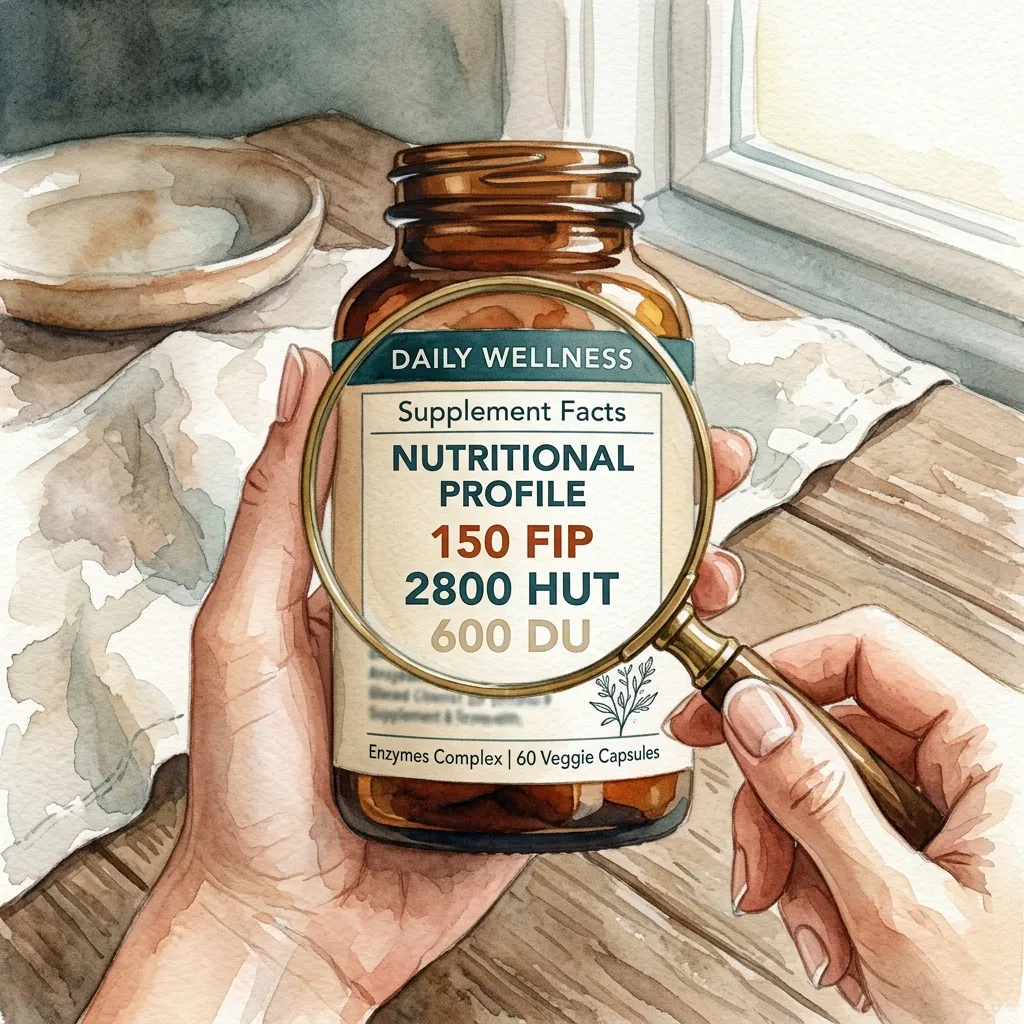
Factor 1 — Activity Units (FIP, HUT, DU) — NOT Milligrams
This is the single most important point that 90% of buyers miss. And it’s what brand marketing deliberately obscures.
- mg (milligrams) = physical weight. Says nothing about actual enzyme activity.
- FIP, HUT, DU = activity units. This is what actually matters [1].
Concrete example: 500 mg of lipase could be only 1,000 FIP if low quality. While 100 mg of high-quality lipase could be 10,000 FIP — 10x stronger despite weighing 1/5 as much.
| Enzyme | Activity Unit | Recommended Dose for Heavy Meals |
|---|---|---|
| Lipase (fat) | FIP | ≥ 5,000 FIP |
| Protease (protein) | HUT | ≥ 30,000 HUT |
| Amylase (starch) | DU or SKB | ≥ 10,000 DU |
| Lactase (lactose) | ALU | ≥ 4,500 ALU |
| Alpha-galactosidase | GalU | ≥ 300 GalU |
→ Rule: If the label only says “500 mg” without activity units → skip this brand, pick another. Honest labels always list both — mg and activity units.
Factor 2 — Source: Plant vs Fungal vs Animal
Not all enzymes are created equal. There are 3 main sources:
| Source | Working pH | Characteristics |
|---|---|---|
| Plant (Papain, Bromelain) | 4.5 – 9.8 | Acid-stable, works throughout the GI tract |
| Fungal (Aspergillus) | 3.0 – 9.0 | Most acid-stable, works at any pH [2] |
| Animal (Pancreatin) | 7.0 – 9.0 | Destroyed by stomach acid, requires enteric coating |
→ Rule: Plant + Fungal are generally better for pH stability — surviving the acidic stomach environment. Animal-based (pancreatin) absolutely requires enteric coating, or it’ll be destroyed before reaching the small intestine [3].
Factor 3 — Broad-Spectrum vs Targeted
- Broad-Spectrum (amylase + protease + lipase + many other enzymes): for mixed meals, or when you don’t know your specific trigger.
- Targeted (lactase only, alpha-galactosidase only, FODMAP blend): for people who know their specific trigger — more potent and cost-effective for the actual problem.
→ Rule: Don’t rush to buy broad-spectrum if your only issue is dairy. Targeted lactase will be more effective + cheaper.
Factor 4 — Third-Party Testing (The #1 Trust Signal After Activity Units)
Because supplements aren’t strictly FDA-regulated, third-party testing is your #1 trust factor. Look for these certification logos on the label:
- NSF International (ANSI 173 standard) — most reputable [4].
- USP Verified — pharmaceutical grade, very rare for supplements.
- ConsumerLab Approved — independent testing with online reports.
- Clean Label Project — verifies excipients.
→ Rule: Without at least 1 third-party certification → move to another product. Serious brands always invest in third-party testing.
Factor 5 — Enteric Coating + Excipient List
- Enteric coating = a coating that dissolves in the intestine, protecting enzymes from stomach acid. Mandatory for animal-based enzymes (pancreatin) and systemic enzymes (high-dose bromelain for inflammation). Plant + Fungal may not need it.
- Excipient list should be as short as possible. Avoid: titanium dioxide, high-dose magnesium stearate, artificial colors, soybean oil. Excipients are additives — fewer means more pure.
Match Enzymes to Your Problem — Decision Matrix
This is the spine of the article. Instead of asking “which enzyme is best?”, ask “what’s MY trigger?“. Match the right enzyme to your specific trigger:
| Symptom | Enzyme Match | Recommended Dose | Deep-Dive |
|---|---|---|---|
| Bloating after heavy meat/bean meals | High protease | ≥ 30,000 HUT | — |
| Diarrhea after fatty meals | High lipase | ≥ 10,000 FIP | vs-probiotics |
| Trouble with carbs, starch | High amylase | ≥ 10,000 DU | — |
| Lactose intolerance (dairy) | Targeted lactase | ≥ 4,500 ALU | — |
| Bloating after beans | Alpha-galactosidase | ≥ 300 GalU | for-ibs |
| FODMAP sensitive | FODMAP blend | (per product) | for-ibs |
| Post-gallbladder removal | Ox Bile + Lipase | ≥ 5,000 FIP + 125 mg bile | after-gallbladder-removal |
| Mixed meal, unknown trigger | Broad-spectrum | Per brand | what-are-digestive-enzymes |
| Joint pain / systemic inflammation | Bromelain / Serrapeptase (empty stomach) | 200–500 mg | pineapple |
What’s the first step? Keep a 7-day food journal: record what you ate, how long until symptoms appeared, severity on 1–10. Once you’ve identified 2–3 specific triggers, match the enzyme. Don’t rush to buy broad-spectrum if your only issue is dairy.
Buyer Trust Checklist — 7 Items to Take to the Pharmacy
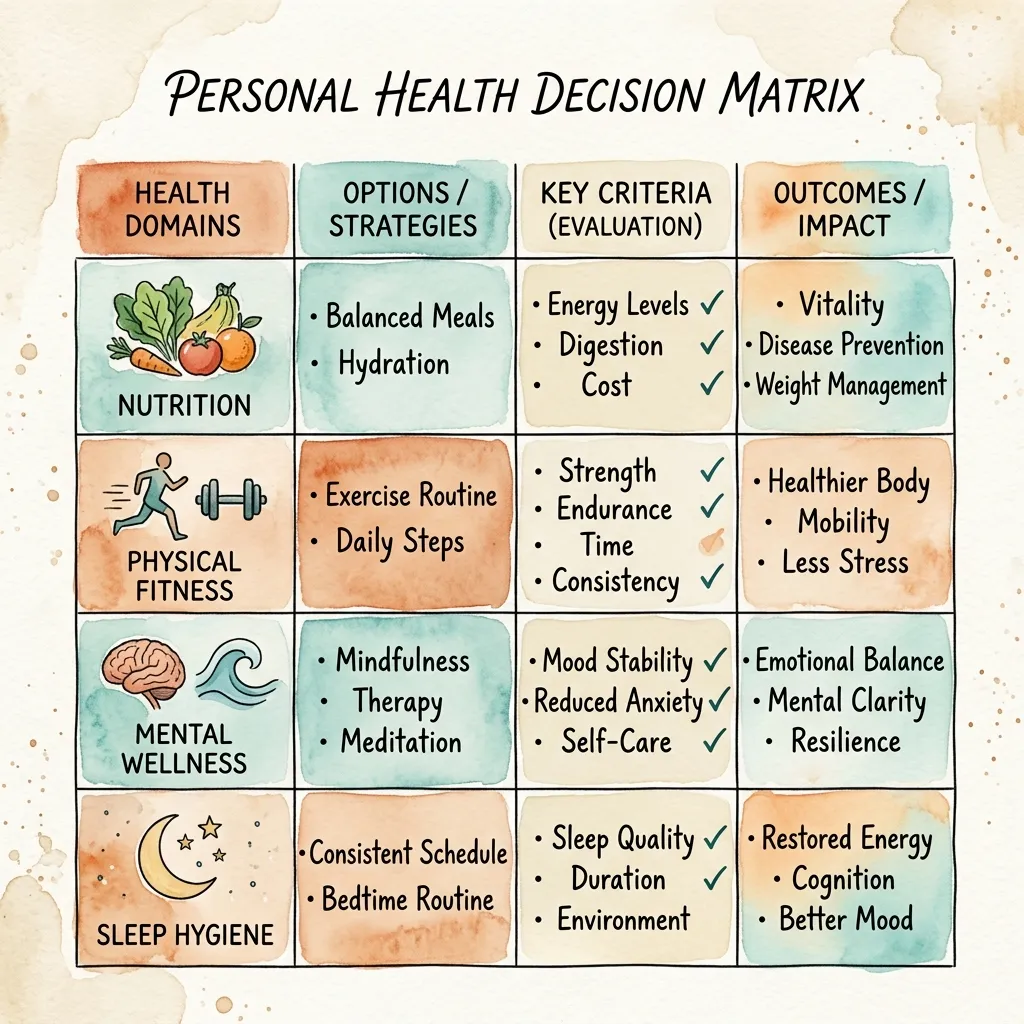
This is the checklist I use myself and share with friends. Print it, fold it in your wallet, bring it when shopping:
- ✅ Activity units clearly listed (FIP, HUT, DU, ALU, GalU) — not just mg.
- ✅ Source clearly stated (Plant/Fungal/Animal) — prioritize Plant + Fungal.
- ✅ Third-party tested (NSF/USP/ConsumerLab) — without it, move on.
- ✅ Short excipient list — avoid unnecessary additives, colors, fillers.
- ✅ Enteric coating if animal-based or systemic enzymes.
- ✅ Money-back guarantee — brands confident in their product usually offer this.
- ✅ Dose appropriate for your trigger (see Decision Matrix above).
→ If a product passes 5/7 or more → worth considering. Under 5/7 → find another product.
5 Categories of Brands (Classification, Not Specific Recommendations)
For practical reference, here are the brand categories buyers commonly encounter. No specific recommendations — you evaluate using the 7 criteria above.
Premium Broad-Spectrum
- Examples: Enzymedica, Pure Encapsulations.
- Characteristics: High activity units, strong third-party testing, premium price $30–60/bottle.
- For: Buyers with budget seeking optimization.
Budget-Friendly Broad-Spectrum
- Examples: NOW Foods, Doctor’s Best.
- Characteristics: Decent activity units, basic third-party testing, fair price $15–25/bottle.
- For: Beginners wanting to try first.
Targeted Enzymes (Single-Purpose)
- Examples: Lactaid (lactase), Beano (alpha-galactosidase), FODZYME (FODMAP blend).
- Characteristics: One specific purpose, highly effective for known triggers.
- For: People who’ve identified their specific trigger.
Combo Formulas with Bile (For Post-Gallbladder Removal)
- Examples: Thorne Bio-Gest, Dr. Berg-style formulas.
- Characteristics: Includes Ox Bile + high-dose Lipase + Pancreatin.
- For: Post-cholecystectomy patients. Read more: Enzymes after gallbladder removal.
Practitioner-Grade
- Examples: Designs for Health, Klaire Labs, Integrative Therapeutics.
- Characteristics: Sold through professional channels, highest quality, premium $50–100+.
- For: People prescribed by functional medicine practitioners.
The Eastern View — Choosing Enzymes by “Body Constitution”
A unique angle no Western top-SERP article has.
In Traditional Chinese Medicine (TCM), each person has a different body constitution. Simplified into 2 main groups:
“Cold” Constitution
- Signs: Cold hands/feet, dislike of cold weather, prone to loose stools, pale tongue, soft stools.
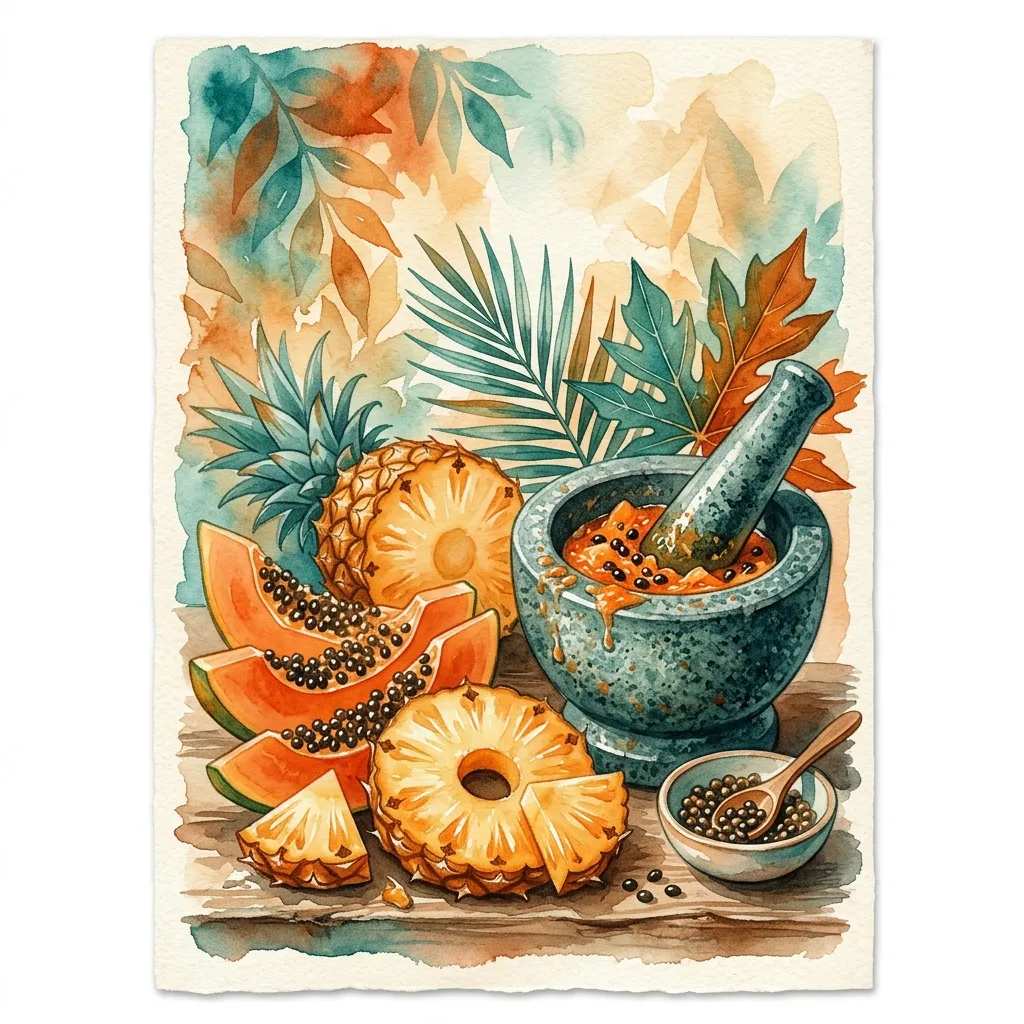
- Appropriate enzymes: Mildly warming, support Spleen Fire. Bromelain (pineapple), Papain (papaya), Zingibain (ginger) — especially good for cold constitution.
- Avoid: Enzymes from cold-natured foods (watermelon, cucumber).
“Hot” Constitution
- Signs: Prone to acid reflux, bitter mouth, red tongue, hot inside, dry stools.
- Appropriate enzymes: Neutral, don’t add heat. Fungal Aspergillus, yeast-extracted lactase.
- Avoid: Too much bromelain (may “add heat” per classical TCM interpretation).
This is a reference angle, not mandatory. But if you’ve observed your constitution, you can choose enzymes that harmonize with your body rather than work against it — I’ve seen this make a noticeable difference for a few family members.
💡 When You DON’T Need Enzymes — What Brands Will Never Tell You
This is the most important section of the article. Because it counter-balances all the enzyme marketing out there.
Before spending money, ask yourself these 5 questions:
- Do you have specific symptoms? — Bloating, diarrhea after fatty meals, gas after beans, indigestion? If NO → don’t buy.
- Are you eating balanced + chewing thoroughly + low stress? — Your body produces enough enzymes under right conditions. Don’t “fix” what isn’t broken.
- Do you sleep 7–8 hours? — Stress + sleep deprivation reduces pancreatic enzyme secretion. Address stress + sleep first, supplement later [5].
- Can you eat more enzyme-rich whole foods? — Pineapple, papaya, ginger, raw sauerkraut, kiwi. Cheaper than supplements, healthier, tastier.
- Symptoms persisting >2 months? — See a gastroenterologist. Don’t long-term self-treat with supplements.
My personal rule: Supplements are a temporary crutch, not a permanent cane. The ultimate goal is to not need any pill at all. Your money deserves to be spent on fresh food.
Read more: Foods high in natural digestive enzymes — the food-first solution, cheap and effective [6].

Side Effects + Long-Term Concerns
For balance, here are things brands rarely emphasize:
- Common side effects: Mild bloating in the first few days, mild diarrhea if dose too high, rare allergies (especially bromelain in pineapple-allergic individuals).
- Drug interactions: Bromelain + warfarin (increased bleeding risk); enzymes + antibiotics (space 2h apart); enzymes + diabetes medications (may affect glucose absorption).
- Long-term concern: Some experts worry that long-term enzyme use may reduce natural pancreatic secretion. Prevent by taking 1–2 week breaks every 2–3 months.
- Pregnancy/breastfeeding: Safety data limited — consult your doctor first.
- Children under 12: Don’t self-administer — requires pediatrician guidance.
Summary & Action
If you remember only three things from this article: (1) There’s no universal “best enzyme” — “Best” = matched to your trigger + measured in activity units (FIP/HUT/DU), not mg + third-party tested. (2) Read the label like a pharmacist using the 7 buyer trust criteria. No third-party testing → skip the product. (3) Sometimes the right answer is DON’T buy — If you’re healthy, no symptoms → your money deserves to go to fresh food instead.
CTA — Action for This Week: Step 1: Keep a 7-day food journal. Step 2: Visit your pharmacy, bring the 7 buyer trust criteria. Compare 2–3 products on the shelf. Step 3: Don’t rush to buy online based on “Top 8 Best” lists. Evaluate independently. Step 4: If symptoms persist >2 months → see a gastroenterologist.
Frequently Asked Questions (FAQ)
What’s the best enzyme for bloating?
No universal best. Bloating after meat → high protease (≥30,000 HUT). After dairy → lactase. After beans → alpha-galactosidase. Keep a 7-day food journal to identify YOUR specific trigger, then match.
Should I take enzymes every day?
Only if you have specific symptoms. Healthy people eating balanced DON’T need them. Long-term users should take 1–2 week breaks every 2–3 months to let the body “exercise itself.”
Plant or animal enzymes — which is better?
Plant + Fungal are generally better for pH stability. Animal-based (pancreatin) absolutely requires enteric coating, or it’ll be destroyed before reaching the small intestine.
Will enzymes make my pancreas “lazy”?
Evidence is weak but the dependency theory exists. Prevent by taking 1–2 week breaks every few months if using long-term.
Should I choose expensive or budget brands?
Expensive doesn’t mean better. What matters is activity units + third-party testing. A budget brand with high activity units + NSF certification can beat an expensive one without testing.
Are “vegan / organic” products better?
Not necessarily. Vegan only means plant/fungal source. Organic only means organic ingredients. Neither guarantees high activity units or third-party testing.
How long until I see results?
Enzymes have immediate effect — reduced bloating within 30–60 min after meals if used correctly. If 2–4 weeks of correct use produces no improvement → enzymes aren’t the solution for your problem.
Are enzymes covered by insurance?
In the US, most OTC enzymes are not insurance-covered. Only PERT (Pancreatic Enzyme Replacement Therapy like Creon) is covered for EPI — not common IBS/bloating.

About Mr. Anh
We turn solid evidence into everyday habits Americans can actually do—plain English, cups/oz, grocery-aisle swaps, and routines that fit real life. Our editorial process: Experience—we road-test tips in real schedules…