How Long Does It Take for Diet to Affect Your Skin? The 28-Day Number Isn’t Yours
Skin renews every 28 days at twenty. At forty it is 35 to 40, and acne needs two to three cycles. Which puts the real answer nearer three months than one.
- Why Most People Quit Three Weeks Too Early
- The 28-Day Number Belongs to Somebody Else
- Acne Needs Two to Three Cycles, Not One
- Weeks Three and Four Often Look Worse
- No, That Is Not "Purging"
- "I Eat Healthy and Still Break Out"
- Why Your Skin Looks Better When You Eat Badly
- What Actually Changes First
- A 30-Day Plan Is a First Leg, Not a Finish Line
- When It Is Not the Food
- Frequently Asked Questions
- The Bottom Line
You have been eating well for five weeks. Your skin is no better, and some weeks it looked worse. You are starting to think this does not work for you.
Before you stop — the number you are using to judge this almost certainly does not belong to you.
Every article on this subject says the same thing: skin renews every 28 days, so give it a month. That figure is real. It is also a twenty-year-old’s figure, and it is being handed to everyone regardless of age.
Here is the actual clock, calculated for your age, and the three things that get misread while you are waiting.
Quick takeaways:
- 28 days is the turnover rate in your twenties. At forty it is 35 to 40 days; past fifty it can exceed 45
- Acne needs two to three cycles, not one — which puts the honest answer closer to three months than one
- Weeks three and four often look worse. That is the backlog, and it is not “purging”
- “I eat healthy and still break out” usually has a simpler explanation than poor absorption
- “My skin looks better when I eat badly” is a lag illusion — today’s skin is last week’s report
Why Most People Quit Three Weeks Too Early

The pattern is remarkably consistent.
Someone changes how they eat. They wait about a month. Nothing much has happened — or something has, in the wrong direction. They conclude that diet does not affect their skin, and they go back to eating the way they did.
That conclusion rests entirely on a borrowed number.
It is worth noticing what Google thinks of the available answers here, too. For the question “how long does it take for diet to affect skin”, the top result is a Reddit thread. Search engines do not put a forum first on a health question when a professional page answers it properly.
I went through the pages that rank underneath it. The one article that presents itself as a timeline never explains skin cell turnover at all — the single mechanism that determines the timeline. Another says the process takes months, which is closer to right, in about 650 words with no sources and no numbers.
So the forum is winning because the alternative is not answering the question. Let me try to answer it.
If you want the food side of this rather than the timing, the clear skin diet guide covers what to eat and what the evidence supports.
The 28-Day Number Belongs to Somebody Else
Skin cell turnover — the journey a new cell takes from the base of the epidermis to the surface, where it is shed — is the clock that governs all of this.
It is not one number. It changes with age:
| Age | Turnover cycle |
|---|---|
| Twenties | around 28 days |
| Thirties and forties | 35 to 40 days |
| Fifty and beyond | over 45 days |
If you are forty-five, the “give it a month” advice is asking you to judge a process that has not completed a single cycle yet.
Where 28 days came from
It is not invented. It is simply the figure for young adult skin, repeated so often that it hardened into a constant.
What makes this odd is that the correction is not hidden. The age breakdown sits on pages ranking for “how long does skin take to renew” — a query that appears in the same searches as this one. The two facts are adjacent on Google and nobody has connected them.
What else slows it down
Age is the main driver, but not the only one. Sleep quality, chronic stress, sun exposure and general health all affect renewal speed.
Which means the same person can run slower at forty-five than they did at forty-two, if the intervening years were hard ones.
One honest caveat before we build on this: these are ranges and trends, not a measurement of you. Individual variation is wide. Use the direction — slower with age — rather than treating any single number as your personal figure.
Acne Needs Two to Three Cycles, Not One
Here is the part that changes the arithmetic completely.
One turnover cycle is not enough for acne. The skin around a blocked follicle takes two to three cycles to normalise — because underlying inflammation has to settle first, and because the follicles already congested have to work through and clear.
Why one cycle is not enough
A visible spot did not start when you saw it. It started as a microcomedone — a microscopic plug at the base of the follicle — and then travelled up.
When you change what you eat today, you are changing what happens to microcomedones forming from today onward. Every one already in the pipeline continues on its original schedule, regardless of your new breakfast.
Which means the first cycle is largely spent clearing inventory. Only from the second cycle onward are you looking at skin produced under the new conditions.
Doing the arithmetic
Put the two figures together:
| Age | Cycle length | Two to three cycles |
|---|---|---|
| Twenties | 28 days | 8 to 12 weeks |
| Thirties and forties | 35 to 40 days | 10 to 17 weeks |
| Fifty and beyond | 45+ days | 13 to 19 weeks |
I want to be straight about what this table is. It is my own multiplication of two published figures — the age-related turnover rates, and the two-to-three-cycle requirement for acne. No study has measured this table directly and published it.
I am showing you the arithmetic rather than announcing a conclusion, so you can see exactly how much weight it holds. It is a reasoned estimate. It is not a measurement.
But even treated cautiously, it makes one thing clear: for anyone over thirty, four weeks is not a test. It is barely a beginning.
Weeks Three and Four Often Look Worse

This is the stage that ends most attempts.
Somewhere around week three, skin frequently gets worse rather than better. New spots appear. It feels like proof the change is not working, or is actively harming.
It is the backlog surfacing. Microcomedones that formed before you changed anything are completing their journey on the schedule they were always going to complete it on. Their arrival has nothing to do with what you ate this week.
The cruel timing is that this coincides almost exactly with the point people have decided to evaluate.
What to do instead of quitting
Photograph it. Once a week, same light, same angle, no makeup. Memory for skin is unreliable in a specific direction — people remember the timeline that fits what they already believe.
A photo from week two next to week eight is data. A recollection of “I think it was a bit better in June” is not.
No, That Is Not “Purging”
A large number of people arriving at this question want to know whether the worsening is “purging” — the idea that things get worse before they get better as the skin clears itself out.
It is a fair question. The answer is fairly clean.
What purging actually is
Purging is associated with products that accelerate skin cell turnover: retinoids, alpha hydroxy acids, beta hydroxy acids. By speeding the cycle up, they bring microcomedones that were weeks from surfacing to the surface all at once.
That is the mechanism. Faster turnover, compressed timeline, everything arriving together.
Food does not accelerate turnover
Nothing you eat speeds up your skin cell cycle the way a retinoid does. There is no dietary equivalent of that mechanism.
So a worsening after a dietary change is almost certainly not purging. The mechanism that defines purging is not present.
What it probably is instead
Two things, usually at once:
The backlog, arriving on its normal schedule. Not accelerated, not compressed — just the spots that were always coming, arriving while you happen to be watching closely.
Coincidence, which is more common than people allow. Diet changes rarely happen in isolation. They cluster with stressful periods, new skincare, seasonal change, sleep disruption, or simply land somewhere in a hormonal cycle. When you are paying close attention to your skin for the first time in years, you also see more.
The term itself is informal
Worth knowing: even mainstream medical sources note that “skin purging” lacks scientific research support and remains a colloquial rather than a medical term.
Why this distinction matters practically: if you believe you are purging, you wait it out. That is the right response to a backlog and the wrong response to a genuine reaction. Knowing which one you are looking at determines whether waiting is patience or stubbornness.
If your skin worsens with a product and only where you apply it, that is the purging conversation. If it worsens after a dietary change, the honest answer is that you are probably watching the backlog and should keep going.
“I Eat Healthy and Still Break Out”
This is one of the most common questions in this whole subject, and the answers currently on offer are pointed in an odd direction.
The version I found ranking answers it with digestion: inadequate chewing, low stomach acid, insufficient enzymes, sluggish bile, a damaged intestinal lining. The conclusion is that you are not absorbing nutrients properly.
That can be true for some people. But there is a much more ordinary explanation that gets skipped.
A lot of “healthy” food carries a high glycemic load
Consider what tends to increase when someone starts eating well:
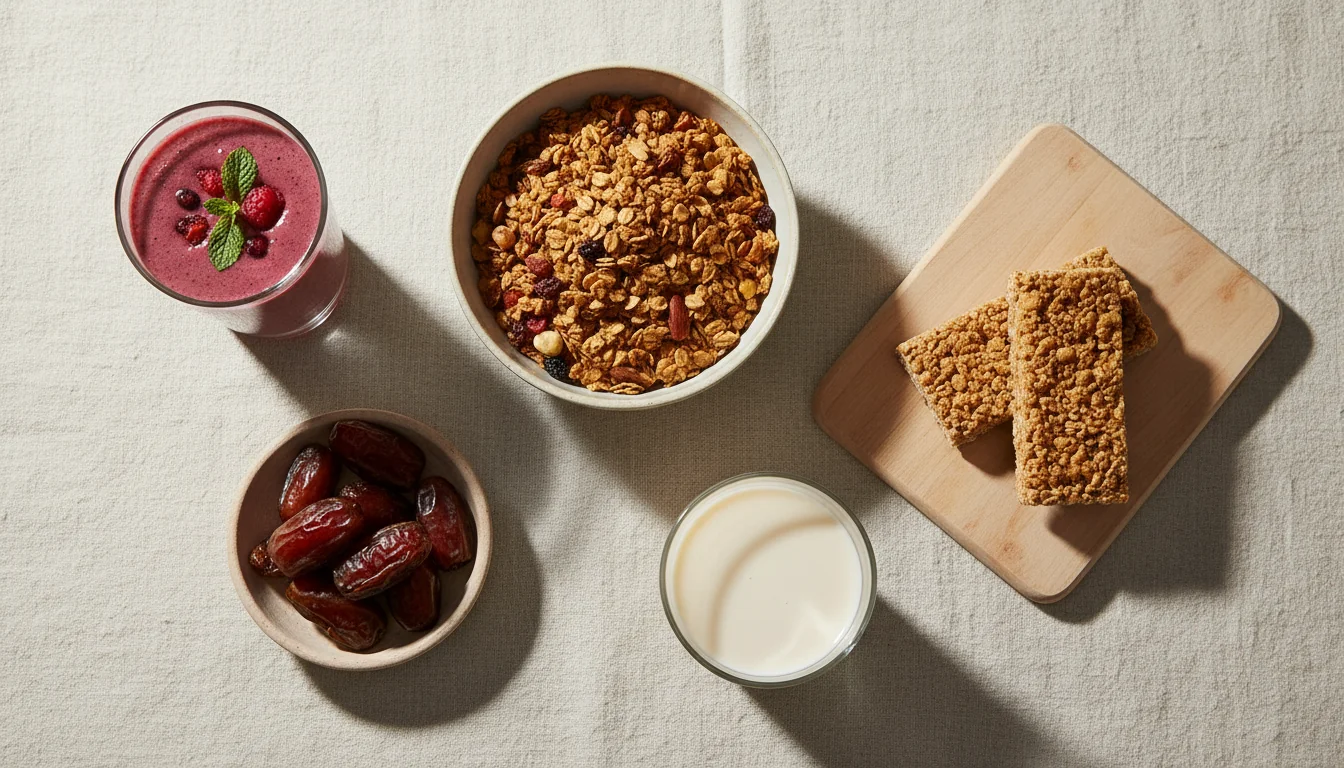
Smoothies. Oat milk. Dates. Granola. Protein bars. Rice cakes. Dried fruit. Fruit juice. Honey instead of sugar.
Every one of these is marketed as a health food. Several of them produce a glucose response comparable to, or higher than, the foods that were replaced. Blending fruit removes the structure that slowed its sugars. Oat milk’s production converts starch into simpler sugars. Dried fruit is fruit with the water removed and the sugar concentrated.
Since glycemic load is the dietary factor with the strongest evidence in acne, it is entirely possible to eat “clean” and increase your exposure to the thing that matters most. I go through which foods actually rank where in the worst foods for skin, and the mechanism for lowering the glucose response of a starchy meal in resistant starch.
Before investigating your enzymes, it is worth checking whether your healthy diet is a low-glycemic one. Often it is not.
When it is worth looking at digestion
If you have genuinely lowered the glycemic load of your meals, given it three months, and nothing has shifted — then digestion becomes a reasonable next question. Signs of poor gut health covers what to look for, and gut health and skin covers how the two are connected.
Second, not first.
Why Your Skin Looks Better When You Eat Badly
People ask this, and nobody answers it.
You go on holiday, drink more, eat worse, sleep less — and your skin looks great. You come home, eat properly, and it breaks out. It feels like evidence that the whole idea is nonsense.
It is a lag illusion, and it follows directly from everything above.
Today’s skin is last week’s report. Possibly last month’s. The skin you see on the third day of a holiday was produced under the conditions of the weeks before the holiday. The breakout that arrives in week two at home was set in motion while you were away.
Memory does not work this way. Memory runs in order: I ate badly, then my skin was good, therefore. Biology runs on a delay long enough to break the connection entirely.
The one direction that is fast
There is an asymmetry worth understanding, because it is the source of most of the confusion.
Getting worse can be quick. Controlled trials have found chocolate increasing lesion counts within one to two weeks — because you are adding to inflammation already underway, and pushing along follicles already congested.
Getting better is slow. Improvement requires the pipeline to empty, and the pipeline runs at your turnover rate, twice or three times over.
So “I ate badly and broke out days later” can genuinely be true. “I ate well for two weeks and nothing happened” tells you nothing whatsoever. The same person can experience both and reasonably conclude that food only ever makes things worse.
It does not. You are just watching one direction with a fast shutter and the other with a slow one.
A Traditional Perspective: “A person plants in spring and looks at the ground in June, and finding nothing, decides the seed was bad. The seed was fine. They were reading the wrong calendar — one borrowed from a younger person’s garden, in a warmer year.”
— Mr. Anh, Founder of Essential Wellness AZ
What Actually Changes First
If you want to know what to expect rather than what to hope for, roughly this sequence:
Weeks 1–2 — your gut, not your face. Gut microbial composition begins shifting within days of a consistent change in what you feed it. Digestion, energy and bloating often move first. Your skin has not received the message yet. Your gut microbiome covers what is actually happening at this stage.
Weeks 3–4 — the backlog. Often the worst-looking period. Nothing has failed.
Weeks 6–8 — the first honest signal. And note what it looks like: fewer new spots, not clear skin. The existing ones are still working through. Fewer arrivals is the early indicator, and it is easy to miss if you are looking at the total.
Weeks 10–17 — the real evaluation window if you are over thirty. This is where a judgement becomes meaningful.
That is a description of sequence, not a promise. Some people see nothing at any of these points, and that is also useful information.
A 30-Day Plan Is a First Leg, Not a Finish Line
There is clearly an appetite for the thirty-day version. People search for it constantly, in every format — plan, meal plan, PDF, recipes. Google is currently ranking Pinterest boards for it, which tells you how little serious material exists.
I am not going to pretend thirty days is the answer, because the arithmetic above says it is not. For someone over forty, thirty days is barely three-quarters of a single cycle.
But a month is not useless. It is just a different thing than people think.
What thirty days is actually good for
Building the habit. A change you cannot sustain for a month will not survive three.
Collecting a baseline. Four weeks of photographs and notes gives you something to compare against later.
Getting through the worst of it. Weeks three and four are the hardest part. Finishing a month means you have already passed the point where most people stop.
The three things to fix in month one
- Lower the glycemic load of your meals — the highest-leverage change, and the one with the best evidence
- Change one variable at a time — two changes at once produce an unreadable result
- Write it down — a photo a week, in the same light
Then keep going. The real evaluation point is week twelve.
When It Is Not the Food
Diet is one input. For many people it is not the dominant one, and no timeline changes that.
See a dermatologist rather than adjusting your food again if you have:
- Cystic or nodular acne — deep, painful lesions
- Acne that is scarring. Scarring is permanent, and three months spent waiting is three months you cannot recover
- Acne that is affecting your mood, confidence or daily life
- No change after three months of a genuinely consistent dietary change
- Sudden severe acne alongside irregular periods or unusual hair growth, which is worth investigating properly
Medical treatments work faster than food does, and the two are not in competition. Adjusting what you eat is a reasonable thing to do alongside treatment — not instead of it, and not for three months while something scars.
Frequently Asked Questions
How long does it take for diet to affect skin?
Longer than the usual advice suggests, and it depends on your age. Skin turnover runs around 28 days in your twenties, 35 to 40 in your thirties and forties, and over 45 past fifty. Acne needs two to three of those cycles, which puts most adults in the range of ten to seventeen weeks rather than four.
How long does it take for diet to clear acne?
Plan on two to three turnover cycles. For someone in their twenties that is roughly eight to twelve weeks; in their forties, closer to ten to seventeen. The first cycle is largely spent clearing spots that were already forming before you changed anything.
Does your skin really renew every 28 days?
In your twenties, roughly. The figure rises with age — 35 to 40 days is typical in the thirties and forties, and it can exceed 45 past fifty. Sleep, stress and sun exposure affect it too. The 28-day number is quoted as though it were universal, and it is not.
Why is my skin worse since I started eating healthy?
Two common reasons. The first is the backlog: spots that were forming before you changed anything are surfacing on their original schedule, and weeks three and four are typically the worst-looking. The second is that many “healthy” foods carry a high glycemic load — smoothies, oat milk, granola, dried fruit — so the change may not have lowered the factor that matters most.
Is it purging or a breakout?
If it followed a dietary change, it is almost certainly neither — it is the backlog. Purging is associated with products that accelerate skin cell turnover, such as retinoids and acids. Food does not accelerate turnover, so the mechanism that defines purging is not present. Worth knowing that “purging” is a colloquial term rather than a medical one.
Why does my skin look better when I eat unhealthy food?
Because today’s skin reflects the previous weeks, not yesterday’s dinner. The delay is long enough to break the connection your memory is making. There is also a real asymmetry: getting worse can happen within one to two weeks, while improvement takes two to three full turnover cycles — so the harmful direction is simply easier to notice.
Can you clear your skin in 30 days?
Unlikely, and for anyone over forty, thirty days is less than a single turnover cycle. A month is useful for building the habit, collecting a baseline and getting past the difficult third and fourth weeks. Treat it as the first leg. The meaningful evaluation point is around week twelve.
The Bottom Line
Most people who conclude that diet does not affect their skin never actually ran the test. They ran a quarter of it, using a stopwatch calibrated for someone twenty years younger.
The honest version:
- Your turnover cycle is probably longer than 28 days unless you are in your twenties
- Acne needs two to three cycles, so the real window is ten to seventeen weeks for most adults
- Weeks three and four looking worse is expected — and it is a backlog, not purging
- “Healthy” is not the same as low-glycemic, and that gap explains a lot of stalled attempts
- Today’s skin is last week’s report. Judge accordingly
None of this makes food a cure. It makes it a slow input with a delay long enough that most people never see the result of their own experiment.
If you are going to run it, run the whole thing. For what to actually eat during those twelve weeks, start with the clear skin diet guide.
Disclaimer: I’m trained in traditional medicine in Vietnam, but I’m not currently practicing medicine or providing personal diagnosis or treatment advice through this website. I write from personal experience, ongoing research, and my own food-first wellness experiments. My work explores digestion, daily energy, traditional self-care, movement, breathwork, meditation, and simple habits that support everyday well-being. Everything I share here is educational and reflective, not medical advice. It should not replace diagnosis, treatment, or care from a licensed healthcare professional.

About Mr. Anh
We turn solid evidence into everyday habits Americans can actually do—plain English, cups/oz, grocery-aisle swaps, and routines that fit real life. Our editorial process: Experience—we road-test tips in real schedules…