Do Walking Pads Help You Lose Weight? The Honest Answer
Walking pads can increase energy expenditure and reduce sitting time, but the evidence does not support buying one for weight loss alone.
Table of Contents
- Do walking pads help you lose weight? The short answer
- What the best review found
- What happened in actual workplace trials
- The calorie math people get wrong
- The work trade-off: typing is not free
- Who a walking pad is actually worth it for
- A realistic walking pad routine
- What the evidence has not shown
- Verdict: should you buy one?
- Frequently Asked Questions
- The bottom line
- References
Do Walking Pads Help You Lose Weight? The Honest Answer
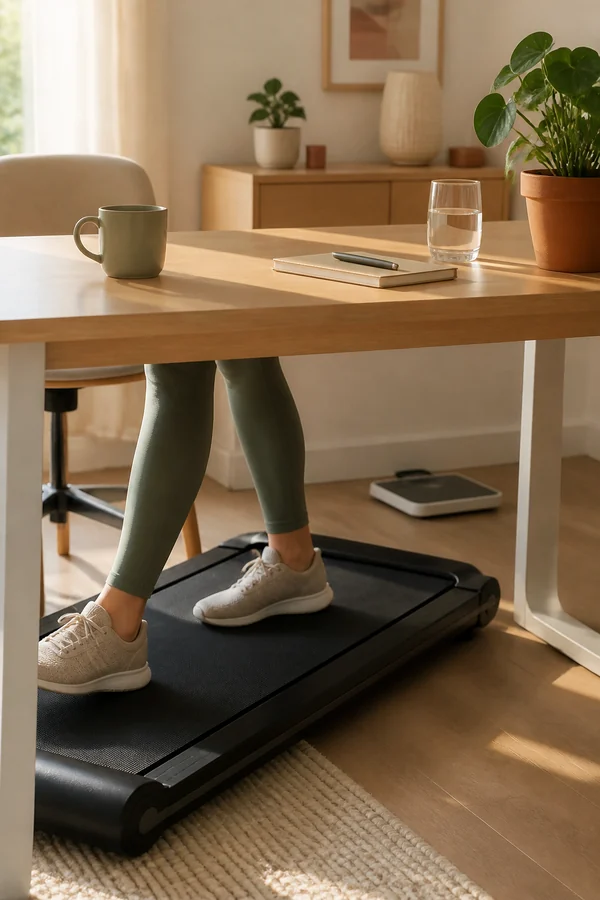
If you are buying a walking pad because you want the scale to move by itself, pause. Do walking pads help you lose weight? They can help you burn more calories and sit less. That part is real. But the evidence does not support the cleaner, shinier promise that a walking pad reliably causes weight loss on its own. That distinction matters, especially if you work at a desk and you are trying to make one smart purchase instead of collecting another piece of equipment that ends up leaning against a wall. This guide separates four questions that usually get mashed into one: calories burned, sitting time reduced, body weight changed, and work performance affected. By the end, you will know when a walking pad is worth it, when it is not, and how to test one without fooling yourself. The short version:- Walking pads increase energy expenditure. The best review found about 105 kcal per hour more than sitting.
- They reduce sitting time and add light activity during the workday.
- Weight change is modest, variable, and not guaranteed.
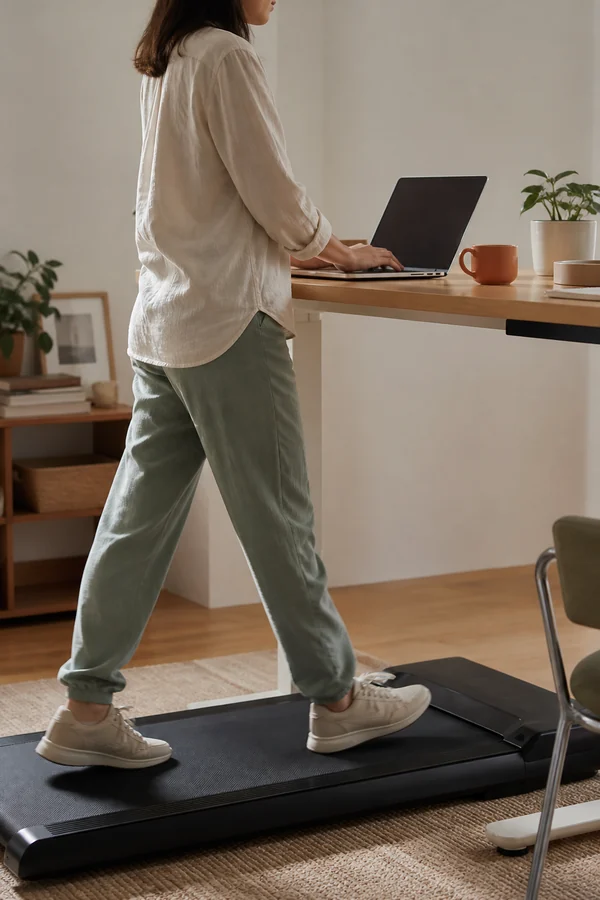
- Typing and some attention tasks can be worse while walking.
- Buy one for the sitting problem first. Think of weight loss as a possible side effect, not the reason to believe.
Do walking pads help you lose weight? The short answer
What the best review found
The strongest starting point is a 2021 systematic review and meta-analysis in BMC Public Health. The authors included 13 studies with 351 total participants: six workplace studies and seven laboratory studies. In the laboratory studies, treadmill desks increased energy expenditure by 105.23 kcal per hour compared with sitting. That is the number you will see repeated everywhere, and it is a real number. The same review found that workplace studies reduced sitting time by about 1.73 minutes per hour over a 24-hour period. That sounds small, but remember what workplace studies measure. They are not asking whether you can walk for one perfect hour in a lab. They are asking whether real office routines change when the tool is available. The uncomfortable part is the cardiometabolic and weight side. The review did not find strong evidence of statistically significant changes in other metabolic outcomes in workplace studies. That does not make walking pads useless. It tells you what they are best at. They increase movement reliably. The downstream health and weight outcomes are weaker, slower, and harder to prove. If you want a walking pad to help you stop sitting through the whole workday, the evidence is on your side. If you want it to replace a weight-loss plan, the evidence gets much thinner.What happened in actual workplace trials
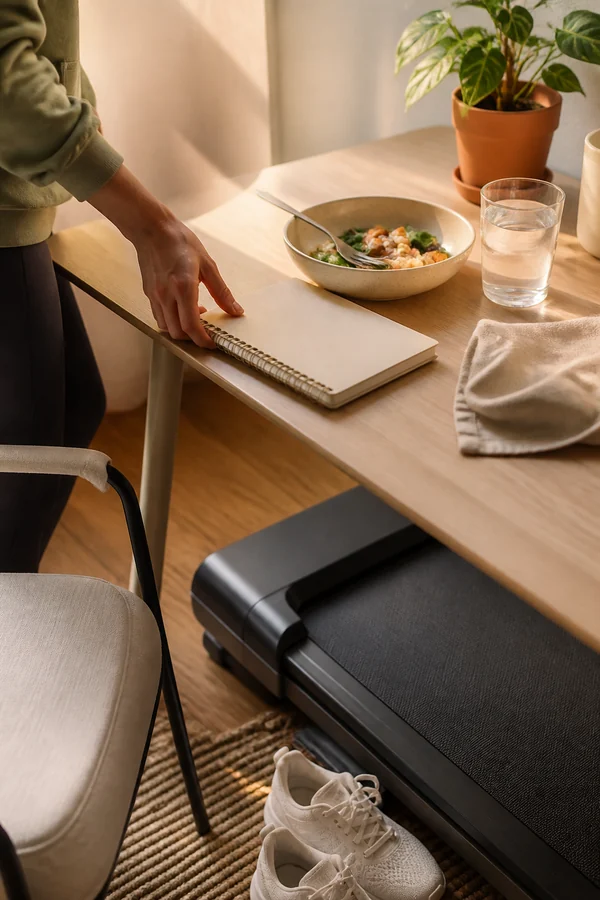
The workplace trials are more useful than the lab calorie number because they show what happens when people try to use these things around real work. A 3-month randomized controlled trial followed 41 overweight or obese office workers. The treadmill-desk group increased daily steps by 1,622 steps per day, increased light physical activity by 1.6 minutes per hour, and reduced sedentary time during work by 3.6 minutes per hour compared with usual work conditions. That is a meaningful behavior shift. It is not a dramatic transformation. And that is exactly the point. A 1-year prospective trial gave treadmill desks to 36 sedentary employees. Daily activity increased at 6 and 12 months, and sedentary time decreased. Average weight loss across the full group was 1.4 ± 3.3 kg. In participants with obesity, average weight loss was 2.3 ± 3.5 kg. That is not nothing. It is also not the kind of predictable result that should be marketed as “buy this and lose weight.” A smaller randomized crossover study in 20 overweight or obese physicians found that treadmill-desk use increased activity by about 197 kcal/day. The study also reported a 1.85 kg difference between 12-week periods and lower body fat during the treadmill-desk condition. Useful? Yes. Definitive? No. The participants were physicians, the sample was small, and the intervention included counseling and accelerometer feedback. That is not the same as a person buying a walking pad online, putting it under a desk, and hoping the device does the thinking.The calorie math people get wrong
The work trade-off: typing is not free
- phone calls
- webinars
- reading
- inbox triage
- admin review
- low-stakes meetings
- deep writing
- spreadsheets
- detailed design work
- rapid typing
- emotionally loaded messages
- anything where a mistake is expensive
Who a walking pad is actually worth it for
A realistic walking pad routine
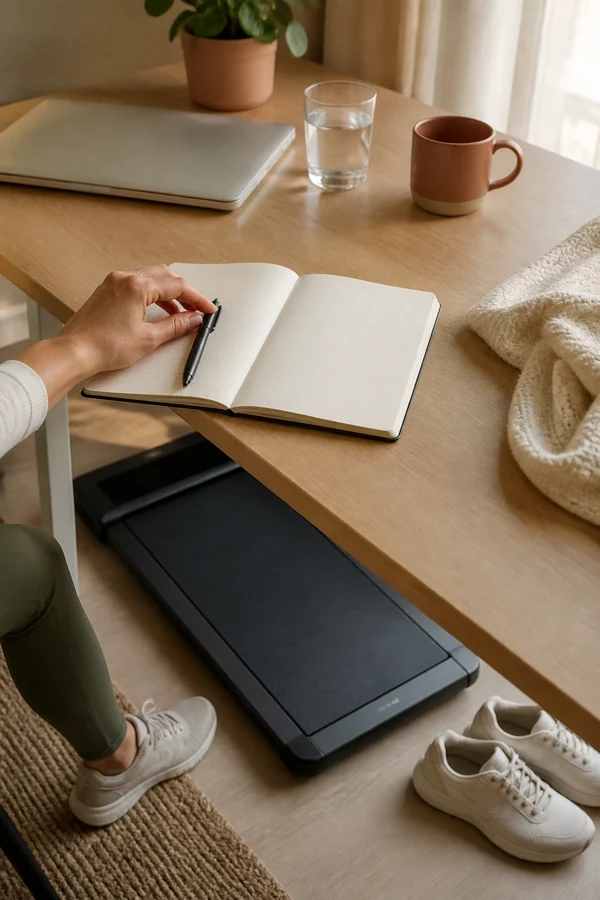
What the evidence has not shown
This section is the reason I trust the rest of the article. The evidence has not shown that a walking pad reliably causes meaningful weight loss for every desk worker. It has not shown that the average person will use one for an hour a day for years. It has not shown that people fully adapt to typing while walking. It has not shown that a cheap consumer walking pad will hold up like a research treadmill desk. It has not shown that walking during work replaces the value of dedicated exercise, strength training, sleep, or food quality. And it has definitely not shown that a walking pad cancels every cost of sitting. The better way to say it is this: a walking pad can help interrupt a sedentary pattern. That is meaningful. It is not magic. That is also why I would connect this decision to your actual workday pattern. If sitting after lunch is part of your desk bloat pattern, or if long chair blocks make your energy feel worse, then a walking pad has a clearer job. If your only goal is the scale, the job is too vague.Verdict: should you buy one?
Yes, if your main goal is to sit less and add light movement to parts of the workday that are currently motionless. Maybe, if weight loss is a secondary goal and you are willing to track whether the extra movement actually happens. No, if you need the walking pad to do the entire job for you. That is the cleanest way I can put it. The research makes walking pads look useful, but not miraculous. They are movement tools. They can help you spend fewer hours completely still. They can raise energy expenditure. They can make calls and low-focus tasks less sedentary. But if you buy one, buy the honest version: a tool that helps you practice light movement more often, not a machine that promises a different body while everything else stays the same.Frequently Asked Questions
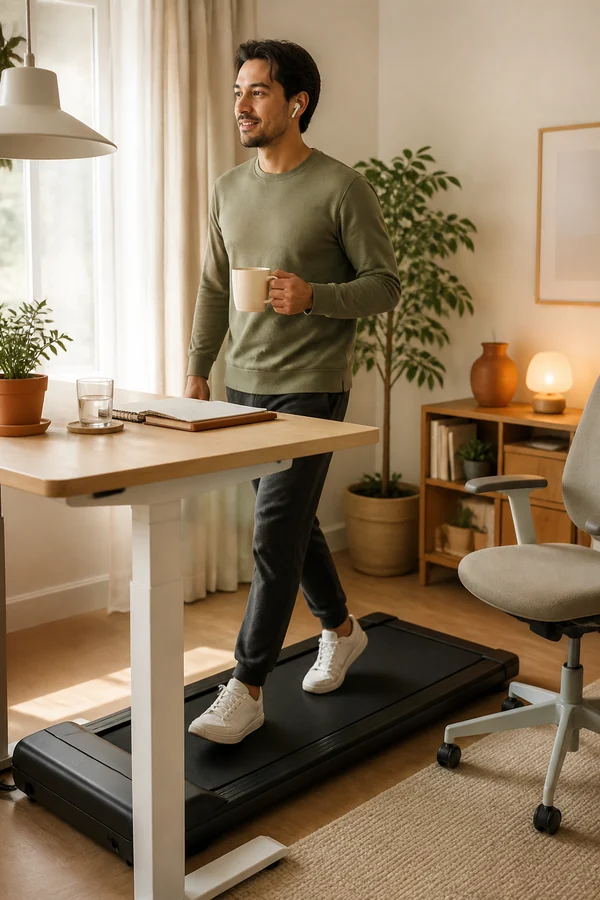
Do walking pads actually help you lose weight? They can help, but the evidence does not support guaranteed weight loss. The strongest review found walking pads increased energy expenditure by about 105 kcal per hour and reduced sitting time, but workplace studies did not show strong, consistent weight-loss outcomes. They are better understood as movement tools than weight-loss devices. How long should I use a walking pad each day? Start with 10 to 15 minutes once or twice per workday. Build only if it feels easy to repeat and does not hurt your focus, joints, or work quality. A routine you can repeat four days a week is more valuable than a one-hour target you abandon. How many calories do walking pads burn? A 2021 meta-analysis found treadmill desks increased energy expenditure by about 105 kcal per hour compared with sitting in laboratory studies. Your actual number depends on body size, speed, duration, and whether you compensate later with more food or less movement. Can I use a walking pad while typing? Yes, but typing may slow down. A 2015 randomized study found treadmill walking at 1.5 mph led to worse typing outcomes and modestly worse performance on some attention and learning tasks. Walking works better for calls, reading, and light admin than for deep writing or precision work. Is a walking pad better than a standing desk? For movement, yes. Standing changes posture, but a walking pad adds light activity. That matters because some sitting-break research suggests light walking does more metabolically than standing still. For focused typing, though, a normal seated setup may still be better.The bottom line
Do walking pads help you lose weight? Not reliably enough to buy one for that reason alone. They help you move more. They help you sit less. They may support a calorie deficit if you use them consistently and do not compensate elsewhere. But the strongest reason to buy one is not the scale. It is the workday pattern: fewer hours locked in a chair, more light movement, and a more realistic way to make desk work less sedentary. If you want to test that honestly, track one workweek before and after. Minutes used, hunger, focus, and how your body feels by late afternoon will tell you more than the product page does.Educational content only. This article describes population research and is not medical advice. If you have a heart, joint, or metabolic condition, talk to your doctor before changing your activity pattern.
References
- Oye-Somefun A, Azizi Z, Ardern CI. A systematic review and meta-analysis of the effect of treadmill desks on energy expenditure, sitting time and cardiometabolic health in adults. BMC Public Health. 2021. PMCID PMC8590128.
- Schuna JM Jr, et al. Evaluation of a workplace treadmill desk intervention: a randomized controlled trial. Journal of Occupational and Environmental Medicine. PMID 25479296.
- Koepp GA, et al. Treadmill desks: A 1-year prospective trial. PMID 23417995.
- Thompson WG, Koepp GA, Levine JA. Increasing physician activity with treadmill desks. Work. 2014. PMID 24004766.
- Larson MJ, et al. Cognitive and typing outcomes measured simultaneously with slow treadmill walking or sitting: implications for treadmill desks. PLOS One. 2015. PMID 25874910.
- Champion RB, et al. Reducing prolonged sedentary time using a treadmill desk acutely improves cardiometabolic risk markers in male and female adults. Journal of Sports Sciences. PMID 29667496.

About Mr. Anh
We turn solid evidence into everyday habits Americans can actually do—plain English, cups/oz, grocery-aisle swaps, and routines that fit real life. Our editorial process: Experience—we road-test tips in real schedules…