The Gut-Brain Connection in TCM: Why Stress Can Hit Your Stomach First
Why can the same meal feel fine one day and upset your stomach the next? Learn how stress, eating context, and TCM's Spleen-Stomach framework can help you ask better questions.
- Why Can Stress Make Your Stomach React?
- How Does TCM Explain This Experience?
- What Are These Two Maps Pointing Toward?
- Same Meal, Different Day: Do Not Blame Food or Feelings Too Quickly
- Try This at Your Next Meal
- When Should You Stop Observing and Seek Care?
- Choose the Next Step That Fits Your Pattern
- Frequently Asked Questions
- Your Gut Is Not Betraying You
- References
You can remove one food after another and still end up with stomach pain, uncomfortable fullness, or a sudden need to find a bathroom.
Worse, the symptoms often arrive at the exact moment you can’t afford them: before a meeting, during your commute, halfway through lunch with friends, or just as you’re about to leave home. Eventually, it’s not only the discomfort you fear. It’s the meal, the trip, and every place where you don’t know the location of the nearest restroom.
So you inspect everything on your plate. You cut out dairy, avoid spicy food, change your meal times, and search for one more list of “safe” foods. But one easily missed variable remains:
What if the problem is not only what you eat, but also the state your body is in while you eat it?
Your brain and digestive tract are always exchanging signals. That is why a familiar meal may feel fine on a relaxed day yet sit heavily when your body is wound tight. Modern science calls this two-way communication the gut-brain connection. In traditional Chinese medicine, or TCM, part of the same lived experience is expressed in the saying “pensiveness injures the Spleen”: prolonged mental strain may accompany disrupted digestive function.
That doesn’t make every digestive symptom psychological. And it certainly doesn’t mean you imagined your pain. It reveals a possible link that endless food swapping may never touch.
By the end of this guide, you will understand why pressure can reach your stomach before you consciously feel stressed, how TCM describes that pattern without turning an emotion into a diagnosis, and a three-step experiment you can try at your very next meal to see whether tension may be adding to your symptoms.
Why Can Stress Make Your Stomach React?
Before a difficult meeting, your body doesn’t wait for you to finish thinking. Your heart speeds up. Your mouth goes dry.
Your shoulders tighten, your hands cool, and your breathing gets shallow. Your gut is part of that same body, so why would it sit out the response?
The brain and digestive system continually send information in both directions through neural, hormonal, and immune pathways. The gut microbiome is also being studied as part of this communication. You do not need to memorize those mechanisms to understand the practical point: when your body detects pressure, hunger, eating behavior, bowel habits, and sensations in your abdomen may change.
Think of your brain as an alarm system. Once it rings, your attention snaps toward the immediate demand—a presentation, an argument, a departing flight, or an unsettling message. Lunch becomes background noise. You eat faster, chew less, miss signs of fullness, or lose your appetite altogether.
This is an illustration, not a complete biological explanation. The body is more complex than an alarm, and no single mechanism explains every digestive symptom. The National Institute of Diabetes and Digestive and Kidney Diseases describes gut-brain disorders as involving interacting biological, psychological, and social factors while noting that many mechanisms remain under investigation.

Worrying about your gut can intensify the loop
Suppose your stomach starts gurgling before a meeting. You immediately think, “What if I have to run out during my presentation?”
Now you notice every movement and sound in your abdomen. A mildly uncomfortable sensation becomes harder to ignore. The more worried you feel, the more tense your body becomes. The more tense your body becomes, the more closely you monitor your gut.
The loop may look like this:
Pressure → body changes state → gut reacts → worry about the symptom → more pressure
None of this makes the symptom imaginary. Pain, fullness, nausea, and urgency are real. Attention and anxiety may turn up the volume, but that doesn’t make you responsible for creating the sensation.
The loop does not always start in the brain. Repeated abdominal pain can make you afraid to eat away from home, travel, or move too far from a restroom. In that case, the digestive symptom creates more stress. That is why two-way connection is more accurate than saying either the brain controls the gut or the gut controls the brain.
How Does TCM Explain This Experience?
Traditional Chinese medicine didn’t develop with terms such as enteric nervous system, stress hormones, or microbiome. It looks at the same person through a different map.
Within that map, the Spleen and Stomach are central to receiving and transforming food. But the TCM “Spleen” isn’t simply the anatomical spleen under your left rib cage. It’s a broader traditional functional system.
I trained in traditional medicine in Vietnam, and I’m not currently practicing medicine. When I use terms such as Spleen Qi here, I’m explaining the traditional framework—not diagnosing you or replacing medical care.
Picture the Spleen and Stomach as a kitchen
The Stomach receives food. The Spleen is described as helping transform it and distribute nourishment. For a beginner, it may help to imagine the Spleen-Stomach system as a kitchen.
A kitchen runs smoothly when the ingredients are manageable, the cook has enough time, and the work follows a steady rhythm. Now imagine the cook stirring a pot, answering three phone calls, searching for lost keys, and worrying about the next meeting. The kitchen can quickly become chaotic.
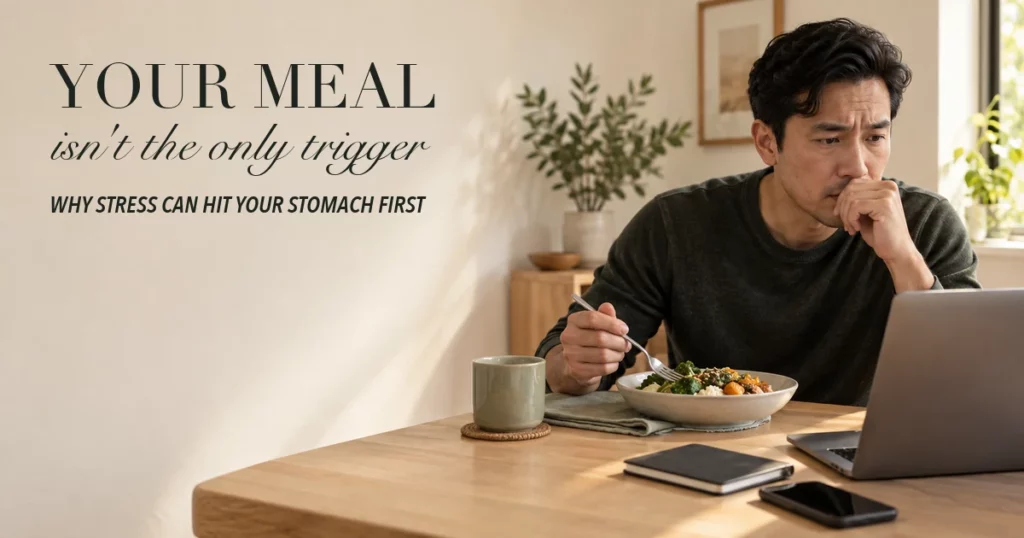
Many meals happen in a similar setting. Your mouth is chewing while your eyes remain on a screen. Your hand holds a fork while your mind has already moved into the next meeting. Your body receives food while your attention is being pulled in several directions.
The kitchen metaphor helps explain TCM thinking. It does not mean stress switches off your anatomical spleen or causes food to sit untouched in your stomach.
“Pensiveness injures the Spleen” does not mean thinking is bad
The TCM saying commonly translated as “pensiveness injures the Spleen” can sound alarming when taken literally. It does not offer a useful basis for claiming that ordinary thought damages the physical spleen.
Here, pensiveness is closer to mentally chewing the same problem over and over: replaying a conversation, worrying about something that has not happened, or making decision after decision while trying to eat.
Imagine a web browser with 30 tabs open. It still works, but moving between tasks becomes slow and heavy. In TCM language, this kind of prolonged mental load is associated with disharmony in the Spleen-Stomach system.
The answer isn’t to “stop thinking.” That’s neither realistic nor helpful. Ask a more useful question instead: when your mind has too many tabs open, do your eating habits and post-meal sensations change?
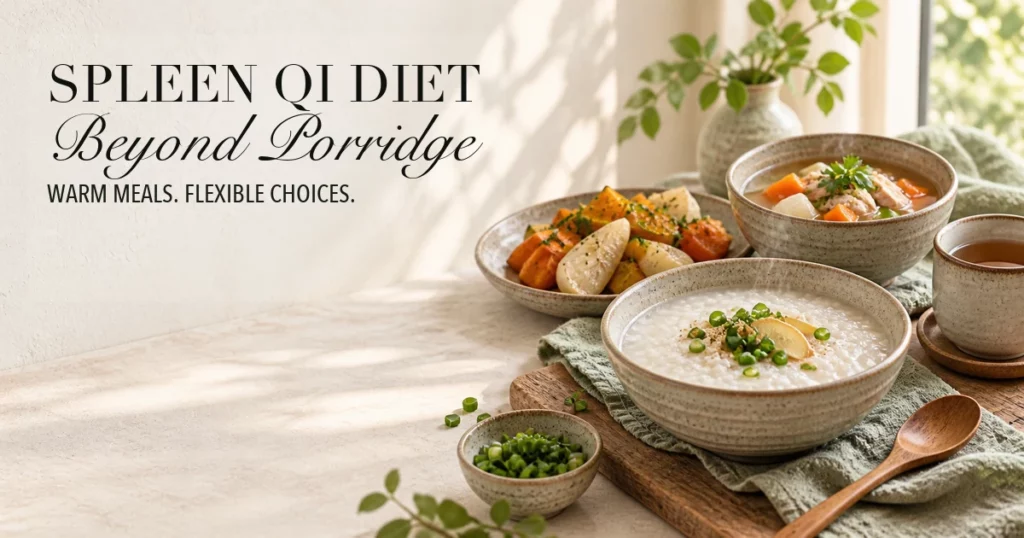
If you want to explore food within the Spleen Qi framework, read our spleen qi deficiency diet guide. This article stays focused on emotional context and meals.
Where do frustration and fear fit?
TCM commonly associates frustration, anger, or feeling stuck with the Liver system. Traditional pattern language may describe constrained Liver Qi when movement feels blocked. In everyday life, some people notice more upper-abdominal tension, reduced appetite, or discomfort during conflict.
That observation doesn’t prove anger causes reflux, gastritis, or ulcers. These symptoms have many possible causes and deserve appropriate evaluation when they persist.
Fear is traditionally associated with the Kidney system and downward movement. The image may feel familiar to someone who needs the bathroom before an exam, flight, or presentation. But fear alone cannot explain ongoing diarrhea.
Use these associations to open a question, never to close the case with a self-diagnosis.
What Are These Two Maps Pointing Toward?
Modern science investigates measurable communication pathways between the brain and gastrointestinal tract. TCM uses imagery and functional patterns developed within a different medical tradition.
We can place them side by side to make the experience easier to understand, as long as we do not pretend they are equivalent:
| What you experience | A simple modern view | A simple TCM view |
|---|---|---|
| You lose your appetite when worried | Stress and attention may change hunger and eating behavior | Pensiveness may disturb the Spleen-Stomach system |
| Your upper abdomen tightens when frustrated | Brain processing, bodily sensation, and behavior may influence one another | Constrained Liver Qi may affect the Spleen and Stomach |
| You need the bathroom before a frightening event | A stress response may occur with changes in bowel habits | Fear is associated with the Kidney system and downward movement |
Keep this limit in mind: Spleen, Liver, and Kidney in this table refer to TCM functional systems. They are not automatically the anatomical spleen, liver, and kidneys. The table can help you ask questions; it cannot diagnose you.
The most useful point of overlap is simple: your body does not digest a meal separately from the rest of your life.
The boundary is equally clear. We cannot say TCM discovered the vagus nerve or microbiome thousands of years ago. In the other direction, a modern gut-brain study does not automatically validate every TCM theory or treatment.
The National Center for Complementary and Integrative Health also advises that evidence and risks vary across TCM practices. An emotion-organ association is not a reason to self-prescribe an herbal formula.
Same Meal, Different Day: Do Not Blame Food or Feelings Too Quickly
Now return to that familiar meal from the opening. The stressful meeting stands out, but it may not be the only thing that changed.
Ask three questions before reaching a conclusion.
1. What changed on the plate?
Was the portion larger? Did the food contain more fat or spice? Did you drink more coffee?
Did you eat at noon as usual, or wait until 2 p.m. when you were extremely hungry?
“Almost the same” is not always the same.
2. What changed around the plate?
How much did you sleep? Did you finish the meal in 10 minutes or 30? Were you arguing, editing slides, or scrolling through upsetting news while you ate? Had you started a medication or supplement, or recently been ill?
This is where both the gut-brain perspective and TCM encourage us to widen the frame.
3. Did it happen once, or does it repeat?
One event is a clue. When similar discomfort keeps appearing under similar conditions, you have a pattern worth noticing. Even then, you haven’t proved the cause.
“My stomach often feels tight when I rush lunch before a meeting” is more useful than “stress caused my disease” or “this food is bad for me.” The first statement helps you choose a sensible next step while leaving room for other explanations.
If post-meal fullness is your main concern, our guide to why bloating happens after eating examines portions, timing, and common triggers in more detail.
Do not make food carry all the blame. Do not make emotion carry all the blame. Look at both the plate and the circumstances around it.
Try This at Your Next Meal
Trying to change your diet, sleep, breathing, and emotional life in one day only gives you another project to manage. At your next meal, do three things. That’s all.

Step 1: Put the phone or laptop aside
You don’t need a silent room or 20 minutes of meditation. Create one small boundary: while you eat, eat.
If your workday does not allow a long break, try spending at least the first few minutes without a screen. The goal is to see your food, notice your pace, and reduce how many tasks you are processing at once.
Step 2: Slow down the first five bites
You don’t need to count 30 chews or force yourself to eat slowly through the entire meal.
For the first five bites, notice the smell, taste, and temperature of the food. Check whether your shoulders or jaw feel tight. Then continue eating normally.
This is not a treatment and cannot guarantee relief from bloating. It is simply small enough to do and specific enough that you know what changed.
Step 3: Write one sentence after the meal
Use this template:
“I ate ___ while ; about ___ minutes later, my stomach felt .”
For example: “I ate chicken and rice at my desk while reviewing slides; about 20 minutes later, my stomach felt mildly tight.”
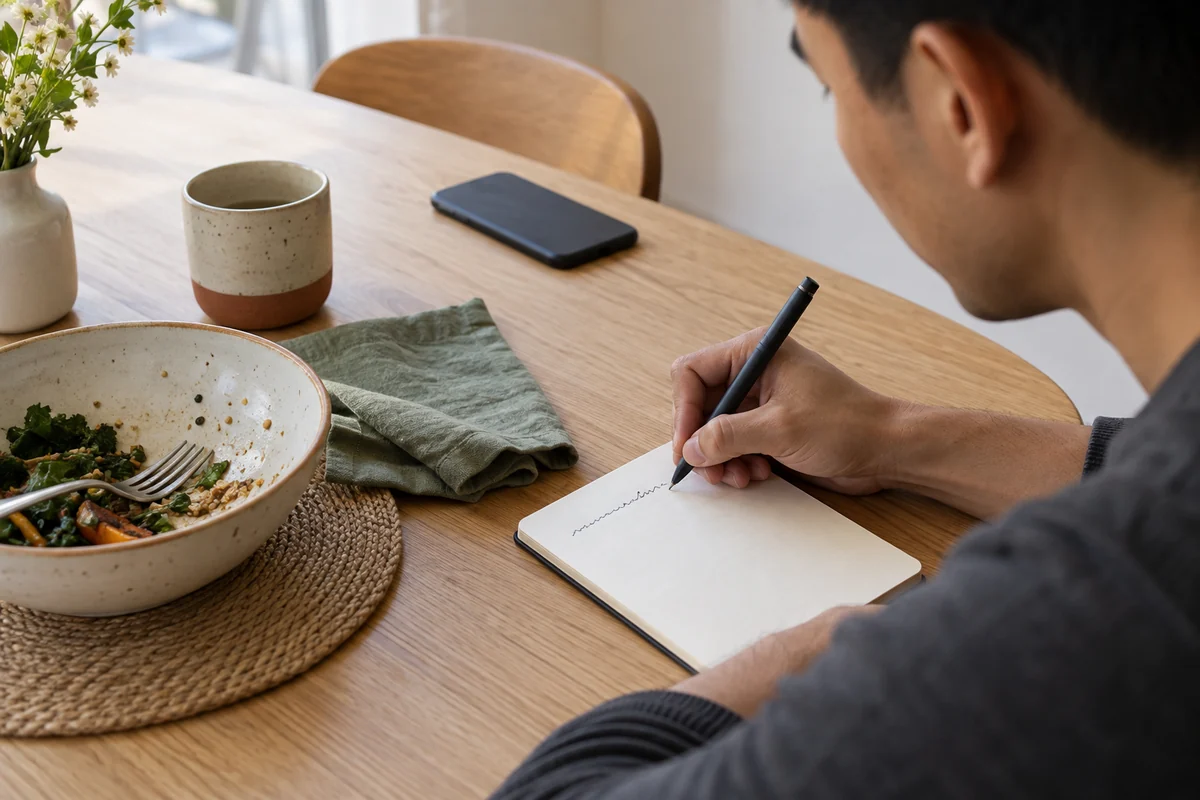
Don’t grade your body. Don’t name a syndrome. And don’t eliminate a food after one uncomfortable experience.
If one sentence helps you see more clearly, use the free 5-Day Workday Gut Trigger Journal to follow the pattern across five workdays. The journal is a memory aid, not a diagnostic test.
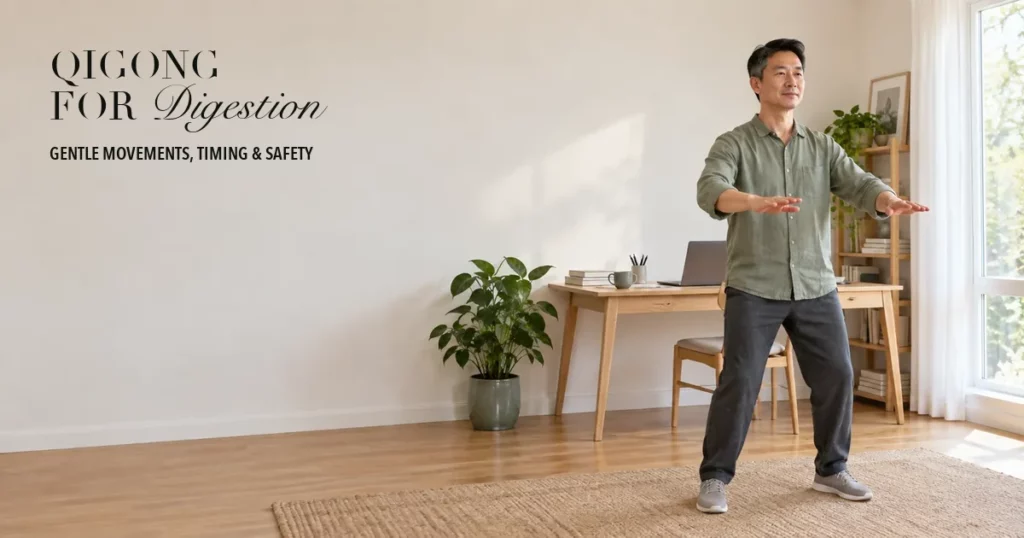
If you want to add comfortable movement instead of staying tense in front of a screen, our qigong for digestion guide offers seated and standing options. Use them as gentle movement for general well-being, not as medical care for digestive disease.
When Should You Stop Observing and Seek Care?
Meal observation is appropriate for mild, occasional discomfort. When symptoms recur, get worse, or interfere with eating, sleep, work, or daily life, discuss them with an appropriate healthcare professional. A short record may help you describe the problem more clearly at the appointment.
Do not use “it is just stress” or “it is Spleen deficiency” to dismiss warning signs. Seek timely medical care for blood in the stool or black, tarry stool; severe or constant abdominal pain; persistent vomiting; difficulty swallowing; fainting or clear signs of dehydration; unintended weight loss; or fever with significant digestive symptoms.
An inability to pass stool or gas together with abdominal swelling, pain, or vomiting also needs prompt assessment. This list is not exhaustive. When a symptom is sudden, severe, persistent, or worrying, do not delay care because an online explanation sounds plausible.
Choose the Next Step That Fits Your Pattern
If you want to continue, choose one path that matches your current concern:
- Meals become uncomfortable during stressful workdays: explore foods that may feel gentler on a nervous stomach.
- You want to understand food within the traditional Spleen framework: read the spleen qi deficiency diet guide.
- You want to add gentle movement to your day: start with qigong for digestion.
- You need a broader foundation instead of chasing one symptom at a time: use our food-first system for improving gut health.
Don’t open every guide. Pick the one closest to your situation and leave the others for later.
Frequently Asked Questions
Does worry really injure the Spleen?
In TCM, prolonged pensiveness or worry is associated with disharmony in the Spleen system. This Spleen is a traditional functional concept, not merely the anatomical organ. “Pensiveness injures the Spleen” should therefore not be read as a claim that thinking damages your physical spleen. Use it as a prompt to observe whether mental overload accompanies changes in how you eat or feel after meals.
Can stress cause stomach pain or diarrhea?
Stress may contribute to changes in digestive function, abdominal sensation, eating behavior, and bowel habits in some people. It is not the only possible factor. Recurrent, persistent, severe, or concerning pain or diarrhea deserves appropriate evaluation instead of being automatically attributed to stress.
How can I tell whether food or stress is responsible?
One uncomfortable event is rarely enough to know. Record the meal, timing, eating pace, circumstances, and what happened afterward. A repeated pattern may help you ask better questions or communicate more clearly with a clinician. A journal alone cannot prove that either food or stress caused the symptom.
Your Gut Is Not Betraying You
Your gut is not “betraying” you before a meeting. It is responding within the same body as your thoughts, breathing, eating pace, sleep, and food.
Modern science uses the gut-brain connection to study that two-way exchange. TCM uses images involving the Spleen-Stomach, Liver, and Kidney systems to observe the experience through a traditional map. Both perspectives may help you widen the frame, as long as a clue does not become a diagnosis.
At your next meal, don’t try to fix everything. Put the screen aside, slow down the first five bites, and write one sentence afterward.
That one small action may not give you the answer. But it can help you listen without panicking—and without convicting the food or your emotions before you have enough evidence.
Disclaimer: I am trained in traditional medicine in Vietnam, but I am not currently practicing medicine or providing personal diagnosis or treatment advice through this site. Everything I share here is educational and reflective, intended to support everyday well-being. It is not medical advice and should not replace diagnosis, treatment, or care from a licensed healthcare professional. Please talk with a licensed healthcare professional if your symptoms are severe, persistent, getting worse, or come with red flags such as unexplained weight loss, blood in your stool, black stools, trouble swallowing, or ongoing vomiting.
References

About Mr. Anh
We turn solid evidence into everyday habits Americans can actually do—plain English, cups/oz, grocery-aisle swaps, and routines that fit real life. Our editorial process: Experience—we road-test tips in real schedules…