How Much Exercise Offsets Sitting? The Number Keeps Falling
Research has put the sitting offset number anywhere from 60-75 minutes to about 22 minutes per day. The difference comes mostly from how sitting and activity were measured.
- The million-person study, and the number nobody repeats
- Then the number dropped to 22
- Two questions that keep getting merged
- Breaking up sitting: the second question
- Standing up does not count the same as walking
- What a walking pad actually does
- What the evidence has not shown
- What to do with this
- Frequently Asked Questions
- The bottom line
- References
How Much Exercise Offsets Sitting? The Number Keeps Falling
How much exercise does it take to offset sitting all day? In 2016, the best answer we had was 60 to 75 minutes of moderate activity. By 2023, a different research team put it closer to 22.
Your body didn’t change in those seven years. The way researchers measured you did.
That’s the whole story, and almost nobody tells it that way.
If you work at a desk, you have probably heard both halves of this argument. One says prolonged sitting carries its own risk no matter how hard you train. The other says a decent workout cancels it out. Both sides quote real studies. Neither explains why you still feel flattened by three o’clock on the days you did train. Neither side usually mentions that they are measuring different things, over different timescales, in different people.
So here’s what I’ll do instead. I’ll lay out what each study actually measured, how many people were in it, and how it was designed. By the end you will know the current number, where it came from, and — the part almost nobody publishes — which questions the research still has not answered.
The short version:
- The largest study on this looked at over a million people and found roughly 60–75 minutes of daily moderate activity removed the mortality signal from heavy sitting.
- A smaller but better-measured 2023 study put the threshold near 22 minutes.
- “Does exercise offset sitting?” and “does standing up more often help?” are two separate questions with very different evidence behind them.
- Standing up does not appear to do what walking does.
The million-person study, and the number nobody repeats
In 2016, The Lancet published a harmonised meta-analysis by Ekelund and colleagues. It pooled 16 studies covering 1,005,791 adults. Follow-up ranged from 2 years to more than 18. During that time, 84,609 people died.
The question was direct: does physical activity reduce, or remove, the association between sitting time and death?
The answer was that it largely removes it. In people getting roughly 60 to 75 minutes of moderate-intensity activity per day, the increased mortality risk associated with high sitting time was no longer detectable.
That’s a substantial finding from an enormous dataset. It’s also rarely quoted, and it’s worth asking why. Sixty to seventy-five minutes a day is far more than most people do. A finding that says “you can offset this, but only with an hour or more daily” is not comfortable for either side of the argument. It undercuts the alarmist framing and it undercuts the reassuring one.
One important limitation. This was observational research. It can show two things travel together. It can’t prove one causes the other. And sitting time in most of those pooled studies was self-reported. People aren’t accurate about how long they sat yesterday.
Hold onto that last point. It turns out to matter enormously.
I should tell you where I read this from, because it shapes what I noticed in it.
I was trained in a tradition that describes health as qi and blood moving freely and staying in balance. In that language, sitting for hours is trệ khí — stagnant qi. Keep the habit long enough and stagnation becomes blockage, and the tradition holds that blockage is where illness starts.
That’s the framing I grew up inside. It isn’t a mechanism I can show you in a study, and I’m not going to pretend otherwise.
But here’s the part that made me sit up. The same tradition is just as wary of the opposite. Training too hard, too long, past what your body has on the day — that’s hao tổn khí, spending energy you don’t have. And the tradition says it ends in the same place. Blockage.
So when I read Ekelund’s 60 to 75 minutes, my first thought wasn’t “good, I’ll do 75.” It was that this analysis measured what happens when people move more. It wasn’t built to tell us what happens when people move too much. That’s a different question, and it sits outside what these numbers can answer.
I’m not claiming the old framework predicted anything. I’m telling you it made me ask where the top of the range is, and the honest answer is that this study doesn’t say.
Then the number dropped to 22
In November 2023, the British Journal of Sports Medicine published a pooled analysis with a very different design.
It covered nearly 12,000 adults aged 50 and over, drawn from four cohorts: the Norwegian Tromsø Study, the Swedish Healthy Ageing Initiative, the Norwegian National Physical Activity Survey, and the US NHANES programme.
The critical difference was not the size. It was the instrument. Instead of asking people how long they sat, researchers put a hip-worn accelerometer on them and measured it.
The results: people sitting more than 12 hours a day were 38% more likely to die during the study period than people sitting around eight hours. But that elevated risk showed up only in people getting less than 22 minutes of moderate-to-vigorous activity per day. Above roughly 22 minutes, the association with higher mortality was not present.
What actually changed
Not human physiology. Measurement.
Why would that shift the number so much?
Self-reported sitting time is noisy. People underestimate, overestimate, and forget. That noise blurs the relationship between sitting and outcomes, and blurred relationships need larger doses of the offsetting factor before they resolve.
When you measure movement with a device instead of a questionnaire, the picture sharpens — and the amount of activity needed to erase the signal comes down.
There is a trade-off here worth naming honestly. The 2016 analysis had 1,005,791 people and weaker measurement. The 2023 analysis had about 12,000 people, better measurement, and only adults over 50. Bigger isn’t automatically better. Neither is newer. They are different instruments pointed at a similar question.
Two questions that keep getting merged
Most articles on this topic quietly blend two separate research questions. Once you separate them, the contradiction disappears.
These aren’t competing findings. They’re different outcomes, on different timescales, with sample sizes separated by a factor of roughly fifty thousand.
Sound familiar? It’s the same move as quoting a mouse study to argue about people.
When someone tells you “exercise doesn’t undo sitting,” they are usually citing question B evidence to answer question A. That’s the error worth spotting.
Breaking up sitting: the second question
This is a smaller and much more preliminary body of work than the mortality research. It deserves to be described that way.
Healy 2008
Published in Diabetes Care, this study used the Australian AusDiab cohort — 168 participants, average age 53. Each wore an accelerometer for seven consecutive days.
The finding was that the number of breaks in sedentary time was favourably associated with waist circumference, BMI, triglycerides, and two-hour plasma glucose. Crucially, that held independent of total sitting time and independent of moderate-to-vigorous activity time.
In plain terms: how often you interrupted sitting carried information that neither your total sitting nor your workout time captured.
Limitations, stated plainly. This was cross-sectional — a single snapshot. It cannot establish cause. And 168 people is a small sample for drawing general conclusions.
Dunstan 2012
Also in Diabetes Care, this one was a randomised three-period crossover trial, which does support causal inference in a way the observational work cannot.
Nineteen overweight or obese adults aged 45–65 completed three conditions on separate days: uninterrupted sitting, sitting with two minutes of light walking every 20 minutes, and sitting with two minutes of moderate walking every 20 minutes. After an initial two hours of sitting, participants drank a standardised test drink of 75 g glucose and 50 g fat. Glucose and insulin were tracked for five hours.
Light walking every 20 minutes significantly reduced post-meal glucose and insulin compared with sitting straight through. The same principle sits behind the older habit of taking a short walk after a meal.
Limitations, again stated plainly. Nineteen people. A single day per condition. Laboratory setting. Overweight and obese participants only. And a glucose-and-fat test drink is not lunch. This tells you something real about acute physiology. It doesn’t tell you what happens over a year. It also does not explain everything people notice when they walk after eating — some of that is mechanical rather than metabolic.
If you want the food side of the same picture, the post-meal blood sugar response is also shaped by what is on the plate, not only what you do afterwards.
Standing up does not count the same as walking
This is the finding that gets skipped most often, and it is inconvenient for a large industry.
A 2015 crossover trial in the Journal of Science and Medicine in Sport compared breaking up sitting with standing against breaking it up with light walking. Same protocol both ways: two minutes every 20 minutes. Light walking improved post-meal glucose. Standing did not.
Before you rearrange your office around that, look at the sample. Ten adults. One day per condition. That is a genuinely small study, and I’d rather tell you that than let a tidy finding do more work than it has earned.
The standard workplace advice is “stand up more.” The measured result suggests standing, on its own, is not doing the metabolic work that low-intensity movement does.
The practical version: if you’ve got a height-adjustable desk and you use it by standing still, you’re changing your posture more than your physiology. The two-minute walk to fill a water bottle appears to matter more than the hour spent standing at your desk.
Here’s what I actually do, for whatever that’s worth to you.
I sit for 30 to 40 minutes — usually one Pomodoro — then I get up. I walk. There’s a pull-up bar and a set of dumbbells in the room where I work, so some breaks I hang or pull for a minute. Five minutes, then back to the desk. When I train properly it’s about 30 minutes a session, sometimes twice in a day.
I’m not going to tell you that pattern is optimal. I have no way to measure that. What I can tell you is that I feel good on it, and that it landed close to what the interruption trials tested — which genuinely surprised me when I read them, because I didn’t arrive at it from research.
So the honest version of my advice is this. Listen to your own body first, then check what you notice against something measurable. The tradition gave me the habit. The research told me which parts of it have been tested, and which parts nobody has looked at yet.
And yes — this section argues against a product category this site will eventually cover. It’s here because it’s what the research shows.
What a walking pad actually does
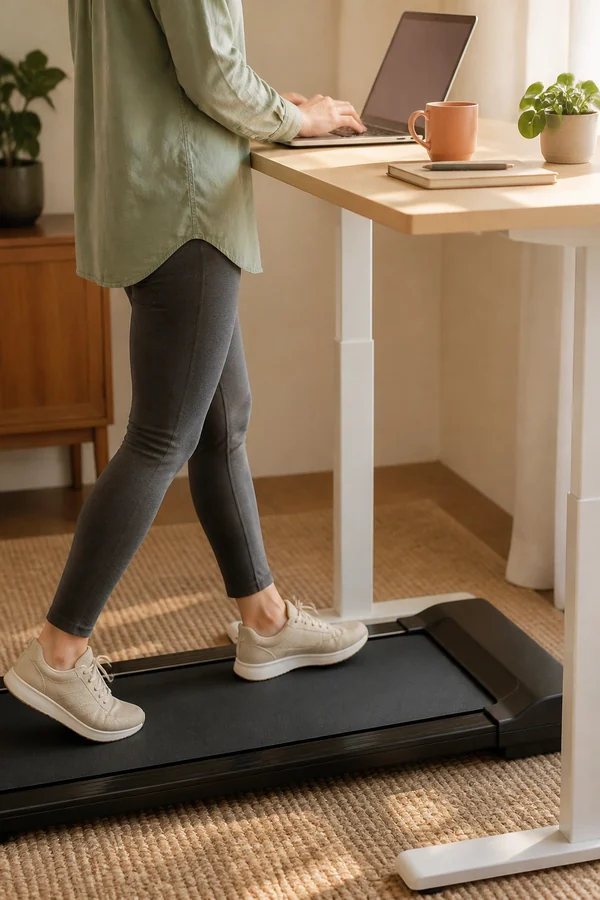
Since the evidence points toward light movement rather than standing, under-desk treadmills are the obvious next question. Here is the honest accounting.
What they do. A 2021 meta-analysis of 13 studies found under-desk walking pads add roughly 105 kcal per hour of use and measurably reduce sitting time. Both of those are real, and both are consistent with the mechanism above.
What they do not do. In those same trials, body weight change was not statistically significant — including in studies that gave people 12 weeks of access. Cardiometabolic improvements were described as modest. The pattern across this literature is a large shift in activity paired with small changes in measured outcomes.
What they cost you. Typing speed drops about 16% while walking. Accuracy holds up better than speed, and the workable range tops out around 1.4 mph before accuracy and learning measurably decline. Performance on attention tasks was lower while walking in at least one trial, though a separate study found no harm to executive control at 1.5 mph. Concentration at a desk has more inputs than movement alone.
So: more movement, more energy burned, less sitting, slower typing, no reliable weight change.
That might still be a good trade for you. It’s just a different trade from the one on the box.
What the evidence has not shown
This section exists because leaving it out is how health content stops being worth reading.
- No trial of sitting interruptions has followed people to hard endpoints. Nothing here shows that standing up every 30 minutes prevents a heart attack. The metabolic trials measure blood markers over hours.
- The metabolic work skews to one population. Middle-aged, overweight or obese adults. Whether the same effect sizes apply to a lean 28-year-old has not been established.
- The 2023 threshold study was adults 50 and over. The 22-minute figure should not be assumed to transfer to younger desk workers.
- Sitting time in the largest analysis was self-reported. Which is precisely the weakness the newer study was built to fix.
- Nobody has run a multi-year trial on walking pads. The longest evidence runs about 12 weeks.
What to do with this
Sorted by how much evidence stands behind it.
Well supported. Get moderate-intensity activity most days. The threshold estimates range from about 22 minutes to 75, depending on how it was measured and in whom — but every analysis here agrees that more of it weakens the association between sitting and mortality. Brisk walking counts.
Reasonably supported, short-term. Interrupt long sitting blocks with brief, light movement rather than with standing. The trial evidence used two minutes roughly every 20. A walk to the kettle qualifies. This is the piece your evening workout does not replace, and the piece a walking desk addresses directly.
Not yet established. That a specific break schedule changes long-term health outcomes. That a walking pad will change your weight. That any of these numbers transfer cleanly to your age group.
One realistic note. The threshold that matters most isn’t 22 minutes or 75 minutes. It’s the one you’ll actually do on a Thursday with three meetings stacked up. A 20-minute walk you take five days a week beats an hour you keep meaning to start.
Frequently Asked Questions
How many minutes of exercise offset sitting all day?
Estimates range from about 22 to 75 minutes of moderate activity per day. The 2016 Lancet analysis of over a million people pointed to 60–75 minutes; a 2023 British Journal of Sports Medicine analysis of about 12,000 adults over 50, using accelerometers rather than questionnaires, put it near 22. The difference comes mainly from how sitting and activity were measured.
Does standing count as breaking up sitting?
Not in the same way. Research in the Journal of Science and Medicine in Sport found light walking improved post-meal glucose while standing did not produce an equivalent effect. Standing changes your posture; brief walking appears to be what changes the metabolic response.
Do walking pads help you lose weight?
A 2021 meta-analysis of 13 studies found they add roughly 105 kcal per hour and reduce sitting time, but body weight changes were not statistically significant, including in trials running 12 weeks. They increase daily movement reliably. Weight change is not a reliable outcome.
How often should I get up from my desk?
The trial that produced the clearest metabolic result used two minutes of light walking every 20 minutes. That was a laboratory protocol with 19 participants, not a general recommendation. As a practical starting point, a brief walk every 30 minutes is closer to the tested pattern than one long break.
Is sitting really as bad as smoking?
No, and the researchers behind much of this work have pushed back on that comparison. The 2023 analysis found people sitting more than 12 hours daily had a 38% higher mortality risk than those sitting around eight — and that difference was concentrated in people getting under 22 minutes of daily activity. The risk is real, conditional, and much smaller than the slogan implies.
The bottom line
The number will move again. Measurement keeps improving, and each improvement has so far made the required dose look smaller, not larger.
What won’t move is how to read them. Ask what was measured, over what period, in how many people, and with what instrument. When two headlines seem to contradict each other, that’s almost always where the answer is hiding.
If you want to see how this plays out in your own week rather than in a cohort, tracking it for two weeks is more informative than any threshold figure.
Educational content only. This article describes population research and is not medical advice. If you have a heart, joint, or metabolic condition, talk to your doctor before changing your activity pattern.
References
- Ekelund U, et al. Does physical activity attenuate, or even eliminate, the detrimental association of sitting time with mortality? A harmonised meta-analysis of data from more than 1 million men and women. The Lancet. 2016. PMID 27475271.
- Daily 20–25 minutes of physical activity may offset death risk from prolonged sitting. British Journal of Sports Medicine. November 2023.
- Healy GN, et al. Breaks in sedentary time: beneficial associations with metabolic risk. Diabetes Care. 2008;31(4):661. PMID 18252901.
- Dunstan DW, et al. Breaking up prolonged sitting reduces postprandial glucose and insulin responses. Diabetes Care. 2012. PMC3329818.
- Breaking up prolonged sitting with light-intensity walking improves postprandial glycemia, but breaking up sitting with standing does not. Journal of Science and Medicine in Sport. 2015. PMID 24704421.
- Cognitive and typing outcomes measured simultaneously with slow treadmill walking or sitting: implications for treadmill desks. PLOS One. 2015.

About Mr. Anh
We turn solid evidence into everyday habits Americans can actually do—plain English, cups/oz, grocery-aisle swaps, and routines that fit real life. Our editorial process: Experience—we road-test tips in real schedules…