Foods for Healthy Nails: What to Eat — and What’s Wrecking Them
Your nails are a direct readout of your nutrition — built from what you ate 3–6 months ago. This guide shows you the 7 best foods for nail strength, the 5 habits that silently break them down, and an honest 8-week timeline.
- What Your Nails Are Actually Made Of (And Why Diet Is the Missing Link)
- An Eastern Lens: The Liver Governs the Nails
- The 7 Best Foods for Healthy Nails — Your EAT List
- The 5 Habits Secretly Destroying Your Nails
- Your 8-Week Nail Transformation Timeline
- Should You Add Nail Supplements? (Honest Answer)
- Frequently Asked Questions
- The Bottom Line
A note before we begin: I trained in traditional Vietnamese medicine but I don’t practice clinically or treat patients. Everything below is a researcher’s notes — what I’ve read in the modern literature, what I’ve worked through in my own routine, and how those two pictures fit together. Significant nail changes (sudden colour shifts, separation from the bed, severe deformity) deserve a dermatologist visit, not a recipe swap. This is education, not medical advice.
If your nails keep breaking no matter what you do, the answer is almost always in your plate, specifically, the foods for healthy nails you’re missing. Your nail polish isn’t the problem.
I’ve seen this pattern more times than I can count: someone goes through a stressful season, cuts back on real meals, leans on convenience food, and three months later, their nails are peeling at the tips, snapping at the slightest pressure, or sporting those annoying vertical ridges down the middle. The nail problem shows up now. But the nutrition gap started back then. That three-to-six-month lag is the thing nobody talks about.
In this guide, you’ll get the full story which foods for healthy nails actually move the needle, which everyday habits are quietly wrecking your nail structure, and a realistic 8-week timeline so you know exactly what to expect and when.
Quick Takeaways:
🥚 Eggs + almonds + salmon = the nail-repair core trio
🚫 Soda, alcohol, and crash diets actively break down nail proteins
⏱ Expect visible improvement in new nail growth within 6–8 weeks
🔴 White spots = zinc | Ridges = magnesium | Brittleness = biotin/iron/omega-3
💊 Supplements can accelerate results — but consistent food habits are the real foundation
What Your Nails Are Actually Made Of (And Why Diet Is the Missing Link)
Nails are built from a layered protein called keratin — the same structural protein in your hair and the outer layer of your skin. To produce strong, fast-growing keratin, your body needs a whole team of nutrients working together: biotin, iron, zinc, magnesium, protein, omega-3 fatty acids, vitamin C, vitamin A, and collagen precursors.
Here’s the thing most nail health articles completely skip: there’s a 3–6 month nutritional lag. Nails grow roughly 3mm per month. So the nail you’re looking at right now was built from nutrients you consumed three to six months ago. That’s why you can clean up your diet and feel like nothing’s happening — the new nail just hasn’t grown out yet.
The lag also works in reverse. A stressful quarter, a round of restrictive dieting, several weeks of skipped meals — the damage to your nails shows up months afterward, long after most people have moved on and forgotten the context. Sound familiar?
The Nail Symptom Decoder — What Your Nails Are Actually Telling You
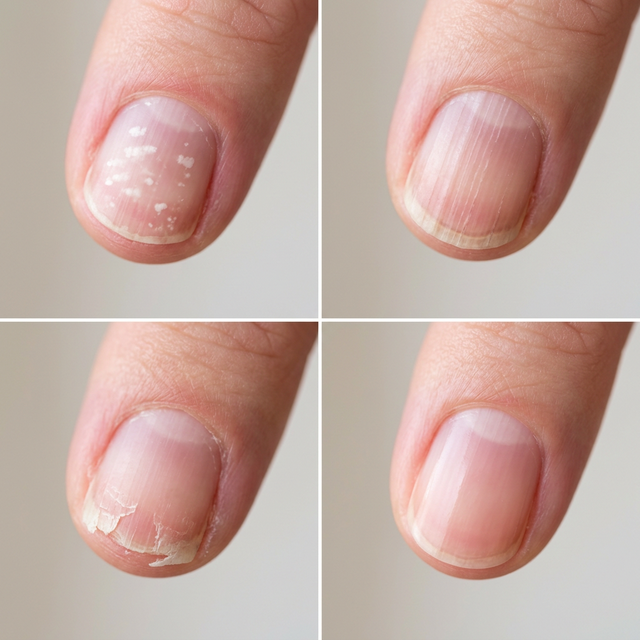
Each visible nail symptom maps directly to a nutritional gap — and to a specific food that addresses it.
According to the NIH Office of Dietary Supplements, iron deficiency is one of the most common micronutrient deficiencies in women of reproductive age — and a well-documented cause of brittle, ridged nails.
An Eastern Lens: The Liver Governs the Nails
There’s a framework I keep returning to from traditional Vietnamese and Chinese medicine. In TCM, your nails aren’t just a cosmetic surface — they’re considered the most external outgrowth of one specific organ system: the Liver (Can).
The classic line is “Can chủ trảo” — the Liver governs the nails (and, in the same system, the tendons). The Liver’s role in TCM is to store blood, and the quality of that blood store shows up directly at the tips of your fingers. When Liver Blood runs low — usually from chronic stress, poor sleep, heavy menstrual loss, or sustained under-eating — nails become brittle, ridged, slow-growing, and sometimes take on a pale or yellowish tinge. Hair often thins at the same time, eyes feel dry, and sleep gets shallow. They’re not separate problems. They’re the same picture.
This is why the Western “biotin deficiency” answer often misses the real driver. Brittle nails in an otherwise well-fed adult are almost never about a single micronutrient — they’re a blood-quality and absorption story.
The foods that nourish Liver Blood in this framework are mostly red, deep-coloured, and gently warming:
- Beetroot, red dates, goji berries — classic Vietnamese-Chinese “blood foods.” A small bowl of beet-and-goji soup a few times a week is a kitchen staple in older Vietnamese households for exactly this reason.
- Dark leafy greens (spinach, kale, watercress) — move and nourish Liver Blood while clearing heat.
- Black sesame, black beans, mulberries — black foods nourish Yin and Blood deeply.
- Quality animal sources: liver, egg yolks, oysters, sardines — concentrated heme iron, choline, and zinc. The single most overlooked food group for nail recovery in modern diets.
- Bone broth simmered with red dates and goji — combines collagen with blood-nourishing herbs.
You’ll notice the modern Western view (iron, biotin, collagen, zinc) maps almost perfectly onto these same foods — the two systems just describe the same biology with different vocabularies.
What I noticed in my own routine:
In my early thirties, after a long stretch of poor sleep, late nights, and skipping real meals, my nails started peeling at the tips and developing those vertical ridges. My eyes also felt dry and my hair was shedding more than usual. According to the Liver-Blood pattern I grew up reading about, these weren’t three separate problems — they were one. I changed three things: a small portion of dark leafy greens with most dinners, beetroot or sardines twice a week, and a daily handful of black sesame and goji berries stirred into morning oats. The first two months I saw almost nothing. By month three the new growth at the lunula was visibly thicker, the ridges started smoothing near the base, and my sleep had settled at the same time. It tracked exactly with the 8-week timeline laid out below — and with the older idea that nails are simply where Liver Blood shows itself.
The 7 Best Foods for Healthy Nails — Your EAT List
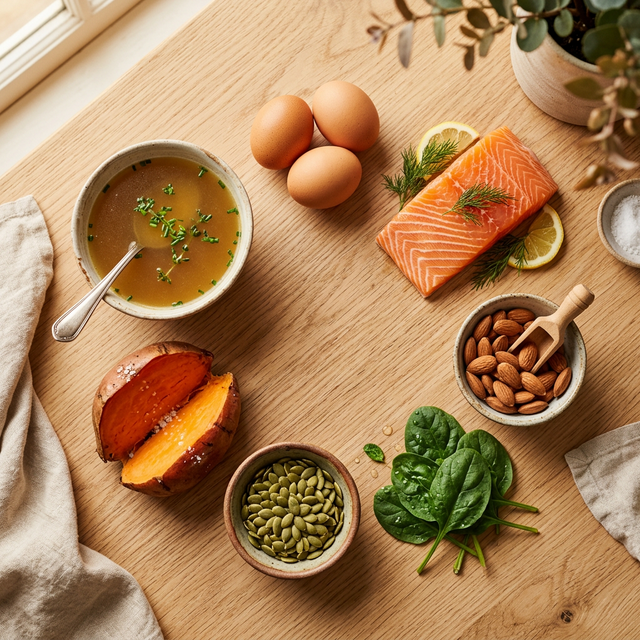
Skip the supplement aisle for now. These seven whole foods address the most common nutritional gaps driving weak, brittle, or slow-growing nails. I’ve matched each one to the specific vitamins for nail health it delivers so you understand why it works — not just that someone told you it does.
🥚 Eggs — The Most Complete Nail Food
One egg contains biotin, high-quality protein, cysteine, vitamin D, and selenium. That’s nearly the entire keratin-building toolkit in a single food. A study published in the Journal of the American Academy of Dermatology (Hochman et al., 1993) found that 2.5mg of biotin daily led to 91% improvement in nail firmness in patients with thin, brittle nails over 5.5 months.
One thing to get right: only eat cooked eggs. Raw egg whites contain avidin, a protein that binds biotin in your gut and blocks its absorption entirely. Scrambled, poached, hard-boiled — doesn’t matter. Just cook them. Aim for 1–2 eggs per day.
Expect: 8–12 weeks of daily intake before visible nail strengthening.
🐟 Salmon — Nail Bed Moisture from the Inside
When nails peel at the tip or feel dry no matter what you put on them topically, the problem is usually the nail bed — not the nail plate itself. Salmon addresses this from the inside. Its omega-3 fatty acids lubricate the nail bed and slow moisture loss, which is the root cause of that peeling, splitting type of brittleness.
It also delivers biotin, complete protein, and vitamin D — making it one of the most comprehensive foods for healthy nails for women who tend toward dry or splitting nails. Can’t manage salmon three times a week? Sardines work just as well, and they’re also an excellent collagen-building protein source. I keep tins on hand for exactly this reason.
Expect: 6–8 weeks to notice reduced peeling and improved nail flexibility.
🥜 Almonds — The Single Best Snack for Nail Strength
If you had to pick one snack for nail health, almonds win. One ounce gives you magnesium (20% RDA), vitamin E, zinc, biotin, and plant protein — all five in one handful.
Here’s what most people don’t know: magnesium is the most overlooked nail nutrient. Vertical ridges running down the nail are almost always a sign of magnesium deficiency — not biotin deficiency. Almonds address both at once. Swap your afternoon chips or crackers for a small handful of raw or dry-roasted almonds. It took me about two weeks to make the switch a habit — now I keep a small jar on my desk.
Expect: 8 weeks of consistent daily intake for visible ridge reduction.
🌿 Spinach — Iron for Nails That Won’t Grow
Iron = oxygen delivery. When iron is low, nail cells don’t receive adequate oxygen, which slows growth, causes brittleness, and — in more severe cases — produces that spoon-shaped curvature (koilonychia) that signals serious deficiency.
What makes spinach particularly useful is that it pairs iron with folate and vitamin C in the same food. Vitamin C dramatically improves non-heme iron absorption — so eating them together is genuinely more effective. A cup of cooked spinach alongside any meal gives you all three as a package deal.
Expect: 6–8 weeks for improved nail growth rate and reduced brittleness.
🎃 Pumpkin Seeds — The Zinc Fix for White Spots
White spots on nails often point to minor zinc deficiency (though minor trauma is also a culprit). Zinc is essential for cell division and nail plate formation. One ounce of pumpkin seeds covers roughly 20% of your daily zinc requirement, plus iron, magnesium, and omega-3s. Add a tablespoon to yogurt, oatmeal, or salads, or eat them straight. They’re cheap and take about 30 seconds to add to anything.
Expect: 8–10 weeks to see white spots fade as nails grow out.
🍖 Bone Broth or Sardines — Collagen for Structural Integrity
A randomised, placebo-controlled clinical trial (Hexsel et al., International Journal of Dermatology, 2017) showed that 5g of collagen peptides daily produced:
- 12% faster nail growth rate
- 42% fewer broken nails
- 64% overall clinical improvement in brittle nail condition
Bone broth contains collagen peptides naturally alongside glycine and proline. Sardines eaten with the bones are a rich marine collagen source. Aim for bone broth 3–4 times per week.
If your diet is inconsistent or you’re vegetarian, a high-quality hydrolyzed collagen peptide supplement (≥5g per serving, with added vitamin C) is a practical daily bridge. I add an unflavored version to my morning coffee — you genuinely can’t taste it.
Expect: 10–12 weeks for visible improvement in nail structure and reduced breakage.
🍠 Sweet Potato — Vitamin A for Shine and Hydration
Sweet potato is loaded with beta-carotene, which your body converts to vitamin A. Vitamin A regulates nail cell regeneration and hydration — when it’s low, nails look dull, feel dry, and grow slowly. Eat sweet potato with a little olive oil or butter to maximise beta-carotene absorption.
Expect: 6 weeks for noticeable improvement in nail shine and hydration.
The 5 Habits Secretly Destroying Your Nails
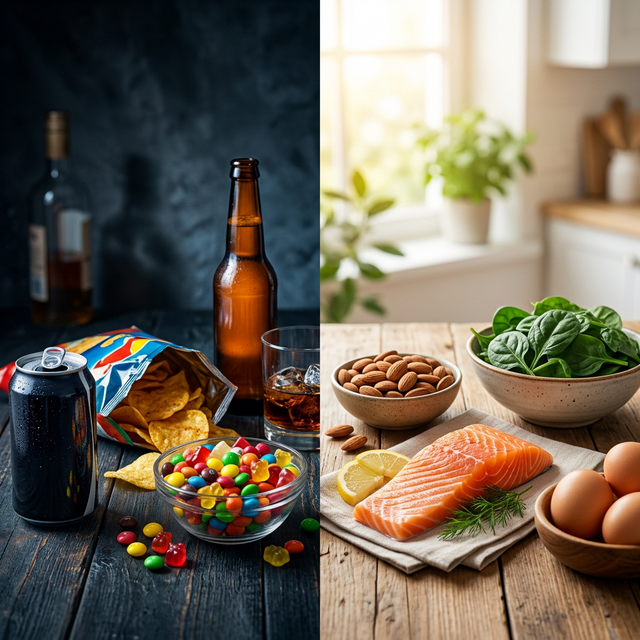
This is the section missing from every top-ranking article on foods for healthy nails — and it might matter more than the EAT list. You could eat eggs and salmon every single day and still see your nails deteriorating if you’re also doing three of these five things regularly.
🥤 Soda — Calcium Theft in a Can
Both regular and diet soda contain phosphoric acid. That compound competes directly with calcium absorption in your intestines — and calcium is a key structural mineral in the nail plate. On top of that, the high sugar in regular soda triggers glycation — a process where sugar molecules cross-link with collagen proteins, reducing their flexibility and making nails more brittle over time. Even 1–2 cans per day is enough to meaningfully affect nail mineral density over months.
🍷 Alcohol (More Than 2 Drinks Per Day)
Regular alcohol consumption depletes zinc, folate, and B-vitamins — the exact trio your nails depend on for plate formation and flexibility. Alcohol also dehydrates the nail plate itself, which increases splitting and peeling risk. Cutting back to 1–2 occasional drinks (rather than daily) makes a bigger difference than most people expect.
🍟 Ultra-Processed Junk Food
Every time chips, crackers, or fast food replaces a real meal, your nails miss a delivery of iron, biotin, or zinc. The oxidised seed oils and refined carbs in processed foods also spike blood sugar and trigger the same collagen glycation damage as soda. This is the same pattern that tends to affect other body systems too — junk food disrupts the gut first, and poor gut absorption is what makes the nail nutrients above almost useless. Our guide on a food-first daily plan for gut health covers the absorption side of this picture.
🥚 Raw Egg Whites
Raw egg whites contain avidin — a protein that binds biotin in your digestive tract before it can be absorbed. If you’re adding raw eggs to smoothies or protein shakes regularly, you may be blocking the very nutrient you’re counting on for nail repair. Just cook them.
🥗 Crash Diets Under 1,200 Calories
Below 1,200 calories, your body redirects available nutrients to vital organs and downgrades nail and hair growth. Protein intake is almost always insufficient at that level, which means keratin production drops. Women who cycle through repeated low-calorie dieting often notice nail breakage getting progressively worse with each round. If this is a pattern, it’s worth exploring a more sustainable approach — crash dieting hits hormones hard, and hormonal imbalance shows up in nails almost as fast as in mood. Our guide on flax seeds for hormone balance walks through one gentle food-first way to support that.
Your 8-Week Nail Transformation Timeline

Here’s what almost every nail health article gets wrong: they tell you what to eat but give you zero honest guidance on when to expect results. Then you try it for three weeks, see nothing, and give up — even though you were two weeks away from seeing the first signs of change.
How to Track Your Progress (Without Guessing)
Take a clear photo of both hands on Day 1 in consistent lighting. Use a white nail pencil to make a tiny dot at the base of your thumbnail. Watch where that dot travels over the following weeks — it’s a literal growth tracker. When it reaches the nail tip, you’ve completed one full growth cycle.
Should You Add Nail Supplements? (Honest Answer)
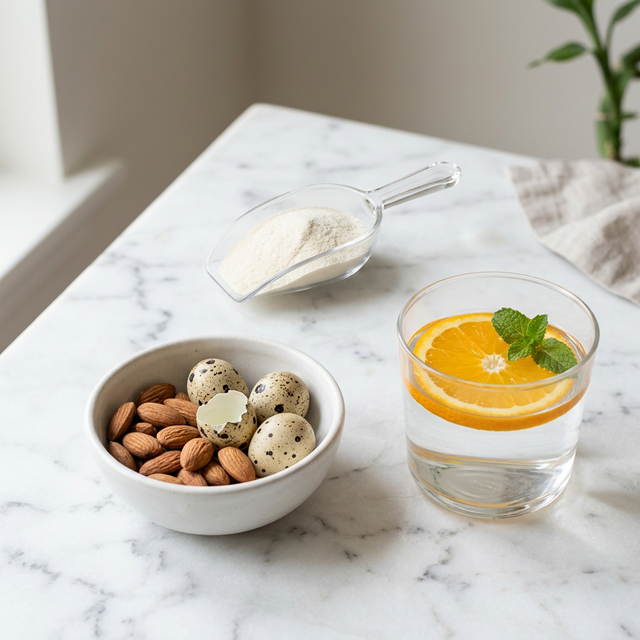
Most women asking this question actually need more dietary variety — not a daily pill. A supplement can’t substitute for consistently missing whole food groups. But in two specific situations, they genuinely help.
When Biotin Supplements Are Worth It
Biotin supplementation at 2.5mg/day has real clinical backing for people with thin, brittle nails. The Hochman study (JAAD, 1993) found 91% improvement in nail firmness at that dose over 5.5 months — but this benefit is specific to people with actual biotin deficiency. For everyone else, 1–2 eggs and a handful of almonds daily covers your biotin baseline. The NIH Biotin fact sheet is a useful deep-dive if you want the full clinical picture.
When Collagen Peptides Are Worth Adding
The Hexsel 2017 RCT — a real randomised controlled trial — found 5g of collagen peptides daily produced 12% faster growth and 42% fewer breaks over 24 weeks. If your diet is variable, adding an unflavored hydrolyzed collagen peptide powder to your morning coffee or smoothie is a practical bridge. Look for ≥5g collagen per serving with added vitamin C — vitamin C is a required co-factor for collagen synthesis.
Frequently Asked Questions
What foods help nails grow faster?
Eggs, salmon, pumpkin seeds, and bone broth — they cover biotin, complete protein, collagen precursors, and omega-3s. Expect early changes at the nail base within 3–4 weeks of consistent intake.
Does biotin really work for strengthening nails?
For thin, brittle nails specifically: yes, with clinical evidence at 2.5mg/day. For nails that are structurally normal, the effect is modest. Most people overestimate how biotin-deficient they are — iron or magnesium deficiency is a far more common culprit.
What foods make nails brittle and weak?
Soda (phosphoric acid depletes calcium), alcohol (strips zinc and B-vitamins), ultra-processed foods (displace whole foods and trigger collagen glycation), raw egg whites (block biotin absorption), and very low-calorie crash diets.
How long does it take to see improvement through diet?
Most women notice a visible difference in new nail growth within 6–8 weeks. Full nail turnover — where you can assess the whole nail — takes 4–6 months with consistent dietary changes.
Is salmon good for nails?
It’s one of the best single foods you can eat. Salmon delivers omega-3 fatty acids (nail bed moisture), biotin, complete protein, and vitamin D in a single serving. The omega-3 content specifically targets dry-peel brittleness.
What vitamins are best for brittle nails?
Ranked by evidence: Biotin (B7), Iron, Omega-3 fatty acids, Vitamin C, Zinc, and Magnesium. Most women with brittle nails are iron- or magnesium-deficient — not biotin-deficient — as the actual root cause.
Does alcohol damage nails?
Yes. More than 2 drinks daily depletes zinc, folate, and B-vitamins — the core trio for nail plate formation. It also dehydrates the nail plate, increasing splitting and peeling risk.
What does a practical nail-friendly day look like?
Breakfast: 2 scrambled eggs. Snack: almonds + pumpkin seeds. Lunch/dinner: salmon or sardines 3× per week. Daily: a cup of cooked spinach. Swap soda for mineral water. Limit alcohol to occasional. Add collagen or bone broth when protein intake falls short.
The Bottom Line
Nail health is roughly 80% nutrition and 20% topical care. The most common mistake is obsessing over the EAT list while ignoring the AVOID list — and then losing patience before the 6-week mark when results are about to show up.
Strong, fast-growing nails are a structural health outcome. They’re built the same way any structural outcome is built: consistent protein, the right micronutrients working together, and removing the habits that actively undermine your progress.
For a broader look at how the same nutrients show up across the body, our guide on a daily diet that supports skin from the inside covers the parallel picture — the foods that build strong nails are almost identical to the foods that build clearer, more resilient skin.
⚠️ Health Disclaimer: I’m trained in traditional Vietnamese medicine but I don’t practice clinically. This guide reflects modern research, traditional frameworks I grew up with, and what I’ve observed in my own routine — all educational, not medical advice. Significant nail changes (sudden colour shifts, separation from the nail bed, severe deformity) may indicate an underlying medical condition and deserve a dermatologist or healthcare provider visit. Individual results from dietary changes vary.

About Mr. Anh
We turn solid evidence into everyday habits Americans can actually do—plain English, cups/oz, grocery-aisle swaps, and routines that fit real life. Our editorial process: Experience—we road-test tips in real schedules…