Iron Rich Foods for Women: The Absorption Blueprint That Actually Works
You're eating spinach and lentils — so why does fatigue keep winning? The secret isn't which iron foods you eat. It's how your body absorbs them. Here's the blueprint most articles skip.
- Why Women Need More Iron Than Men (And When It Gets Critical)
- Heme vs. Non-Heme Iron — Why This Difference Changes Everything
- Top Iron-Rich Foods for Women — Ranked by Bioavailable Iron Per Serving
- The Iron Absorption Blueprint — Pairing Your Meals for Maximum Results
- Iron-Rich Foods for Women on Specific Diets
- Food vs. Iron Supplement — When Diet Isn't Enough
- Frequently Asked Questions
- The Bottom Line
The best iron rich foods for women aren’t just about which foods you eat — it’s about how your body absorbs them. You’ve been eating “healthy” — spinach salads, lentil soup, the occasional steak. So why does your energy still crash by 2 p.m.? Why is your hair thinning even though you’re doing everything right?
Here’s the thing most iron articles skip right over: eating iron-rich foods is only half the equation. The part that actually determines how much iron your body keeps? It’s how you eat them. The pairing. The timing. The combinations your plate is missing.
According to the NIH Office of Dietary Supplements, up to 1 in 3 women of childbearing age in the US doesn’t get enough iron — making it the most common nutritional deficiency in the world. And many of those women are already eating iron-rich foods. The problem isn’t what’s on the plate. It’s what’s happening inside the gut.
In this complete guide to iron rich foods for women, you’ll learn exactly which foods deliver the most iron per serving — ranked by what your body can actually absorb — plus the science-backed pairing strategies that can increase that absorption by up to 300%. You’ll also walk away with a ready-to-use 3-meal daily template built around the 18mg target for women aged 19–50.
Quick Takeaways:
- Women aged 19–50 need 18mg of iron daily (27mg during pregnancy)
- Heme iron (meat/seafood) absorbs at 15–35%; plant-based iron absorbs at only 2–20%
- Pairing Vitamin C with non-heme iron can increase absorption by up to 300%
- Coffee and tea within 1 hour of a meal can cut iron absorption by half
- A 3-meal daily template later in this guide can help you hit your goal without counting every milligram
Why Women Need More Iron Than Men (And When It Gets Critical)

Iron isn’t just another item on a supplement label. It’s what your body uses to build hemoglobin — the protein in red blood cells that carries oxygen from your lungs to your brain, your muscles, your skin. Without enough, your cells are running on a low oxygen supply. That’s why iron deficiency feels so total — not just tired, but foggy, cold, breathless, and unmotivated all at once.
The Biology of Iron Loss During Menstruation
Every month, your period causes a loss of roughly 30–80 mL of blood — and with it, significant iron. On average, that translates to an extra 1–2mg of iron lost per day during your cycle. For women with heavy periods (clinically, more than 80mL per cycle), the loss is much higher.
A 2021 paper in the American Journal of Medicine identifies heavy menstrual bleeding as one of the leading causes of iron deficiency anemia in women of reproductive age. This is why women’s iron requirements are nearly double those of men. A man needs 8mg per day. A woman in her twenties, thirties, or forties needs 18mg — and that entire gap is explained by monthly blood loss.
Iron Needs by Life Stage
Your iron target isn’t fixed for life. It shifts — sometimes dramatically — based on where you are:
| Life Stage | Daily Iron Requirement |
|---|---|
| Teen girls (14–18) | 15 mg/day |
| Women (19–50) | 18 mg/day |
| Pregnant women | 27 mg/day |
| Breastfeeding women | 9–10 mg/day |
| Women 51 and older | 8 mg/day |
Source: NIH Office of Dietary Supplements, Iron Fact Sheet for Health Professionals
Pregnancy nearly doubles the requirement — which is why iron deficiency is so common during the first and second trimesters. After menopause, the requirement drops back to 8mg because monthly blood loss stops.
Early Warning Signs Your Iron May Be Low
Iron deficiency rarely announces itself with one obvious symptom. It tends to sneak up slowly. Watch for:
- Fatigue that sleep doesn’t fix — feeling wiped out even after 8 hours
- Brain fog and trouble concentrating — your brain is an oxygen-hungry organ
- Cold hands and feet — poor circulation from reduced hemoglobin
- Brittle nails or nails that curve upward — a textbook iron deficiency sign
- Hair shedding — iron is critical for follicle function; if you’re seeing more in the brush, this matters (more on that in our guide to vitamins for hair growth)
- Pale inner eyelids or pale skin — visible sign of reduced red blood cell production
- Craving ice, clay, or cornstarch (pica) — an unusual but real symptom worth knowing
- Getting winded on stairs you used to take without thinking
⚠️ One important note: These symptoms overlap with thyroid issues, B12 deficiency, and other conditions. Don’t self-diagnose. A ferritin blood test — not just a standard CBC — is the most accurate way to catch iron stores early, before full-blown anemia develops.
Heme vs. Non-Heme Iron — Why This Difference Changes Everything
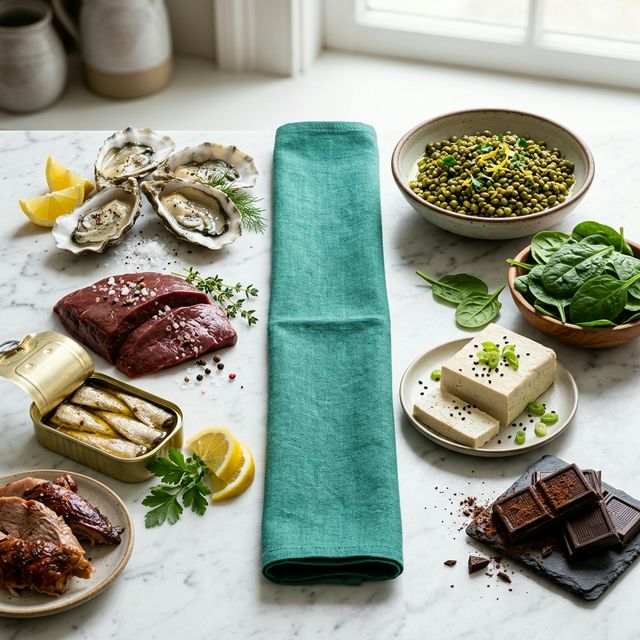
This is the concept that most “iron rich foods” articles skim right past — and it’s exactly why so many women eat iron-rich diets and still end up deficient.
Not all dietary iron is the same. There are two forms, and your gut treats them completely differently.
Heme Iron: What Your Body Was Built to Absorb
Heme iron comes from animal sources — meat, poultry, fish, shellfish. It’s bound to a protein structure your intestinal cells have a dedicated transport pathway for. They recognize it and absorb it efficiently.
Absorption rate: 15–35% and it stays in that range regardless of what else you eat at that meal.
That’s why a small serving of beef liver or oysters punches so far above its weight. Your body isn’t hesitating — it’s absorbing.
Non-Heme Iron: Powerful, But It Needs Your Help
Non-heme iron comes from plant sources — legumes, leafy greens, seeds, fortified cereals, dark chocolate. It’s also found in eggs, despite being animal-derived.
Absorption rate without optimization: 2–20%. That range matters a lot. The difference between 2% and 20% absorbed from the same bowl of lentils comes down almost entirely to what you pair with it.
Here’s what I want you to take away from this section: the same bowl of lentils can deliver two to three times more usable iron if you eat it with bell peppers instead of alone. That’s not a small difference.
What Blocks Iron Absorption
Before we get to the good stuff, here are the habits quietly working against you:
- Coffee and tea with or after meals — Tannins and polyphenols in both reduce non-heme iron absorption by 50–60%. Your morning coffee with your iron-fortified oatmeal is a problem worth solving.
- Calcium at the same meal — Dairy or a calcium supplement taken with dinner can suppress both heme and non-heme absorption. Take calcium supplements at a separate time.
- Phytates in unprocessed whole grains — Phytates bind to iron and carry it out unabsorbed. Soaking, sprouting, or fermenting grains (think sourdough bread) reduces this significantly.
- PPIs and antacids — These reduce stomach acid, which your gut needs to convert non-heme iron into its absorbable form. If you take these daily, talk to your doctor about monitoring your iron levels.
💡 Worth knowing: Iron bisglycinate supplements — a chelated form — are designed to sidestep many of these inhibitors. We’ll get into that later. For now, let’s build from food first.
Top Iron-Rich Foods for Women — Ranked by Bioavailable Iron Per Serving
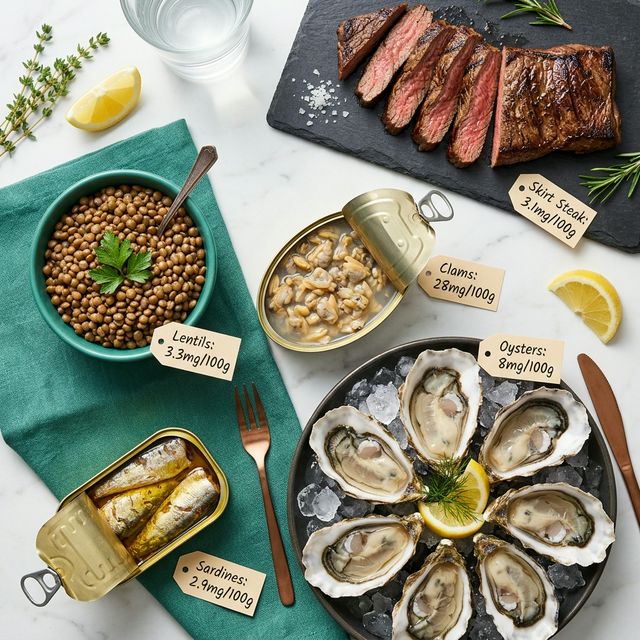
Most lists rank by raw milligrams. That’s incomplete. We’re ranking by what your body can actually use — and pairing each food with its best Vitamin C match to make every bite count more.
Best Heme Iron Sources (Animal-Based)
Even without a Vitamin C pairing, your absorption from these is strong. But adding one still helps.
| Food | Serving | Iron (mg) | % Daily Value | Absorption Rate | Best Paired With |
|---|---|---|---|---|---|
| Canned clams | 3 oz | 23.8 mg | 132% | 15–35% | Tomato-based pasta sauce |
| Oysters | 3 oz | 8.0 mg | 44% | 15–35% | Citrus mignonette |
| Beef liver | 3 oz | 5.2 mg | 29% | 20–35% | Lemon juice / tomato salad |
| Beef (skirt steak) | 3 oz | 2.9 mg | 16% | 20–35% | Roasted bell peppers |
| Sardines (canned) | 3 oz | 2.5 mg | 14% | 15–35% | Squeeze of lemon |
| Dark turkey meat | 3 oz | 2.0 mg | 11% | 15–35% | Cranberry sauce |
Canned clams are the standout. One 3-oz serving covers your entire daily iron need in one shot. They’re inexpensive, shelf-stable, and take under 10 minutes to stir into pasta or a quick chowder.
Best Non-Heme Iron Sources (Plant-Based)
For these, the Vitamin C column on the right is just as important as the iron number on the left. Don’t skip it.
| Food | Serving | Iron (mg) | % Daily Value | Best Vitamin C Pairing |
|---|---|---|---|---|
| Canned white beans | 1 cup | 8.0 mg | 44% | Arugula + lemon dressing |
| Cooked lentils | 1 cup | 6.6 mg | 37% | Diced tomatoes / bell pepper |
| Fortified oat cereal | 1 cup | 6.6 mg | 37% | Fresh orange juice |
| Cooked spinach | 1 cup | 6.4 mg | 36% | Sliced strawberries |
| Firm tofu | ½ cup | 3.4 mg | 19% | Broccoli stir-fry |
| Dark chocolate (70%+) | 1 oz | 3.4 mg | 19% | Handful of strawberries |
| Pumpkin seeds | 1 oz | 2.5 mg | 14% | Orange slices |
| Quinoa (cooked) | 1 cup | 2.8 mg | 15% | Cherry tomatoes |
🌱 Vegetarian or vegan? Target 32mg of iron per day — that’s 1.8x the standard RDA — to compensate for lower non-heme absorption. It’s doable. It just can’t be accidental. Pair every iron meal with a Vitamin C source, and track loosely for a few weeks until it becomes natural.
The Iron Absorption Blueprint — Pairing Your Meals for Maximum Results
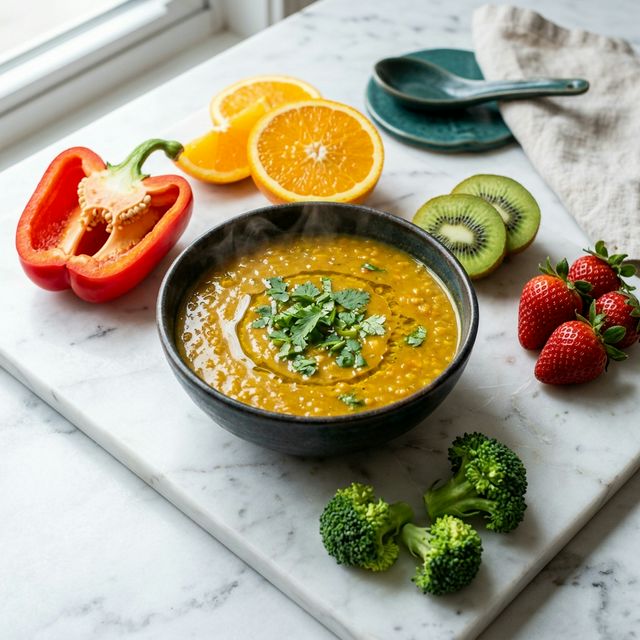
Understanding the right iron rich foods for women strategy is only half the picture. This is where the strategy clicks into place. Knowing what to eat is only useful if you know how to make your body use it.
The Vitamin C Multiplier Rule
A landmark study by Hallberg & Hulthen published in the American Journal of Clinical Nutrition found that eating 75–200mg of Vitamin C alongside non-heme iron can increase absorption by up to 300%. I’ve read a lot of nutrition research, and this finding consistently holds — it’s one of the most reproducible results in dietary science.
What does that look like on a plate?
- Spinach salad alone → roughly 1–2mg of iron actually absorbed
- Spinach salad with strawberry slices and a lemon vinaigrette → closer to 3–5mg absorbed
The practical rule I use: “Add color to your iron.” If the iron source is dark or brown — lentils, beef, spinach — add something bright red, orange, or green to the same meal.
Top Vitamin C sources to keep in rotation:
| Food | Vitamin C per Serving |
|---|---|
| Red bell pepper (½ cup, raw) | 95 mg |
| Orange juice (¾ cup) | 93 mg |
| Kiwi (1 medium) | 64 mg |
| Broccoli (½ cup, cooked) | 51 mg |
| Strawberries (½ cup) | 49 mg |
If you want to take this further and build iron-rich foods into a full weekly eating pattern, our 7-day anti-inflammatory meal plan is designed to do exactly that — it’s structured around the same food-pairing logic.
The Timing Strategy
When you eat matters, not just what.
- Morning and midday meals tend to be best for iron absorption — stomach acid is naturally stronger earlier in the day, which helps convert non-heme iron into its absorbable form.
- Hold coffee and tea for at least 1 hour after an iron-rich meal. This single habit can meaningfully improve your numbers over weeks.
- Don’t pair calcium supplements with iron-rich meals — take them at least 2 hours apart.
- Cast iron cooking bonus: Cooking acidic foods (tomato sauce, citrus-based dishes) in cast iron can leach 3–6mg of dietary iron per serving. Not a primary source, but a useful secondary one. Worth using if you have the pan.
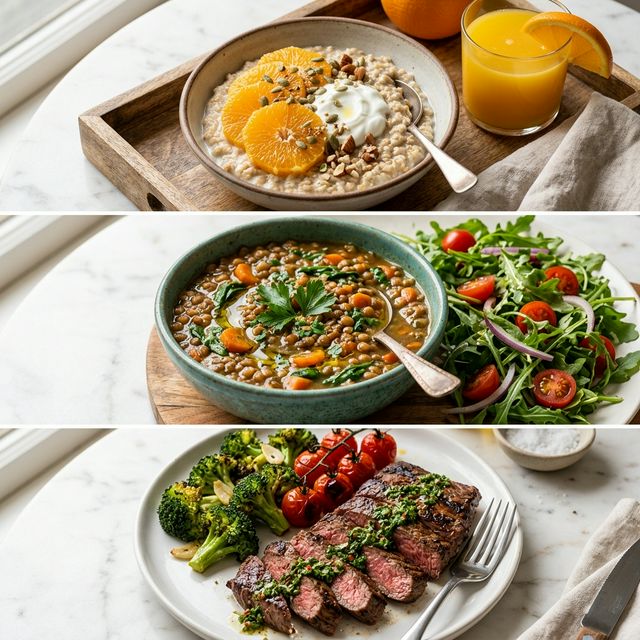
Your 3-Meal Daily Template (18mg Goal)
Here’s what hitting 18mg actually looks like as real food:
🌅 BREAKFAST — Target: ~6mg
Option A: Fortified oatmeal (6.6mg) + glass of orange juice — hold the coffee for 60 minutes
Option B: Scrambled eggs + sautéed spinach (6.4mg) + red bell pepper strips (95mg Vit C)
☀️ LUNCH — Target: ~7mg
Option A: Lentil soup (6.6mg) + arugula salad with lemon dressing + squeeze of lemon
Option B: Clam pasta with marinara sauce + side of roasted broccoli
🌙 DINNER — Target: ~5mg
Option A: Skirt steak (2.9mg) + roasted broccoli + cherry tomatoes
Option B: Tofu stir-fry (3.4mg) + red bell peppers + brown rice (soak overnight to cut phytates)
⚡ SNACK: 1 oz dark chocolate (3.4mg) + handful of strawberries = another 3–4mg
Running total: 18–22mg of iron across the day — from food alone, no tracking apps required.
Iron-Rich Foods for Women on Specific Diets
Iron strategy isn’t one-size-fits-all. Where you are in life changes both your needs and your best approach.
For Vegetarians and Vegans
Plant-based women face the highest risk — not because plants lack iron, but because non-heme absorption is inherently lower. Five plant-iron foods worth anchoring your diet around:
- White beans (1 cup cooked): 8.0mg — Stir into soups, toss in grain bowls with lemon vinaigrette, or mash into a dip with tomato
- Lentils (1 cup cooked): 6.6mg — The everyday workhorse; works in dal, soup, tacos, and pasta sauces
- Cooked spinach (1 cup): 6.4mg — Pack it in; the volume shrinks dramatically when wilted
- Firm tofu (½ cup): 3.4mg — Marinate and sear for best flavor; always pair with broccoli or bell peppers
- Pumpkin seeds (1 oz): 2.5mg — The easiest iron-boosting add-on for salads, oatmeal, or yogurt
One often-overlooked lever: gut health directly affects how much of that non-heme iron you absorb. Our deep dive into probiotic foods for gut health covers this well — fermented foods can help reduce phytate content and improve absorptive surface area in the intestine.
For Pregnant Women
At 27mg per day, pregnancy nearly doubles your iron requirement. Iron deficiency during pregnancy is linked to premature birth and low birth weight — it’s not something to manage loosely.
- First trimester: If nausea makes meat unappealing, lean hard on fortified oat cereal with orange juice, and white bean soups with citrus
- Second and third trimesters: Red meat and clams are your allies — high heme iron plus protein your body can use efficiently
- Always combine with folate-rich foods (lentils, leafy greens, fortified grains) — iron and folate work together for red blood cell production
- Loop in your OB before starting supplements — excess iron in pregnancy carries real risks
For Women Over 50
The good news: your requirement drops to 8mg after menopause. The nuance: absorption efficiency often declines at the same time.
Lower stomach acid production (common after 50) reduces the body’s ability to convert non-heme iron. Proton pump inhibitors — taken daily by many women for reflux — compound the issue significantly. And gut inflammation, which tends to increase with age, reduces absorptive surface area.
If you’re over 50 and on a PPI, ask your doctor for a full iron panel that includes ferritin. And consider that eating an anti-inflammatory diet may over time support gut lining health and improve how efficiently you absorb what you eat.
Food vs. Iron Supplement — When Diet Isn’t Enough
When iron rich foods for women alone can’t close the iron gap, supplements bridge the difference. Let’s be straight about this. For most healthy women eating a varied diet, food can maintain adequate iron levels. But for a meaningful group, diet alone won’t get there — and that’s not a failure of willpower or planning. It’s physiology.
You may need to think seriously about a supplement if:
- Your periods are heavy — lasting more than 7 days or soaking through protection
- You’ve been diagnosed with iron deficiency anemia (ferritin below 12 ng/mL)
- You’re pregnant or recently postpartum
- You’re strictly plant-based and consistently can’t hit 32mg through food
- You’re a long-distance runner (foot-strike hemolysis is a real and underrecognized cause of iron depletion)
What to Actually Look for in an Iron Supplement
The form of iron matters more than the brand.
Iron bisglycinate is what I’d look at first. It’s a chelated form of iron that absorbs efficiently at lower stomach acid levels, is significantly gentler on the digestive tract than ferrous sulfate (the most common form, and the one most likely to cause constipation and nausea), and isn’t as heavily blocked by dietary inhibitors.
When you’re comparing products, check for:
- ✅ Iron bisglycinate (not ferrous sulfate as first choice for gut-sensitive women)
- ✅ Added Vitamin C in the formula
- ✅ NSF Certified or third-party verified for purity
- ✅ Dose within range — the safe upper limit is 45mg/day without medical supervision
My top pick for most women is MegaFood Blood Builder — whole food-based, NSF certified, formulated with Vitamin C and B12, and specifically designed to support women’s iron levels without the GI side effects. If budget is a priority, Nature Made Iron (ferrous sulfate) is USP-verified and under $10 at most pharmacies — just take it with food to reduce GI discomfort.
💊 Reminder: Iron supplements can be harmful in excess and may interfere with medication absorption. Run it by your doctor before starting, especially during pregnancy or if you’re managing other health conditions.
Frequently Asked Questions
Here are the most common questions about iron rich foods for women, answered directly.
How much iron does a woman need per day?
Women aged 19–50 need 18mg daily due to menstrual blood loss. Pregnant women need 27mg. Breastfeeding women need 9–10mg. After menopause (51+), the requirement drops to 8mg. Teen girls (14–18) need 15mg. These figures come directly from the NIH’s Recommended Dietary Allowances.
What is the single highest-iron food for women?
Canned clams — 23.8mg per 3-oz serving, which exceeds a woman’s full daily requirement in a single portion. For plant-based eaters, canned white beans (8.0mg/cup) and cooked lentils (6.6mg/cup) are the strongest everyday options.
Can you get enough iron without eating meat?
Yes, with intention. Non-heme iron absorbs at only 2–20%, versus 15–35% for heme iron. Plant-based women should aim for roughly 32mg/day and pair every iron source with a Vitamin C food at every meal. It’s achievable — it just can’t happen by accident.
What drinks block iron absorption?
Coffee and tea are the two biggest culprits. The tannins and polyphenols in both cut non-heme absorption by 50–60%. Hold your coffee until at least 1 hour after an iron-rich meal. Water and orange juice are your best mealtime options.
How quickly can iron-rich foods raise your iron levels?
Ferritin levels typically start improving within 4–8 weeks of consistent dietary changes. If clinical iron deficiency anemia has already developed, supplementation under medical supervision usually restores levels over 3–6 months. Diet alone is usually too slow to correct clinical deficiency — get tested and work with your doctor.
What fruit is highest in iron?
Fresh fruit is low in iron, but dried varieties concentrate it: dried apricots (~3.5mg per half cup), prunes (~1.6mg), and raisins (~1.4mg). In practice, fresh fruits earn their place as Vitamin C delivery vehicles rather than iron sources — strawberries, kiwi, and citrus are the trio to reach for.
The Bottom Line
Iron deficiency is the world’s most common nutritional deficiency — and focusing on the best iron rich foods for women — and women carry a disproportionate share of it. The fix isn’t just eating more spinach. It’s understanding that absorption is the gatekeeper, and the biggest leverage is in the pairing.
Your simple framework:
- Aim for 18mg daily (27mg if pregnant; 8mg if post-menopausal)
- Prioritize canned clams, liver, and oysters for the highest-impact heme iron
- For every plant-based iron source, add a Vitamin C food to the same plate
- Hold coffee and tea for 1 hour after iron-rich meals
- Use the 3-meal template above as your starting point — it gets you to 18–22mg without any counting
If you’ve cleaned up your diet and are still feeling the fatigue, brain fog, or hair shedding — ask your doctor for a ferritin test specifically. Not just hemoglobin. Ferritin catches the problem earlier.
For a gut-health-first approach to building these foods into meals you’ll actually want to eat, our gut-healthy meal plan is worth a look — a healthy gut absorbs iron more efficiently, and these food pairings fit naturally into that structure.
The information on this site is for educational purposes only and is not intended as medical advice. Always consult a qualified healthcare provider before making any changes to your diet, exercise routine, or supplement use.
About Jane Smith
We turn solid evidence into everyday habits Americans can actually do—plain English, cups/oz, grocery-aisle swaps, and routines that fit real life. Our editorial process: Experience—we road-test tips in real schedules…