Vitamin D + Sunshine: The Complete Guide (Including Winter)
Disclaimer: I’m trained in traditional medicine in Vietnam, but I’m not currently practicing medicine or offering diagnosis or treatment through...
- The Quick Answer
- Why the Standard Sunlight Advice Fails So Often
- The 4 Variables That Actually Decide How Much Sun You Need
- Above 37° Latitude: The Winter Problem Most Articles Skip
- Dark Skin Changes the Equation
- Best Time of Day for Vitamin D Sun
- Sunscreen and Vitamin D: The Balanced Position
- No, You Cannot Get Vitamin D Through a Window
- Foods That Help, Even If They Cannot Do the Whole Job
- The Honest Winter Protocol
- How Long It Takes to Recover Low Vitamin D
- When to Test 25(OH)D Instead of Guessing
- Special Populations Who Need a More Honest Plan
- The TCM Lens: Thận Chủ Cốt
- What This Looked Like in Real Life
- FAQ
- The Bottom Line
Disclaimer: I’m trained in traditional medicine in Vietnam, but I’m not currently practicing medicine or offering diagnosis or treatment through this website. I write from ongoing research, personal observation, and patterns I’ve seen in my own family and community. This article is educational and should not replace advice from your doctor or registered dietitian, especially if you have osteoporosis, kidney disease, pregnancy, or a diagnosed deficiency.
Most vitamin D advice online sounds simple:
“Get 10 to 20 minutes of sun.”
The problem is that this advice is usually geography-blind, season-blind, and skin-tone-blind.
It assumes:
- you live somewhere sunny
- the sun angle is high enough for UVB
- your skin makes vitamin D efficiently
- it is not winter
- you are not behind glass
- and you are not covering the skin the entire time
That is a lot of assumptions for one sentence.
In real life, how much sunlight you need for vitamin D depends on four things first:
- latitude
- season
- skin tone
- time of day
Then a fifth variable enters:
- whether your lifestyle actually allows you to get that sun consistently
This is why two people can both “go outside every day” and get completely different vitamin D results.
One makes enough.
The other does not.
This guide is here to fix that confusion.
It will walk you through:
- how vitamin D sun exposure actually works
- why winter sun fails in much of the U.S.
- why dark skin changes the timing
- what sunscreen changes and what it does not
- why windows do not help
- when food helps
- and when a supplement is simply the honest answer
If you are coming from the vitamin rich foods pillar, this is the deep dive on the Bone Triad section: vitamin D, calcium, and K2.
The Quick Answer

If you want the shortest version first:
- vitamin D depends on UVB, not just brightness or warmth
- above roughly 37° latitude, winter sunlight often cannot generate meaningful vitamin D in skin
- darker skin needs longer sun exposure than lighter skin for the same output
- sitting near a bright window does not help because glass blocks UVB
- sunscreen complicates the process, but there is still room for a balanced approach
- for many people in the U.S., especially from October to March, vitamin D supplementation is more realistic than trying to outwalk the sun
The honest answer is not:
“Sun is enough for everyone.”
The honest answer is:
“Geography beats intention more often than people think.”
Why the Standard Sunlight Advice Fails So Often
Most vitamin D confusion begins here: people see bright light, assume it counts, and never realize the missing variable was UVB strength.
Most vitamin D articles are written as if the sun behaves the same everywhere.
It does not.
The body only makes vitamin D when UVB light reaches the skin at a strong enough angle. If the sun is too low in the sky, the atmosphere filters too much UVB before it gets to you. Reference: NIH ODS Vitamin D.
That means you can stand outside on a bright winter day and still make almost no useful vitamin D.
This is the key concept most readers have never been taught:
brightness is not the same thing as UVB availability.
A cold but high-angle spring sun may help.
A beautiful bright winter day in a northern state may not.
That is why so many people feel confused:
- “I go outside every day.”
- “I get sunlight through my office window.”
- “I walk the dog all winter.”
- “Why is my vitamin D still low?”
Because the variable that matters is not only outdoor time.
It is whether UVB is physically strong enough at your location, in that season, at that hour, on that skin.
That is the whole game.
The 4 Variables That Actually Decide How Much Sun You Need

1. Latitude
Latitude is the hidden variable behind most vitamin D confusion.
The farther you live from the equator, the lower the winter sun angle becomes. Once the angle drops too far, the atmosphere filters out too much UVB for your skin to make much vitamin D.
This is why much of the northern United States effectively loses reliable winter vitamin D production for months at a time.
It is not about laziness.
It is physics.
2. Season
Summer and winter are not interchangeable.
The exact same person, with the exact same skin tone, may produce enough vitamin D in summer and almost none in winter under similar outdoor habits.
That is why a summer routine does not automatically protect you in February.
3. Skin Tone
Melanin matters.
Darker skin provides natural protection from UV damage, but it also slows vitamin D synthesis. That means a darker-skinned person usually needs longer UVB exposure than a fair-skinned person to make the same vitamin D output.
This is one of the biggest honesty gaps in mainstream advice. Generic “10 minutes a day” guidance often fails darker-skinned readers completely.
4. Time of Day
Vitamin D production is tied to UVB intensity, and UVB is usually strongest closer to midday.
A gentle early-morning walk may be great for mood and blood sugar, but it may not do much for vitamin D.
This is also why the phrase “sunlight for vitamin D” is too vague.
We need the right sun, not just any sun.
Above 37° Latitude: The Winter Problem Most Articles Skip

This is the single most practical truth in the whole article.
Above roughly 37° latitude, winter UVB is often too weak for meaningful skin production of vitamin D.
That means for large parts of the U.S., from roughly October through March, trying to get vitamin D from sunlight alone becomes unreliable or unrealistic.
This is where readers often waste energy:
- going outside more
- standing in weak winter light
- assuming bright equals useful
- feeling guilty when their blood level does not improve
That guilt is misplaced.
The issue is not discipline.
The issue is that winter sun often cannot do the job.
This is exactly why a “winter protocol” matters more than more motivational sunlight advice.
Dark Skin Changes the Equation
This is not a minor footnote. It changes how honest your entire sun strategy needs to be.

This section deserves directness.
If you have darker skin, your vitamin D strategy usually cannot be copied from someone with fair skin.
You may need significantly longer UVB exposure to produce the same vitamin D output. That does not mean anything is wrong with your body.
It means the same sun dose does not translate evenly across skin tones.
This is especially relevant for:
- Black Americans
- darker-skinned Hispanic readers
- South Asian readers
- mixed-ethnicity families living in northern states
This is also where well-meaning mainstream advice quietly fails.
When a fair-skinned wellness writer says, “I just get 10 minutes a day,” that may be true for them.
It may be completely inadequate for someone else.
That is why vitamin D recommendations need more honesty and less copy-paste.
Best Time of Day for Vitamin D Sun

If you are relying on sunlight, the most useful window is usually when UVB is strongest, which is generally closer to midday than early morning or late afternoon.
This does not mean:
- baking in the sun
- getting burned
- avoiding all sunscreen forever
It means the body needs a realistic UVB window to work with.
A practical version looks like this:
- short intentional exposure
- enough uncovered skin to matter
- then normal sun protection if you will stay outside longer
That is a more honest approach than either extreme.
Sunscreen and Vitamin D: The Balanced Position

This topic gets polarized fast.
One side says:
- wear sunscreen all the time, no exceptions
The other says:
- sunscreen blocks vitamin D, so skip it
Both become unhelpful when they turn absolute.
The balanced position is more practical: Context: Harvard T.H. Chan.
- short intentional exposure first
- then sunscreen if you stay out longer
That gives the body a chance to synthesize vitamin D while still respecting long-term skin protection.
This is not a permission slip to burn.
It is a permission slip to think instead of choosing a slogan.
No, You Cannot Get Vitamin D Through a Window

This is one of the easiest myths to clear up.
Sunlight through glass feels warm.
It can even brighten mood.
It can tan some skin over time.
But standard window glass blocks most of the UVB needed for vitamin D production.
That means:
- bright office windows do not solve winter deficiency
- driving in sunlight does not count as a vitamin D strategy
- sitting in a sunny room is not the same thing as direct UVB exposure
This matters because a lot of people believe they are “getting sun” when they are really getting brightness without useful UVB.
Foods That Help, Even If They Cannot Do the Whole Job
Food matters, but food is usually support, not the entire answer.
The best vitamin D food sources include:
- salmon
- sardines
- egg yolks
- cod liver oil
- fortified dairy or plant milks
- UV-exposed mushrooms
These foods help most when they are part of a repeatable weekly pattern.
But this is where honesty matters again:
For many adults, especially in winter, food alone does not fully replace what missing UVB would have given.
That does not make food useless.
It makes food one leg of the stool rather than the whole stool.
If you are already exploring the broader nutrient side, go back to the vitamin rich foods pillar after this article.
The Honest Winter Protocol
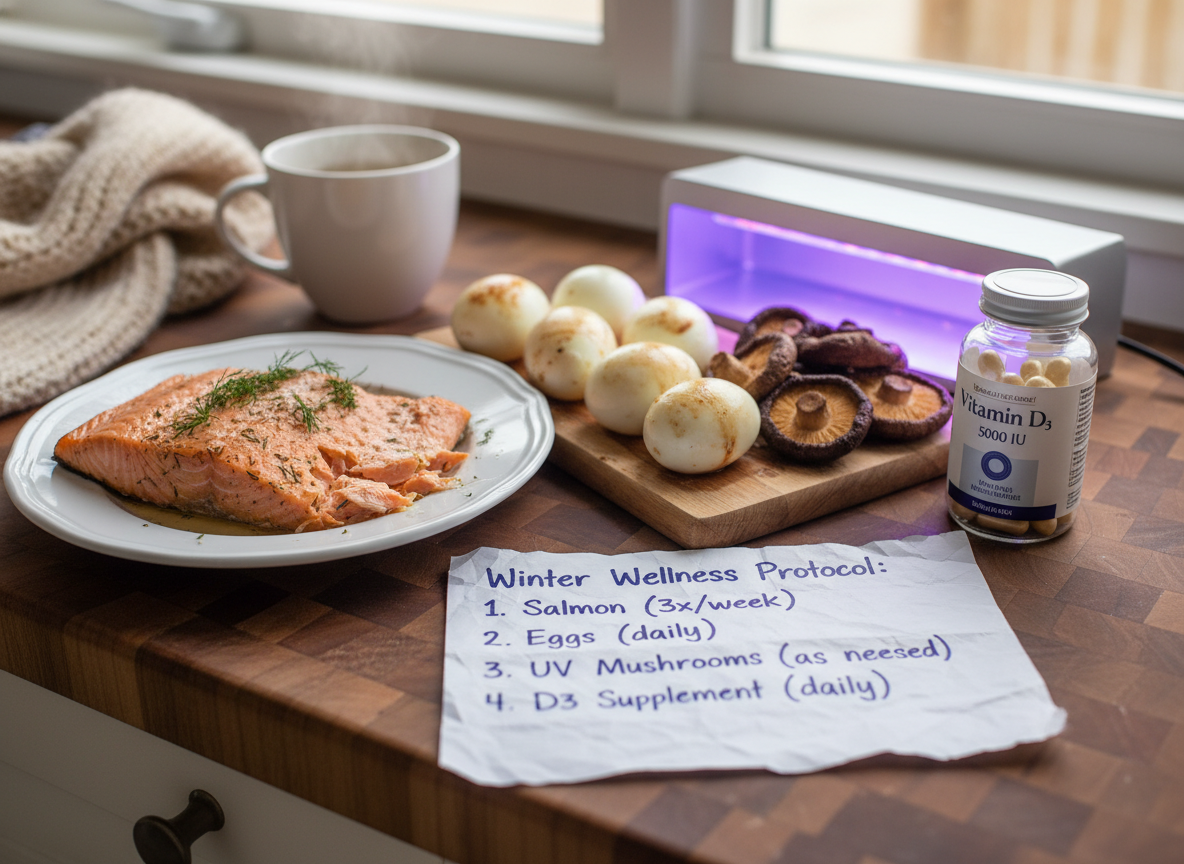
For many readers, this is the most useful section.
If you live in a northern state, work indoors, have darker skin, or simply know winter sunlight is not enough where you are, the cleanest strategy is usually this:
Step 1: Stop pretending weak winter sun will carry the whole load
That mindset wastes months.
Step 2: Use food as support
Keep oily fish, eggs, fortified foods, or UV-exposed mushrooms in the weekly rotation.
Step 3: Use a vitamin D3 supplement when needed
For many adults, a modest daily winter D3 dose is not over-medicalization. It is the honest acknowledgment that geography has limits. Evidence context: VITAL Study and CDC / NHANES context.
Step 4: Pair bone-building nutrients intelligently
Vitamin D does not work in isolation. Calcium, magnesium, and especially K2 affect where mineral support ends up.
That is why the vitamin K + warfarin spoke is such an important cluster link.
Step 5: Reassess after enough time
Vitamin D repletion is not instant. It usually takes weeks, not days.
This is one reason people quit too early.
How Long It Takes to Recover Low Vitamin D
Vitamin D recovery is slower than most readers expect.
If your level is meaningfully low, it usually takes weeks to months of consistent sun, food, or supplementation to shift it in a measurable way.
That is why asking “Is vitamin D working yet?” after five days is the wrong timeline.
The more useful questions are:
- Is the plan realistic enough to sustain?
- Is this summer sun, winter sun, or no real sun at all?
- Am I supplementing consistently if I need to?
- Am I checking my level when the situation actually warrants testing?
This is another place where patience beats intensity.
When to Test 25(OH)D Instead of Guessing
At some point, guessing stops being practical. A clean lab number saves more time than another month of vague experimentation.
Some readers should stop guessing earlier than others.

Testing makes more sense when:
- you live in a northern climate and winter hits you hard every year
- you have darker skin and low sun exposure
- you work indoors most of the day
- you are older
- you have bone health concerns
- you have chronic fatigue or low mood that keeps coming back
- you have kidney disease, gut absorption issues, or obesity

For those readers, a 25(OH)D blood test often gives cleaner direction than endless guessing.

If chronic fatigue is the main complaint, also read the fatigue decoder because vitamin D is only one part of that picture.
And if your symptoms still feel vague rather than dramatic, the subclinical deficiency spoke is the better diagnostic partner article.
Special Populations Who Need a More Honest Plan

Some groups need more than generic advice:
Older adults

Skin synthesis slows, outdoor exposure often drops, and bone risk goes up.
Darker-skinned readers in northern states

This is one of the highest-risk combinations for underestimating vitamin D needs.
Indoor workers

A short commute and office-window light do not add up to meaningful UVB.
People with kidney disease
Vitamin D handling becomes more complex here, and this is where the body’s activation pathway matters more. If kidney health is already part of the picture, see the kidney-support food article with appropriate medical caution.
People with malabsorption
Celiac, IBD, bariatric history, and chronic gut dysfunction can all make deficiency more stubborn.
This is why one-size-fits-all sunshine advice fails.
Risk is not only about outdoor time. It is about physiology, geography, and context.
The TCM Lens: Thận Chủ Cốt
Traditional medicine gives us another useful language for this.
In Vietnamese-Chinese medicine, the Kidney system is said to “govern the bones” — Thận chủ cốt.
That idea maps surprisingly well onto the modern bone-health conversation around vitamin D, calcium, mineralization, and structural resilience.
In practical terms, the old framework points toward foods and habits that support bone depth and long-term reserve:
- sardines with bones
- black sesame
- mineral-rich broths
- fermented foods that support the K2 side of the story
- regular sunlight when it is actually useful
I would not use the TCM lens instead of bloodwork or modern bone-health guidance.
But I would use it to remind readers that bone weakness is rarely a one-variable story.
It is usually a pattern.
What This Looked Like in Real Life
One of the clearest patterns I watched was in my mother.
Every winter she would describe the same shift: shallower sleep, flatter mood, heavier legs, and a quiet reluctance to go outside that she kept blaming on age.
The pattern was subtle enough to dismiss, but consistent enough to recognize. Around late November, she would start waking more at night. By January, she was slower in the morning, less interested in walking, and more likely to say, “Maybe this is just what getting older feels like.”
Her meals were decent. Her habits were not terrible.
But she lives in the same pattern many families do: more time indoors, less midday sun, and a winter routine that looked bright enough without actually giving her useful UVB.
The first useful change was not dramatic.
We stopped pretending sunlight alone would fix it from November through February.
She kept fish, eggs, and warm mineral-rich soups in rotation, added a simple D3 routine, and only tried to get outside during the hours that actually made sense when the season allowed it.
After about six to eight weeks, the first thing she noticed was not a lab value. It was that winter no longer felt like such a steady downhill slide.
She slept a little more deeply. Her morning stiffness softened. Her mood stopped flattening so hard by late afternoon. She still felt winter, but she no longer felt pulled under by it.
That is an important kind of win. Not dramatic. Not cinematic. But real enough to restore trust in the process.
I also watched a close friend who works almost entirely indoors make the same mistake many office workers make: she assumed sitting beside sunny windows and taking short morning walks meant vitamin D was “probably fine.”
It was not.
She was one of those people doing many things “right” on paper while still feeling a little worse each winter: harder time focusing by mid-afternoon, heavier mood, lower drive to exercise, and the strange feeling that she was always trying to push herself uphill.
Once she understood the difference between brightness and UVB, she stopped guessing, tested, and built a more honest winter plan.
The change for her was not some huge burst of energy in three days. It was that the constant uncertainty dropped away. She knew what her winter baseline actually was, she stopped expecting weak sunlight through glass to solve it, and within a couple of months she felt steadier, clearer, and less resentful of the season itself.
Sometimes the most helpful intervention is not heroic.
It is simply admitting what the season can and cannot do.
FAQ
How much sunlight do you need for vitamin D?
It depends on latitude, season, skin tone, time of day, and how much skin is uncovered. There is no one universal number that works for every reader year-round.
Can you get vitamin D through a window?
No, not in a meaningful way. Standard window glass blocks most of the UVB needed for vitamin D production.
What is the best time of day for vitamin D sun?
Usually closer to midday, when UVB is strong enough, not just when the day feels bright.
Does sunscreen block vitamin D?
It can reduce skin production, but a balanced strategy is still possible: short intentional exposure first, then sunscreen if you stay out longer.
How do you get vitamin D in winter?
For many people, winter requires a more honest plan: food support plus D3 supplementation, because weak winter sun often cannot do the full job.
Which foods are highest in vitamin D?
Salmon, sardines, egg yolks, cod liver oil, fortified foods, and UV-exposed mushrooms are among the best practical options.
How long does it take to recover from vitamin D deficiency?
Usually weeks to months, not days. Consistency matters more than intensity.
Who should test vitamin D sooner?
Older adults, darker-skinned readers in northern states, indoor workers, people with bone concerns, and people with malabsorption or kidney issues.
The Bottom Line
The goal is not to fear the sun or worship it. The goal is to use it realistically.
Three takeaways matter most:
1. Sun advice without geography is weak advice.
Latitude, season, and time of day decide whether the sun can do anything useful for vitamin D.
2. Skin tone changes the math.
Darker skin often needs longer exposure, which means generic sunlight advice fails a lot of readers.
3. Winter supplementation is often realism, not failure.
For many adults, especially in northern climates, D3 in winter is not overreaction. It is just the honest response to weak UVB.
If this article made you realize your winter energy and mood drop might not be random, read the subclinical deficiency spoke next.
If it made you realize your issue is bigger than sunshine alone, go back to the vitamin rich foods pillar and rebuild the Bone Triad from there.

About Mr. Anh
We turn solid evidence into everyday habits Americans can actually do—plain English, cups/oz, grocery-aisle swaps, and routines that fit real life. Our editorial process: Experience—we road-test tips in real schedules…