Digestive Enzymes After Gallbladder Removal: The Most Common Misconception + The Right “Bile + Lipase” Protocol
Digestive Enzymes After Gallbladder Removal: The Most Common Misconception + The Right “Bile + Lipase” Protocol You just had your...
- TL;DR — The 60-Second Answer
- The Biggest Mistake — You Didn't Lose Enzymes, You Lost Bile
- The "Continuous Drip" Problem — Why Bile Is "Diluted"
- The Right Protocol — "Bile + Lipase Combo"
- Diet Timeline — 4 Phases of Recovery
- The Eastern View — "Gallbladder & Liver Meridian in the Five Elements"
- ⚠️ When Enzymes/Bile Aren't Enough — Bile Acid Diarrhea & Cholestyramine
- ⚠️ Red Flags — Symptoms Requiring Immediate Medical Attention
- The "First Bite + Warm Sip" Timing Protocol
- Natural Food Support
- Summary & Next Steps
- Frequently Asked Questions (FAQ)
Digestive Enzymes After Gallbladder Removal: The Most Common Misconception + The Right “Bile + Lipase” Protocol
You Google “digestive enzymes after gallbladder removal” hoping to find a magic pill. You read Healthline, Zenwise, Dr. Berg. You order the most expensive broad-spectrum enzyme on Amazon — and see no improvement. The diarrhea comes back every time you eat anything fatty.
Why? Because you’re solving the wrong problem.
Someone close to me in my family walked this exact path — it took her nearly 6 months to eat a normal bowl of pho with fatty meat again, because she kept taking broad-spectrum enzymes following online advice without understanding the real mechanism behind it all.
As someone trained in Traditional Oriental Medicine (a dedicated researcher, not a clinician and not a doctor) with a deep love for Western health science, today I’ll show you the biggest mistake 90% of post-cholecystectomy patients are making — and the protocol that actually works based on the correct physiology.
📋 Important Note
This article is educational and reflects personal research experience, not a substitute for advice from your surgeon or gastroenterologist. Gallbladder removal is a significant medical procedure, and every patient has a different recovery trajectory. Before adding any supplement (including Ox Bile and Lipase), consult the surgeon who performed your procedure.
TL;DR — The 60-Second Answer
After gallbladder removal, you DID NOT lose digestive enzymes — you lost the ability to emulsify fats with bile. So you need Ox Bile (125–500mg) + high-dose Lipase (≥5,000 FIP) with fatty meals. If you have chronic diarrhea >3 months post-surgery, cholestyramine (prescription) is the first-line treatment — talk to your doctor before self-purchasing supplements.
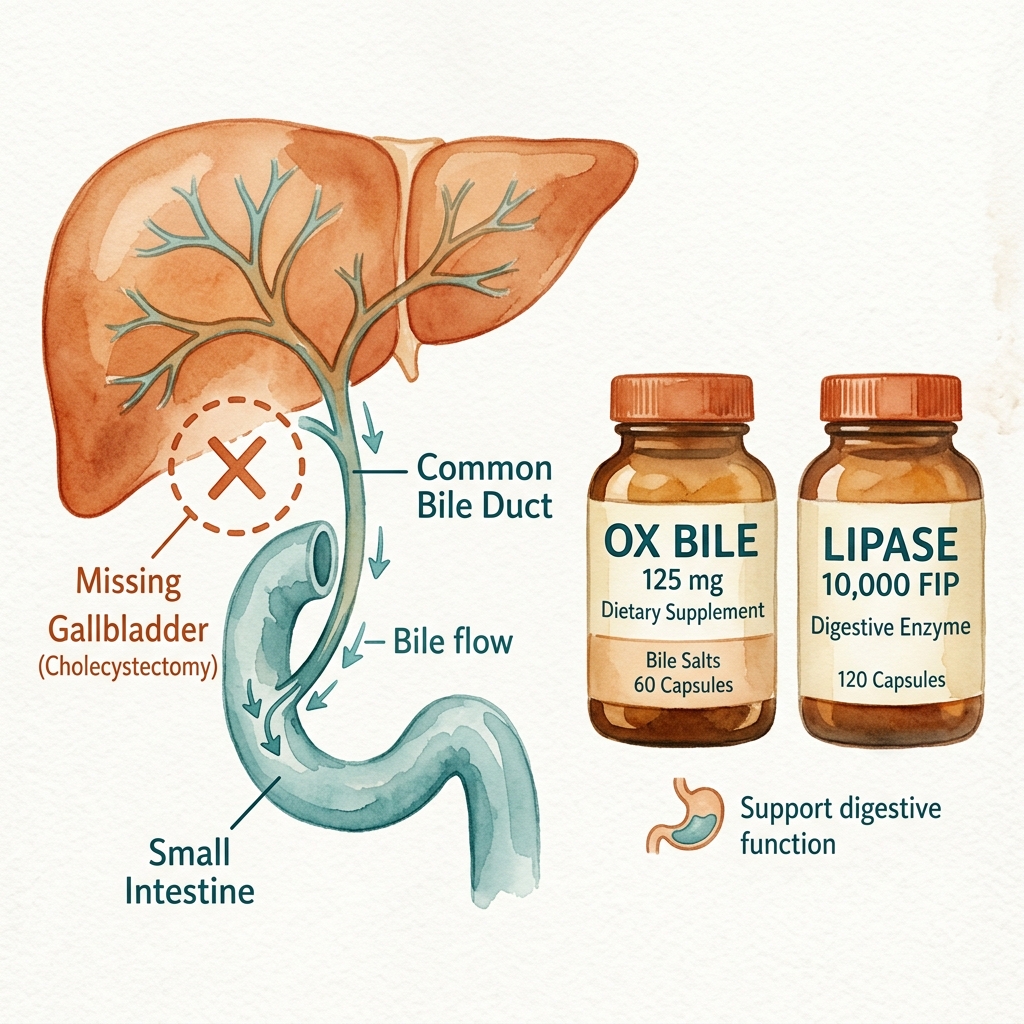
The Biggest Mistake — You Didn’t Lose Enzymes, You Lost Bile
This section busts the most common misconception I see in post-cholecystectomy recovery forums and Facebook groups.
Anatomy 101 — What Does the Gallbladder Actually Do?
Let me say this once and for all: The gallbladder does NOT produce digestive enzymes. This is misconception #1.
The gallbladder is simply a “storage tank” for bile produced by the liver. Here’s how it works:
- The liver continuously produces bile.
- Bile enters the gallbladder, where it gets concentrated 5–10 times.
- When you eat fat → the small intestine sends a hormone signal called CCK (cholecystokinin) → the gallbladder contracts → pumps concentrated bile into the small intestine at the right moment.
- Bile emulsifies the fat (like dish soap breaking down an oil slick into tiny droplets).
- Lipase (an enzyme produced by the pancreas) can now cut the fat into absorbable fatty acids [1].
→ Three independent components: bile (liver/gallbladder), lipase (pancreas), fat (in food).
What Actually Changes After Surgery?
- The liver still produces bile normally — no change.
- The pancreas still produces enzymes (including lipase) normally — no change.
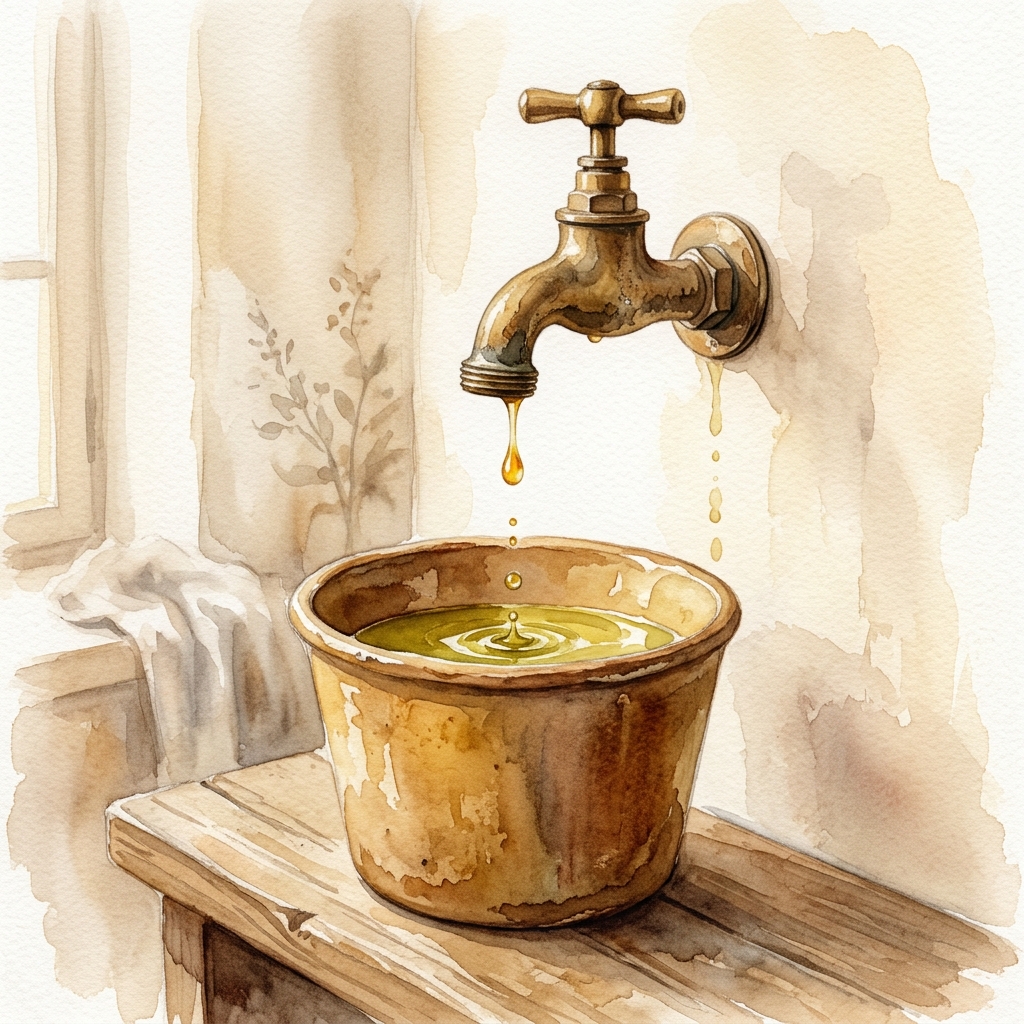
- What’s lost is the “clock” + “concentration tank”: bile now drips continuously from the liver to the small intestine, whether you’re eating or not.
Consequences: Bile is more dilute (no longer concentrated in a storage tank), bile arrives at the wrong time (flowing even when you’re not eating, not concentrated enough when you do eat fat) → fat is not emulsified sufficiently → lipase can’t grip it → fat passes into the colon intact → fatty diarrhea, bloating, gas.
Important corollary: Because pancreatic enzymes are still normal, taking broad-spectrum enzymes alone often DOES NOT solve the problem. You need to supplement bile, not enzymes. This is why so many people take broad-spectrum enzymes after gallbladder removal and still have diarrhea — they’re pouring money into the wrong solution.
The “Continuous Drip” Problem — Why Bile Is “Diluted”
Picture before and after the procedure:
- Before gallbladder removal: Bile is concentrated in the gallbladder (5–10×). When you eat → pumped concentrated in one burst. Fat is strongly emulsified, lipase works efficiently.
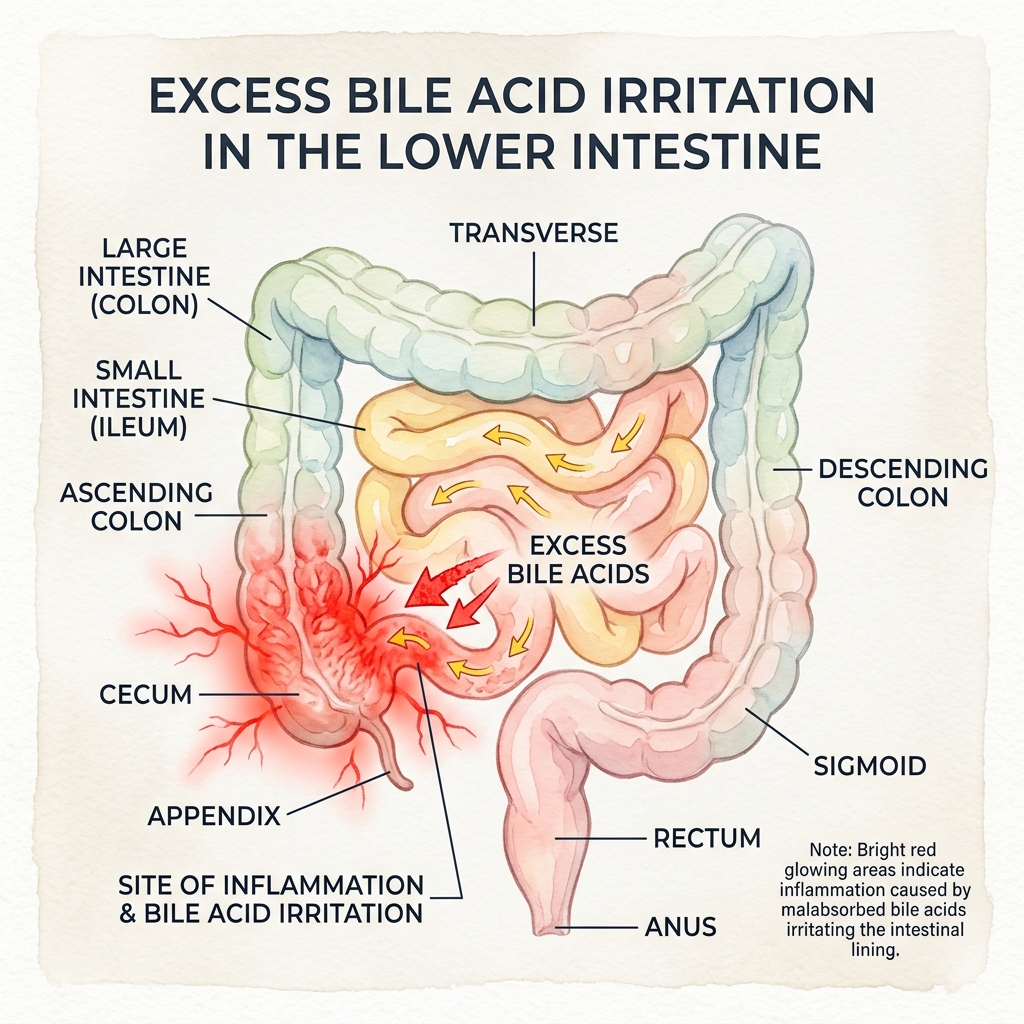
- After gallbladder removal: Bile flows continuously from liver → enters small intestine even when not eating. Bile is much more dilute. When you eat a fatty meal → insufficient concentrated bile → fat passes into colon un-emulsified. Simultaneously, excess bile when not eating → irritates intestinal lining → may cause bile acid diarrhea [2].
→ This is why supplemental Ox Bile at the right mealtime is the most physiologically logical solution.
The Right Protocol — “Bile + Lipase Combo”
After years of research and observing the recovery journey of family and friends, I’ve distilled this protocol. This is not medical advice — discuss with your surgeon before applying.
Ox Bile — How Much, When, Why
- Mechanism: Bovine bile (Ox Bile) contains bile acids similar to human bile. Taken with meals, it emulsifies exogenous fat — replacing the “concentration tank” function the gallbladder lost.
- Starting dose: 125 mg/meal, gradually increase to 500 mg/meal based on fat content.
- Timing: With the first bite of the meal (not before, not after).
- Selection criteria: Pure bovine source, third-party tested (NSF, USP), no unnecessary additives.
High-Dose Lipase — Why ≥5,000 FIP
You might wonder: “If the pancreas still produces lipase normally, why supplement?”
Answer: Because bile is more dilute than normal → fat isn’t emulsified well → your own pancreatic lipase becomes less effective (like opening a tailor shop without anyone cutting fabric in advance). High-dose supplemental lipase helps compensate for the lost efficiency.
- Dose: ≥5,000–10,000 FIP units per capsule.
- Note: FIP is an activity unit, not mg. Don’t confuse the two — 500 mg of lipase could be only 1,000 FIP if quality is poor.
How to Choose a Combination Product
When reading supplement labels with “for no gallbladder” or “post-cholecystectomy” phrasing, look for:
- ✅ Lipase ≥5,000 FIP per capsule
- ✅ Ox Bile 100–500 mg per capsule
- ✅ Pancreatin (provides other enzymes — amylase, protease)
- ✅ May include Betaine HCl (supports stomach acid)
- ✅ Third-party tested (USP / NSF / ConsumerLab certified)
- ❌ Avoid: high prebiotic fiber (may trigger symptoms if SIBO overlap — see Digestive Enzymes vs Probiotics)
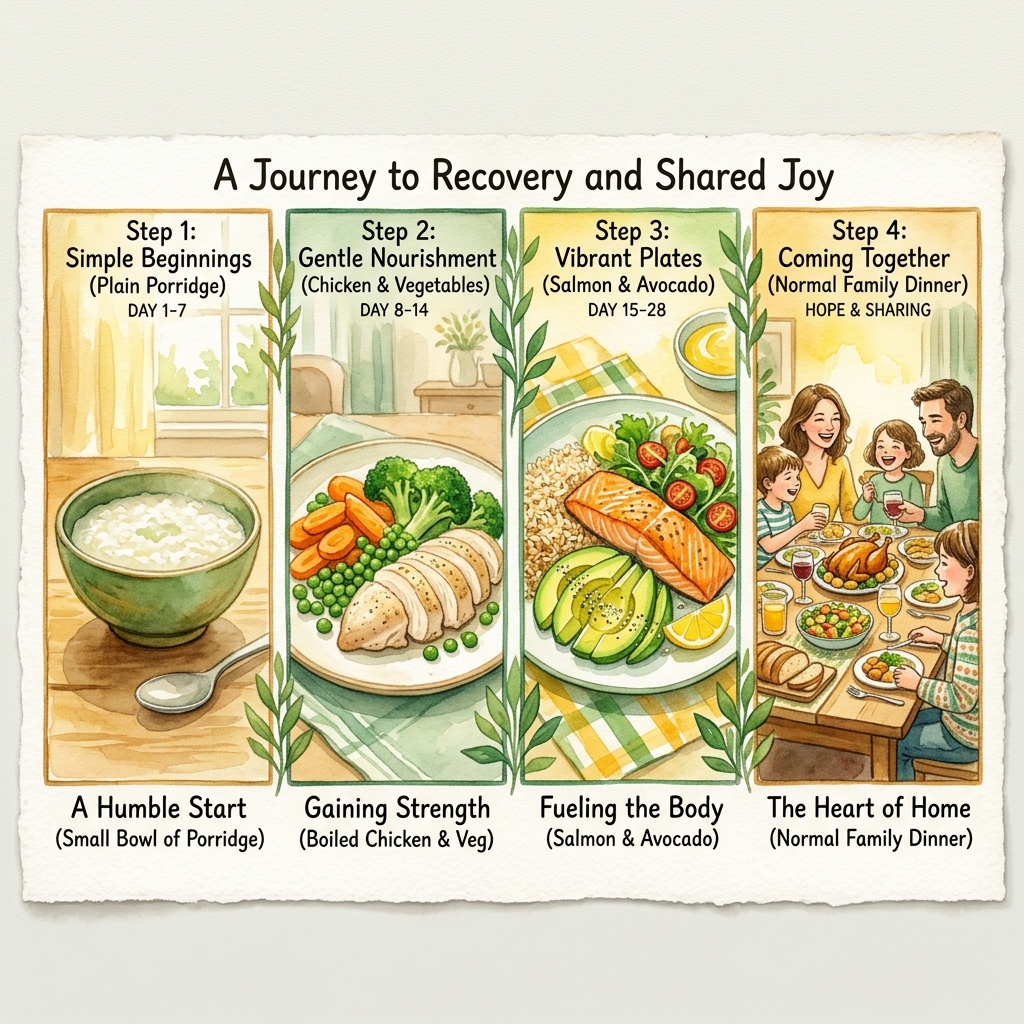
Diet Timeline — 4 Phases of Recovery
This is the section 99% of articles about gallbladder removal skip. They only say “low-fat diet” vaguely. The truth is that your diet must change across phases, because your body is also changing across phases [3].
Week 1 (Days 0–7) — Post-Surgical Recovery
- Eat: Clear liquids (broth, jelly) → soft bland (plain porridge, light soup). ZERO fat.
- Supplement: Not yet Ox Bile/Lipase. Body is focused on wound healing.
- Meal frequency: 5–6 small meals instead of 3 large ones — matches the new “continuous drip” pattern.
Month 1 (Weeks 2–4) — Strict Low-Fat
- Eat: Lean protein (skinless chicken, steamed fish), boiled/steamed vegetables, easy-to-digest starches. Fat ≤30% calories, saturated fat ≤10%.
- Supplement: Start Ox Bile 125 mg + Lipase 5,000 FIP for fattier meals.
- Avoid: Fried foods, full-fat dairy, fatty meats, coconut oil, butter.
Month 3 (Weeks 5–12) — Re-introduce Fat Gradually
- Eat: Start adding healthy fats — avocado, olive oil, fatty fish (salmon), nuts — per personal tolerance.
- Supplement: Increase Ox Bile to 250–500 mg + Lipase 10,000 FIP for fatty meals.
- Track: Food journal — if diarrhea returns, reduce fat or increase supplement.
Long-Term (>3 Months) — “New Normal”
- Eat: Mostly back to normal. Body has adapted to “continuous drip” pattern.
- Supplement: Only use for ultra-high-fat meals (parties, buffets, hot pot, holidays).
- Important warning: If after 3 months you still have chronic diarrhea → see a doctor, may be bile acid diarrhea requiring cholestyramine.
The Eastern View — “Gallbladder & Liver Meridian in the Five Elements”
This is the angle absent from every top-SERP Western article. And it’s the angle that may explain the “non-digestive” symptoms many people experience after gallbladder removal — like irritability, sleep issues, prone to overheating.
In Traditional Chinese Medicine (TCM), the gallbladder is called Đởm (胆) — belonging to the Liver-Gallbladder meridian. They are a paired Yang-Yin organ system:
- Liver (Can) — governs blood storage, free flow of qi, long-term planning.
- Gallbladder (Đởm) — governs decisiveness, courage, “assistant” to the Liver.

Removing the Gallbladder Affects Both Liver and Spleen
After gallbladder removal: (1) Liver loses its “partner” — prone to overheating, prone to being overwhelmed by stress, prone to irritability. Many post-surgical patients report this — and it’s not purely psychological. (2) Spleen loses an “assistant” in fat transformation — because bile is more dilute → Spleen must “carry” more work → easily fatigued after meals. (3) Need to nurture both Liver and Spleen simultaneously, not just focus on digestion.
TCM Supportive Recovery Protocol
- Nurture the Spleen: Warm, easy-to-digest food, small frequent meals. Porridge, soup, stews. Avoid raw cold foods, ice water.
- Soothe the Liver: Reduce stress, sleep before 11 PM (Liver peak hour). Chamomile tea, dried tangerine peel (chen pi).
- Support fat metabolism: Warm ginger tea after meals, a bit of fresh turmeric in cooking.
- Avoid: Fried foods (harms Liver), alcohol (strongly harms Liver), excessive sweets (creates dampness, harms Spleen).
I’ve seen someone close to me in my family take 6 months after gallbladder removal before being able to eat a normal bowl of pho with fatty meat — after combining Ox Bile + high-dose Lipase + 5–6 small meals/day + nurturing the Liver through stress reduction and early sleep. The “Liver-nurturing” part is something Western articles don’t mention, but I believe it plays an important role.
⚠️ When Enzymes/Bile Aren’t Enough — Bile Acid Diarrhea & Cholestyramine
This is the YMYL trust core of the article. And it’s also the section supplement-side articles avoid — because it “doesn’t sell products.”
What Is Bile Acid Diarrhea (BAD)?
After gallbladder removal, 20–30% of patients develop a condition where excess bile flows continuously into the colon → irritates colonic lining → chronic diarrhea (often morning, or 30–60 minutes after meals) [4]. This is an official medical condition — called Type 3 Bile Acid Malabsorption or Post-Cholecystectomy Diarrhea (PCD).
Cholestyramine — First-Line Treatment (Prescription)
Cholestyramine (and same-class drugs: colestipol, colesevelam) are bile acid sequestrants — they bind excess bile acids in the gut, removing them through stool, without irritating the colon. Clinical studies show 70% symptom reduction in responders [5]. This is a PRESCRIPTION DRUG — requires a doctor’s order. Not sold OTC. Cannot be replaced by supplements.
When Is Ox Bile NOT Appropriate?
Warning: If you have chronic diarrhea (>3 months post-surgery) → Ox Bile may make it worse (because you have excess bile, not deficient). In this case, see your doctor about cholestyramine before self-purchasing supplements [6].
- Ox Bile is appropriate for people who lack concentrated bile when eating fat (bloating, fatty diarrhea with fatty meals).
- Ox Bile is NOT appropriate for people with excess continuously-draining bile (chronic diarrhea, frequent daily bowel movements, especially morning).
⚠️ Red Flags — Symptoms Requiring Immediate Medical Attention
The following symptoms require urgent medical attention (ER or your surgeon) after gallbladder removal:
- ❌ High fever (>101°F / 38.5°C) with severe abdominal pain
- ❌ Jaundice (yellow skin or eyes — suspected bile leak or duct obstruction)
- ❌ Sudden severe pain in upper right abdomen, not resolving in 24h
- ❌ Persistent vomiting unable to keep food/fluids down
- ❌ Clay-colored stools (gray-white — sign of bile duct obstruction)
- ❌ Dark tea-colored urine persisting
- ❌ Surgical incision swollen, red, draining fluid, or foul-smelling
- ❌ Chronic diarrhea >3 months (suspected BAD, requires cholestyramine evaluation)
If any of these signs appear, do not self-treat with supplements — see a doctor immediately.
The “First Bite + Warm Sip” Timing Protocol
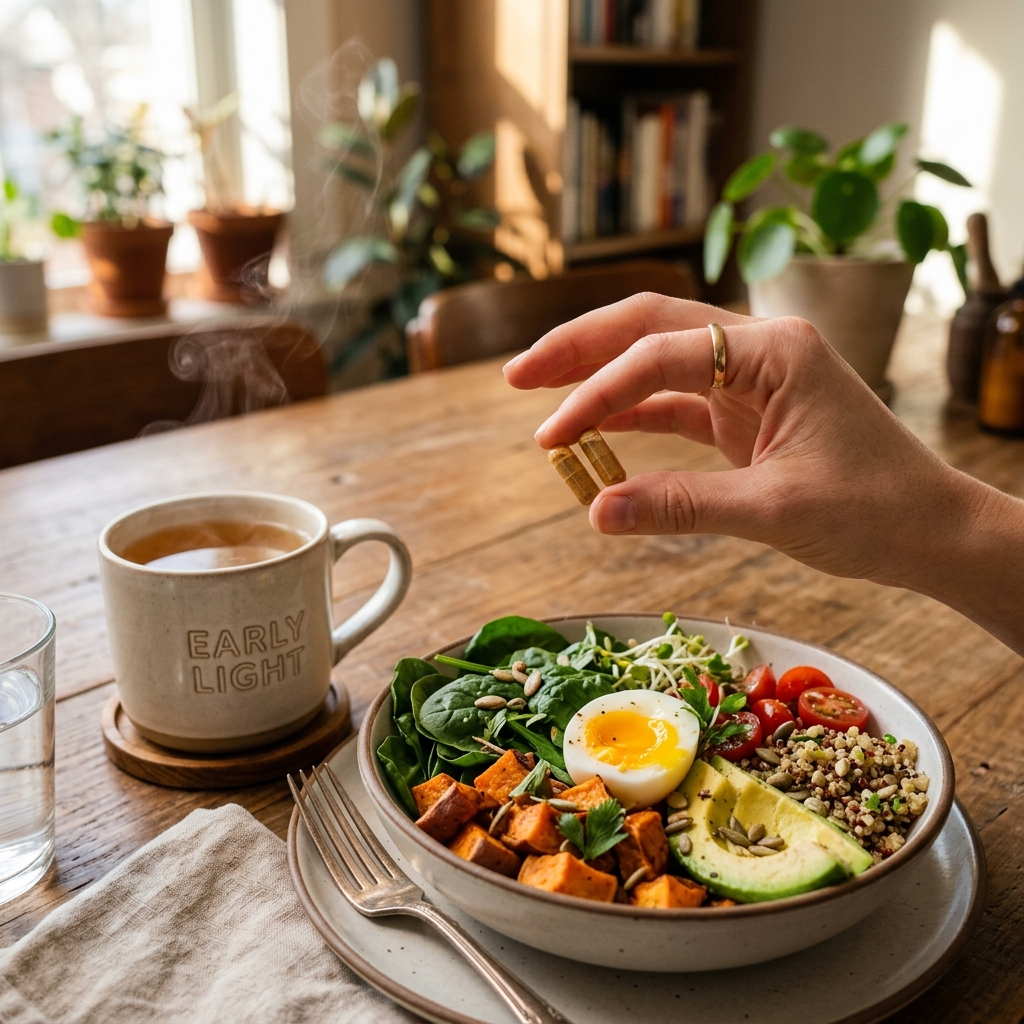
Once you’ve chosen the right Ox Bile + Lipase combination, timing is critical: take with the first bite of your meal (especially fatty meals), with 2–3 sips of warm water. Avoid ice-cold water — it slows gastric motility, prolongs food residence time, especially bad for post-cholecystectomy patients because bile is already “dilute” enough.
Full protocol details and TCM/Western rationale in When to Take Digestive Enzymes.
Natural Food Support
Before rushing to buy supplements, leverage these easily-accessible foods:
- Beetroot: Supports natural bile production in the liver.
- Artichoke: Contains cynarin that stimulates bile flow from the liver.
- Fresh ginger (Zingibain): Supports digestion + warms the belly + reduces nausea.
- Fresh pineapple + green papaya: Bromelain and Papain support protein digestion.
- 5–6 small meals per day: This is the most important post-cholecystectomy practice — matches the new “continuous drip” bile pattern.
Read more about the food-first approach: Foods high in natural digestive enzymes and Pineapple digestive enzymes — Bromelain.

Summary & Next Steps
If you remember only three things from this article: (1) Gallbladder removal DOES NOT eliminate digestive enzymes — you lost concentrated bile. The right solution is Ox Bile (125–500mg) + high-dose Lipase (≥5,000 FIP), not broad-spectrum enzymes alone. (2) Diet changes across 4 phases — not one-size-fits-all. Be patient — your body needs time to adapt. (3) If chronic diarrhea persists >3 months → see a doctor about cholestyramine (prescription, first-line) — don’t self-buy Ox Bile because it may make things worse.
CTA — Action for This Week: Step 1: Assess which phase you’re in (Week 1 / Month 1 / Month 3 / Long-term). Step 2: If you’re in Month 1 and want supplements → look for products with Ox Bile + Lipase ≥5,000 FIP + Third-party tested. Step 3: Schedule a follow-up with your surgeon — share your symptom journal — for expert evaluation.
Frequently Asked Questions (FAQ)
How long until I can eat normally after gallbladder removal?
Most people return to normal in 1–3 months. Some take 6 months to a year for full digestive adaptation to the “continuous drip” pattern. Patience + small frequent meals are key.
Do I need to take Ox Bile for life?
No. Most people only need it for the first 3–6 months while the body adapts. After that, the digestive system adapts better and you only need it for ultra-high-fat meals (parties, hot pot, buffets).
What’s the difference between Ox Bile and a regular digestive enzyme?
Ox Bile = bile acid from cattle, functions to emulsify fats. Regular enzymes = proteins that cut food. Completely different in nature. After gallbladder removal you need both, but Ox Bile is the primary need because that’s what you actually lost.
I have diarrhea right after eating — is this Bile Acid Diarrhea?
Possibly. If diarrhea occurs 30–60 minutes after meals + persists >3 months + often in the morning → likely BAD. See a doctor, ask about cholestyramine. Don’t self-purchase Ox Bile — it may make things worse because you already have excess bile.
Can I eat olive oil after gallbladder removal?
Yes, but starting from Month 2 and per personal tolerance. Begin with 1 teaspoon per meal, increase gradually. Olive oil is more easily tolerated than coconut oil or animal butter.
Why do I have more gas after gallbladder removal?
Because fat is not emulsified enough → passes into colon → bacteria ferment it → produce methane and hydrogen sulfide gas → smelly bloating. This is why Ox Bile + small frequent meals significantly reduce gas.
Should I take probiotics after gallbladder removal?
Be cautious. Some people develop SIBO overlap post-surgery → probiotics may make it worse. Read more in Digestive Enzymes vs Probiotics to understand the SIBO caution before deciding.

About Mr. Anh
We turn solid evidence into everyday habits Americans can actually do—plain English, cups/oz, grocery-aisle swaps, and routines that fit real life. Our editorial process: Experience—we road-test tips in real schedules…